
中国上海老年人久坐时间、睡眠时间和体育锻炼与多种疾病并存的关联:一项基于国民体质监测数据的横断面研究
Associations of sedentary time, sleep duration and physical exercise with multimorbidity among older adults in Shanghai, China: a cross-sectional study based on national physical fitness surveillance data.
作者信息
Li Kai, Wang Jingjing, Rao Yuqin, Zheng Fanhui, Chen Ying, Zhai Bo, Hong Jintao, Wang Dao, Wang Chen, Liu Bao
机构信息
Department of Health Economics, School of Public Health, Fudan University, 130 Dong'an Road, Shanghai, 200032, China.
Key Laboratory of Health Technology Assessment (Fudan University), National Health Commission, 130 Dong'an Road, Shanghai, 200032, China.
出版信息
BMC Geriatr. 2025 Jan 27;25(1):61. doi: 10.1186/s12877-025-05701-6.
BACKGROUND
Multimorbidity has emerged as a significant challenge for healthcare systems globally. This study aims to examine the associations between key determinants of lifestyle behavior and various multimorbidity patterns.
METHODS
In a cross-sectional sample of older adults (aged 60-79) from the Fifth National Physical Fitness Surveillance in Shanghai, latent class analysis (LCA) was used to identify multimorbidity patterns among 9 chronic diseases. Multinomial logistic regression was performed to analyze the associations between sedentary time, sleep duration, physical exercise, and the different multimorbidity patterns. Weighted analysis was performed to appropriately account for complex sampling designs and provide more robust results.
RESULTS
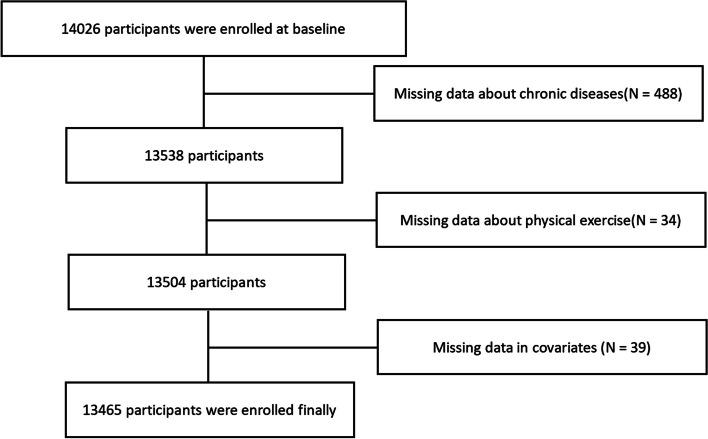
Among 13,465 study participants (unweighted mean age 69.3 years; weighted mean age 67.4 years, 50.7% female), the overall prevalence of multimorbidity was 40.9%-42.3%. Four latent classes among the older adults were identified, with the relatively healthy class (63.6%-64.6%) had an average of less than 1 chronic disease. The other 3 classes, namely the metabolic-cardiovascular-joint-digestive-respiratory disease class (2.9%-3.0%), the metabolic-cardiovascular disease class (14.5%-15.5%), and the joint-digestive-respiratory disease class (17.9%-18.0%), each had an average of more than 2 chronic diseases, representing different multimorbidity patterns. Prolonged sedentary time (> 3 h/day) increased the odds of belonging to the metabolic-cardiovascular-joint-digestive-respiratory disease class by 56%-57% (unweighted odds ratio [OR] 1.57, 95% confidence interval [CI] 1.27-1.94; weighted OR 1.56, 95% CI 1.36-1.80), the metabolic-cardiovascular disease class by 38% (unweighted OR 1.38, 95% CI 1.25-1.53; weighted OR 1.38, 95% CI 1.29-1.48), and the joint-digestive-respiratory disease class by 30%-32% (unweighted OR 1.32, 95% CI 1.19-1.45; weighted OR 1.30, 95% CI 1.22-1.38). Shorter sleep duration (< 7 h/day) also increased the odds of membership in the metabolic-cardiovascular disease class by 48%-49% (unweighted OR 1.49, 95% CI 1.35-1.65; weighted OR 1.48, 95% CI 1.38-1.58), the metabolic-cardiovascular-joint-digestive-respiratory disease class by 37%-47% (unweighted OR 1.47, 95% CI 1.19-1.80; weighted OR 1.37, 95% CI 1.19-1.58), and the joint-digestive-respiratory disease class by 41%-42% (unweighted OR 1.42, 95% CI 1.29-1.56; weighted OR 1.41, 95% CI 1.32-1.50). Each additional daily hour of low-intensity physical exercise (LIPE) reduced the odds of membership in the metabolic-cardiovascular-joint-digestive-respiratory disease class by 24%-25% (unweighted OR 0.76, 95% CI 0.64-0.90; weighted OR 0.75, 95% CI 0.66-0.84), the joint-digestive-respiratory disease class by 20%-21% (unweighted OR 0.79, 95% CI 0.73-0.86; weighted OR 0.80, 95% CI 0.76-0.85), and the metabolic-cardiovascular disease class by 11%-12% (unweighted OR 0.88, 95% CI 0.81-0.95; weighted OR 0.89, 95% CI 0.85-0.94). Compared to LIPE, high-intensity physical exercise (HIPE) showed a significant advantage only in reducing the odds of the metabolic-cardiovascular disease class by 18%-23% (unweighted OR 0.77, 95% CI 0.62-0.97; weighted OR 0.82, 95% CI 0.71-0.95).
CONCLUSIONS
Over 40% of older adults in Shanghai, China, suffer from multimorbidity. Prolonged sedentary behavior and shorter sleep duration were associated with membership in the metabolic-cardiovascular-joint-digestive-respiratory disease class, the metabolic-cardiovascular disease class, and the joint-digestive-respiratory disease class. Physical exercise showed varying degrees of protection against these 3 multimorbidity patterns, with special attention warranted for LIPE. Identifying the relationship between determinants of lifestyle behavior and patterns of multimorbidity can help develop more targeted prevention and management strategies.
背景
多病共存已成为全球医疗系统面临的重大挑战。本研究旨在探讨生活方式行为的关键决定因素与各种多病共存模式之间的关联。
方法
在上海市第五次全国体质监测的老年人群(60 - 79岁)横断面样本中,采用潜在类别分析(LCA)确定9种慢性病的多病共存模式。进行多项逻辑回归分析,以分析久坐时间、睡眠时间、体育锻炼与不同多病共存模式之间的关联。进行加权分析以适当考虑复杂抽样设计并提供更可靠的结果。
结果
在13465名研究参与者中(未加权平均年龄69.3岁;加权平均年龄67.4岁,女性占50.7%),多病共存的总体患病率为40.9% - 42.3%。在老年人中确定了四个潜在类别,相对健康的类别(63.6% - 64.6%)平均患慢性病少于1种。其他3个类别,即代谢 - 心血管 - 关节 - 消化 - 呼吸系统疾病类别(2.9% - 3.0%)、代谢 - 心血管疾病类别(14.5% - 15.5%)和关节 - 消化 - 呼吸系统疾病类别(17.9% - 18.0%),平均每种都有超过2种慢性病,代表不同的多病共存模式。久坐时间延长(>3小时/天)使属于代谢 - 心血管 - 关节 - 消化 - 呼吸系统疾病类别的几率增加56% - 57%(未加权比值比[OR]1.5, 95%置信区间[CI]1.27 - 1.94;加权OR 1.56, CI 1.36 - 1.80),使属于代谢 - 心血管疾病类别的几率增加38%(未加权OR 1.38, 95% CI 1.25 - 1.53;加权OR 1.38, 95% CI 1.29 - 1.48),使属于关节 - 消化 - 呼吸系统疾病类别的几率增加30% - 32%(未加权OR 1.32, 95% CI 1.19 - 1.45;加权OR 1.30, 95% CI 1.22 - 1.38)。睡眠时间缩短(<7小时/天)也使属于代谢 - 心血管疾病类别的几率增加48% - 49%(未加权OR 1.49, 95% CI 1.35 - 1.65;加权OR 1.48, 95% CI 1.38 - 1.58),使属于代谢 - 心血管 - 关节 - 消化 - 呼吸系统疾病类别的几率增加37% - 47%(未加权OR 1.47, 95% CI 1.19 - 1.80;加权OR加权OR 1.37, 95% CI 1.19 - 1.58),使属于关节 - 消化 - 呼吸系统疾病类别的几率增加41% - 42%(未加权OR 1.42, 9% CI 1.29 - 1.56;加权OR 1.41, 95% CI 1.32 - 1.50)。每天每增加1小时的低强度体育锻炼(LIPE),使属于代谢 - 心血管 - 关节 - 消化 - 呼吸系统疾病类别的几率降低24% - 25%(未加权OR 0.76, 95% CI 0.64 - 0.90;加权OR 0.75, 95% CI 0.66 - 0.84),使属于关节 - 消化 - 呼吸系统疾病类别的几率降低20% - 21%(未加权OR 0.79, 95% CI 0.73 - 0.86;加权OR 0.80, 95% CI 0.76 - 0.85),使属于代谢 - 心血管疾病类别的几率降低11% - 12%(未加权OR 0.88, 95% CI 0.81 - 0.95;加权OR 0.89, 95% CI 0.85 - 0.94)。与LIPE相比,高强度体育锻炼(HIPE)仅在将属于代谢 - 心血管疾病类别的几率降低18% - 23%方面显示出显著优势(未加权OR 0.77, 95% CI 0.62 - 0.97;加权OR 0.82, 95% CI 0.71 - 0.95)。
结论
在中国上海,超过40%的老年人患有多病共存。久坐行为延长和睡眠时间缩短与属于代谢 - 心血管 - 关节 - 消化 - 呼吸系统疾病类别、代谢 - 心血管疾病类别和关节 - 消化 - 呼吸系统疾病类别有关。体育锻炼对这三种多病共存模式具有不同程度的保护作用,应特别关注LIPE。确定生活方式行为决定因素与多病共存模式之间的关系有助于制定更具针对性的预防和管理策略。


 Zotero 插件