
癌症患者签署预立医疗指示的相关因素:系统评价。
Factors related to advance directives completion among cancer patients: a systematic review.
机构信息
Student Research Committee, Baqiyatallah University of Medical Sciences, Tehran, Iran.
Behavioral Sciences Research Center, Life Style Institute, Baqiyatallah University of Medical Sciences, Tehran, Iran.
出版信息
BMC Palliat Care. 2024 Jan 3;23(1):3. doi: 10.1186/s12904-023-01327-w.
INTRODUCTION
Advance directives (ADs) has recently been considered as an important component of palliative care for patients with advanced cancer and is a legally binding directive regarding a person's future medical care. It is used when a person is unable to participate in the decision-making process about their own care. Therefore, the present systematic review investigated the factors related to ADs from the perspective of cancer patients.
METHODS
A systematic review study was searched in four scientific databases: PubMed, Medline, Scopus, Web of Science, and ProQuest using with related keywords and without date restrictions. The quality of the studies was assessed using the Hawker criterion. The research papers were analyzed as directed content analysis based on the theory of planned behavior.
RESULTS
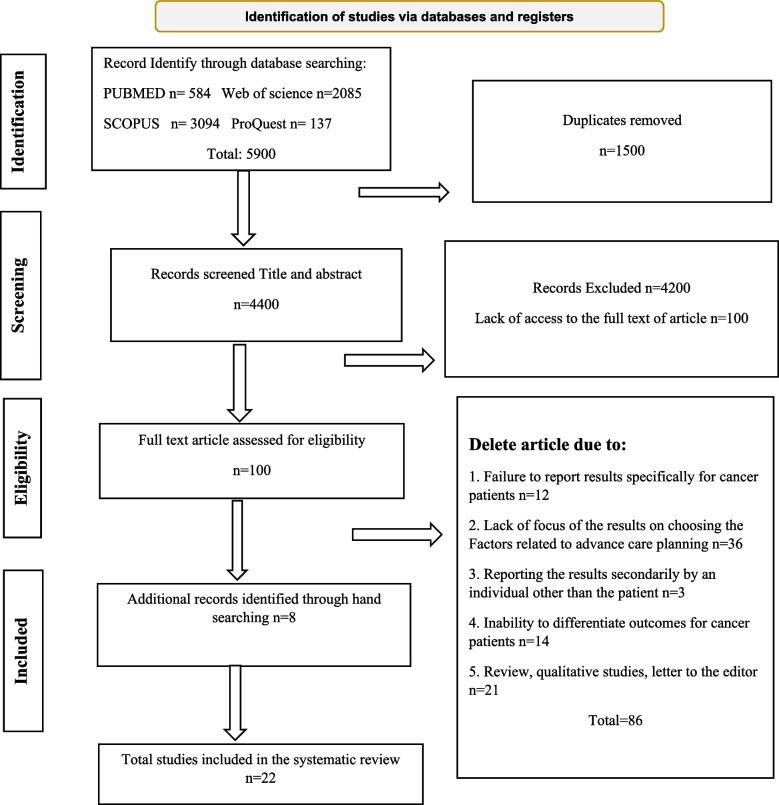
Out of 5900 research papers found, 22 were included in the study. The perspectives of 9061 cancer patients were investigated, of whom 4347 were men and 4714 were women. The mean ± SD of the patients' age was 62.04 ± 6.44. According to TPB, factors affecting ADs were categorized into four categories, including attitude, subjective norm, perceived behavioral control, and external factors affecting the model. The attitude category includes two subcategories: "Lack of knowledge of the ADs concept" and "Previous experience of the disease", the subjective norm category includes three subcategories: "Social support and interaction with family", "Respecting the patient's wishes" and "EOL care choices". Also, the category of perceived control behavior was categorized into two sub-categories: "Decision-making" and "Access to the healthcare system", as well as external factors affecting the model, including "socio-demographic characteristics".
CONCLUSION
The studies indicate that attention to EOL care and the wishes of patients regarding receiving medical care and preservation of human dignity, the importance of facilitating open communication between patients and their families, and different perspectives on providing information, communicating bad news and making decisions require culturally sensitive approaches. Finally, the training of cancer care professionals in the palliative care practice, promoting the participation of health care professionals in ADs activities and creating an AD-positive attitude should be strongly encouraged.
简介
预先指示(AD)最近被认为是晚期癌症患者姑息治疗的一个重要组成部分,是关于个人未来医疗护理的具有法律约束力的指示。当一个人无法参与自己护理决策过程时,就会使用预先指示。因此,本系统评价从癌症患者的角度调查了与 AD 相关的因素。
方法
本系统评价研究在四个科学数据库中进行了搜索:PubMed、Medline、Scopus、Web of Science 和 ProQuest,使用了相关的关键词且没有时间限制。使用 Hawker 标准评估研究质量。研究论文根据计划行为理论进行定向内容分析。
结果
在 5900 篇研究论文中,有 22 篇被纳入研究。共调查了 9061 名癌症患者的观点,其中 4347 名男性,4714 名女性。患者年龄的平均值±标准差为 62.04±6.44。根据 TPB,影响 AD 的因素分为四类,包括态度、主观规范、感知行为控制和影响模型的外部因素。态度类别包括两个亚类:“缺乏 AD 概念的知识”和“疾病的先前经历”,主观规范类别包括三个亚类:“社会支持和与家庭的互动”、“尊重患者的意愿”和“临终关怀选择”。此外,行为感知控制类别分为两个亚类:“决策”和“获得医疗保健系统”,以及影响模型的外部因素,包括“社会人口学特征”。
结论
这些研究表明,关注临终关怀和患者对接受医疗护理和维护人类尊严的愿望、促进患者及其家属之间开放沟通的重要性,以及在提供信息、传达坏消息和做出决策方面的不同观点,需要采取文化敏感的方法。最后,强烈鼓励癌症护理专业人员在姑息治疗实践中接受培训,促进医疗保健专业人员参与 AD 活动,并树立 AD 积极态度。
 Zotero 插件