
FBXO22 在浸润性小叶癌乳腺癌内分泌治疗耐药中的潜在作用。
Potential role of Fbxo22 in resistance to endocrine therapy in breast cancer with invasive lobular carcinoma.
机构信息
Department of Breast and Endocrine Surgical Oncology, Tohoku University Graduate School of Medicine, 1-1 Seiryo-Machi, Aoba-Ku, Sendai, 980-8574, Japan.
Department of Breast Surgery, Osaki Citizen Hospital, Osaki, Japan.
出版信息
Breast Cancer Res Treat. 2024 Apr;204(3):453-463. doi: 10.1007/s10549-023-07209-2. Epub 2024 Jan 5.
BACKGROUND
Invasive lobular carcinoma (ILC) is distinct from invasive ductal carcinoma (IDC) in terms of their hormonal microenvironments that may require different therapeutic strategies. We previously reported that selective estrogen receptor modulator (SERM) function requires F-box protein 22 (Fbxo22). Here, we investigated the role of Fbxo22 as a potential biomarker contributing to the resistance to endocrine therapy in ILC.
METHODS
A total of 302 breast cancer (BC) patients including 150 ILC were recruited in the study. Fbxo22 expression and clinical information were analyzed to elucidate whether Fbxo22 negativity could be a prognostic factor or there were any correlations among clinical variables and SERM efficacy.
RESULTS
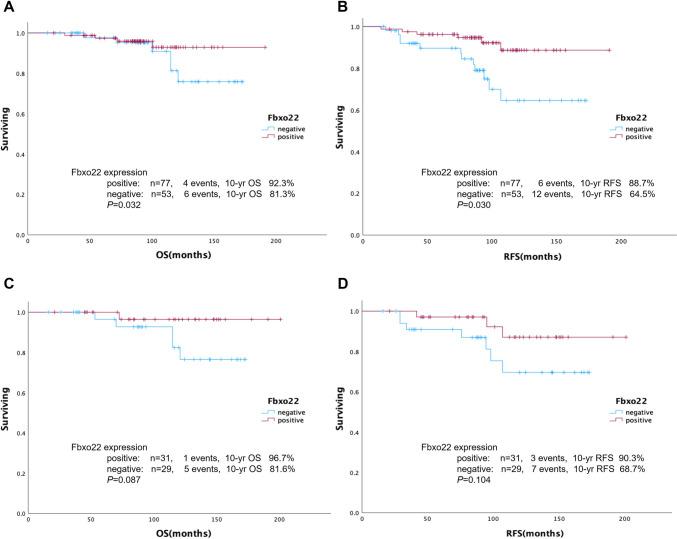
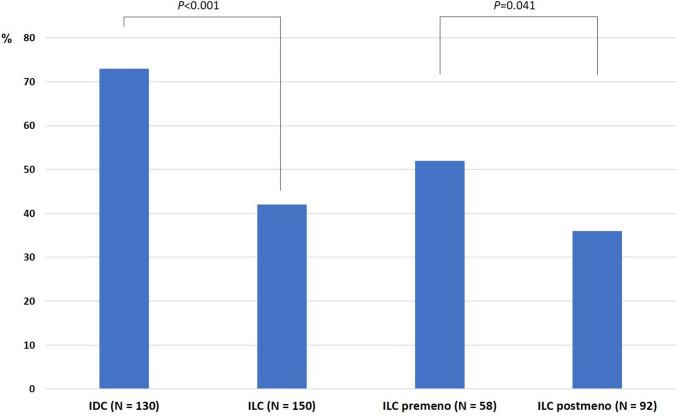
Fbxo22 negativity was significantly higher in ILC compared with IDC (58.0% vs. 27.0%, P < 0.001) and higher in postmenopausal patients than premenopausal patients (64.1% vs. 48.2%, P = 0.041). In the ILC cohort, Fbxo22-negative patients had poorer overall survival (OS) than Fbxo22-positive patients, with 10-year OS rates of 77.4% vs. 93.6% (P = 0.055). All patients treated with SERMs, Fbxo22 negativity resulted in a poorer outcome, with 10-year OS rates of 81.3% vs. 92.3% (P = 0.032). In multivariate analysis regarding recurrence-free survival (RFS) in ILC patients, Fbxo22 status was independently predictive of survival as well as lymph node metastasis.
CONCLUSION
Fbxo22 negativity significantly impacts on survival in BC patients with IDC and ILC, and the disadvantage was enhanced among ILC postmenopausal women or patients treated with SERMs. The findings suggest that different therapeutic strategies might be needed according to the different histopathological types when considering adjuvant endocrine therapy.
背景
浸润性小叶癌(ILC)与浸润性导管癌(IDC)在激素微环境方面存在差异,这可能需要不同的治疗策略。我们之前报道过选择性雌激素受体调节剂(SERM)的功能需要 F-box 蛋白 22(Fbxo22)。在这里,我们研究了 Fbxo22 作为潜在生物标志物在 ILC 内分泌治疗耐药中的作用。
方法
共纳入 302 例乳腺癌(BC)患者,包括 150 例 ILC。分析了 Fbxo22 表达和临床资料,以阐明 Fbxo22 阴性是否可以作为预后因素,以及临床变量和 SERM 疗效之间是否存在相关性。
结果
与 IDC 相比,ILC 中 Fbxo22 阴性率明显更高(58.0%比 27.0%,P<0.001),绝经后患者高于绝经前患者(64.1%比 48.2%,P=0.041)。在 ILC 队列中,Fbxo22 阴性患者的总生存(OS)比 Fbxo22 阳性患者差,10 年 OS 率分别为 77.4%和 93.6%(P=0.055)。所有接受 SERMs 治疗的患者中,Fbxo22 阴性患者的预后较差,10 年 OS 率分别为 81.3%和 92.3%(P=0.032)。在多变量分析中,对于 ILC 患者的无复发生存(RFS),Fbxo22 状态也是生存和淋巴结转移的独立预测因素。
结论
Fbxo22 阴性显著影响 IDC 和 ILC 患者的生存,绝经后或接受 SERMs 治疗的 ILC 患者劣势更为明显。这些发现表明,在考虑辅助内分泌治疗时,根据不同的组织病理学类型,可能需要不同的治疗策略。


 Zotero 插件