
泛素化和去泛素化在癌症中的作用:从机制到新的治疗方法。
Ubiquitination and deubiquitination in cancer: from mechanisms to novel therapeutic approaches.
机构信息
Tianjian Laboratory of Advanced Biomedical Sciences, Academy of Medical Sciences, College of Medicine, Zhengzhou University, Zhengzhou, Henan, 450001, China.
China-US (Henan) Hormel Cancer Institute, Zhengzhou, Henan, 450000, China.
出版信息
Mol Cancer. 2024 Jul 25;23(1):148. doi: 10.1186/s12943-024-02046-3.
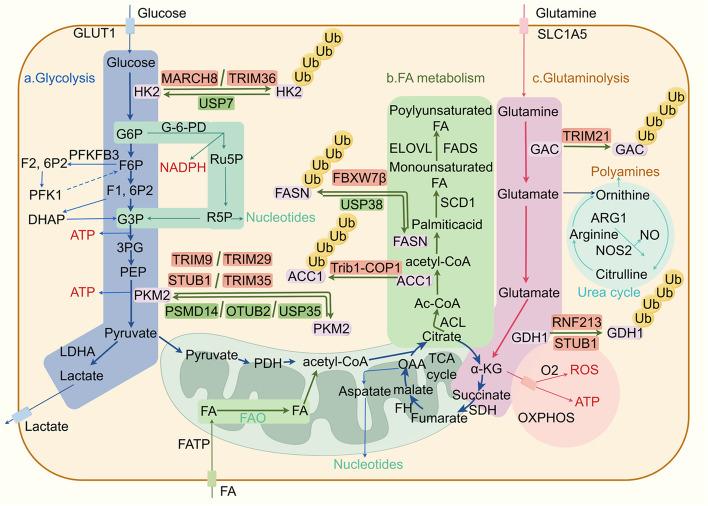
Ubiquitination, a pivotal posttranslational modification of proteins, plays a fundamental role in regulating protein stability. The dysregulation of ubiquitinating and deubiquitinating enzymes is a common feature in various cancers, underscoring the imperative to investigate ubiquitin ligases and deubiquitinases (DUBs) for insights into oncogenic processes and the development of therapeutic interventions. In this review, we discuss the contributions of the ubiquitin-proteasome system (UPS) in all hallmarks of cancer and progress in drug discovery. We delve into the multiple functions of the UPS in oncology, including its regulation of multiple cancer-associated pathways, its role in metabolic reprogramming, its engagement with tumor immune responses, its function in phenotypic plasticity and polymorphic microbiomes, and other essential cellular functions. Furthermore, we provide a comprehensive overview of novel anticancer strategies that leverage the UPS, including the development and application of proteolysis targeting chimeras (PROTACs) and molecular glues.
泛素化是蛋白质的一种关键翻译后修饰,在调节蛋白质稳定性方面发挥着重要作用。泛素化和去泛素化酶的失调是各种癌症的共同特征,这凸显了研究泛素连接酶和去泛素化酶(DUBs)以深入了解致癌过程和开发治疗干预措施的必要性。在这篇综述中,我们讨论了泛素-蛋白酶体系统(UPS)在癌症所有特征中的贡献以及药物发现方面的进展。我们深入探讨了 UPS 在肿瘤学中的多种功能,包括其对多种癌症相关途径的调节作用、在代谢重编程中的作用、与肿瘤免疫反应的相互作用、在表型可塑性和多态微生物组中的功能以及其他重要的细胞功能。此外,我们还全面概述了利用 UPS 的新型抗癌策略,包括蛋白酶体靶向嵌合体(PROTACs)和分子胶的开发和应用。



 Zotero 插件