
正常风险卵巢筛查研究:21年随访更新
Normal Risk Ovarian Screening Study: 21-Year Update.
作者信息
Han Chae Young, Lu Karen H, Corrigan Gwen, Perez Alexandra, Kohring Sharlene D, Celestino Joseph, Bedi Deepak, Bedia Enrique, Bevers Therese, Boruta David, Carlson Matthew, Holman Laura, Leeds Leroy, Mathews Cara, McCann Georgia, Moore Richard G, Schlumbrecht Matthew, Slomovitz Brian, Tobias Dan, Williams-Brown Yvette, Bevers Michael W, Liu Jinsong, Gornet Terrie G, Handy Beverly C, Lu Zhen, Bedia Jacob S, Skates Steven J, Bast Robert C
机构信息
Department of Experimental Therapeutics, University of Texas MD Anderson Cancer Center, Houston, TX.
Department of Gynecologic Oncology and Reproductive Medicine, University of Texas MD Anderson Cancer Center, Houston, TX.
出版信息
J Clin Oncol. 2024 Apr 1;42(10):1102-1109. doi: 10.1200/JCO.23.00141. Epub 2024 Jan 9.
PURPOSE
The Normal Risk Ovarian Screening Study (NROSS) tested a two-stage screening strategy in postmenopausal women at conventional hereditary risk where significantly rising cancer antigen (CA)-125 prompted transvaginal sonography (TVS) and abnormal TVS prompted surgery to detect ovarian cancer.
METHODS
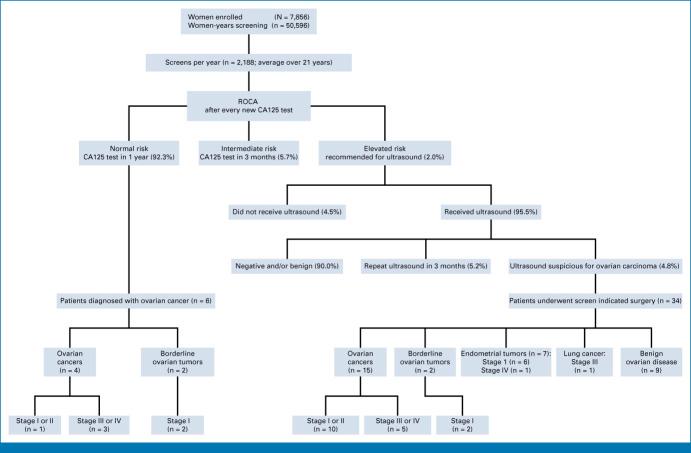
A total of 7,856 healthy postmenopausal women were screened annually for a total of 50,596 woman-years in a single-arm study (ClinicalTrials.gov identifier: NCT00539162). Serum CA125 was analyzed with the Risk of Ovarian Cancer Algorithm (ROCA) each year. If risk was unchanged and <1:2,000, women returned in a year. If risk increased above 1:500, TVS was undertaken immediately, and if risk was intermediate, CA125 was repeated in 3 months with a further increase in risk above 1:500 prompting referral for TVS. An average of 2% of participants were referred to TVS annually.
RESULTS
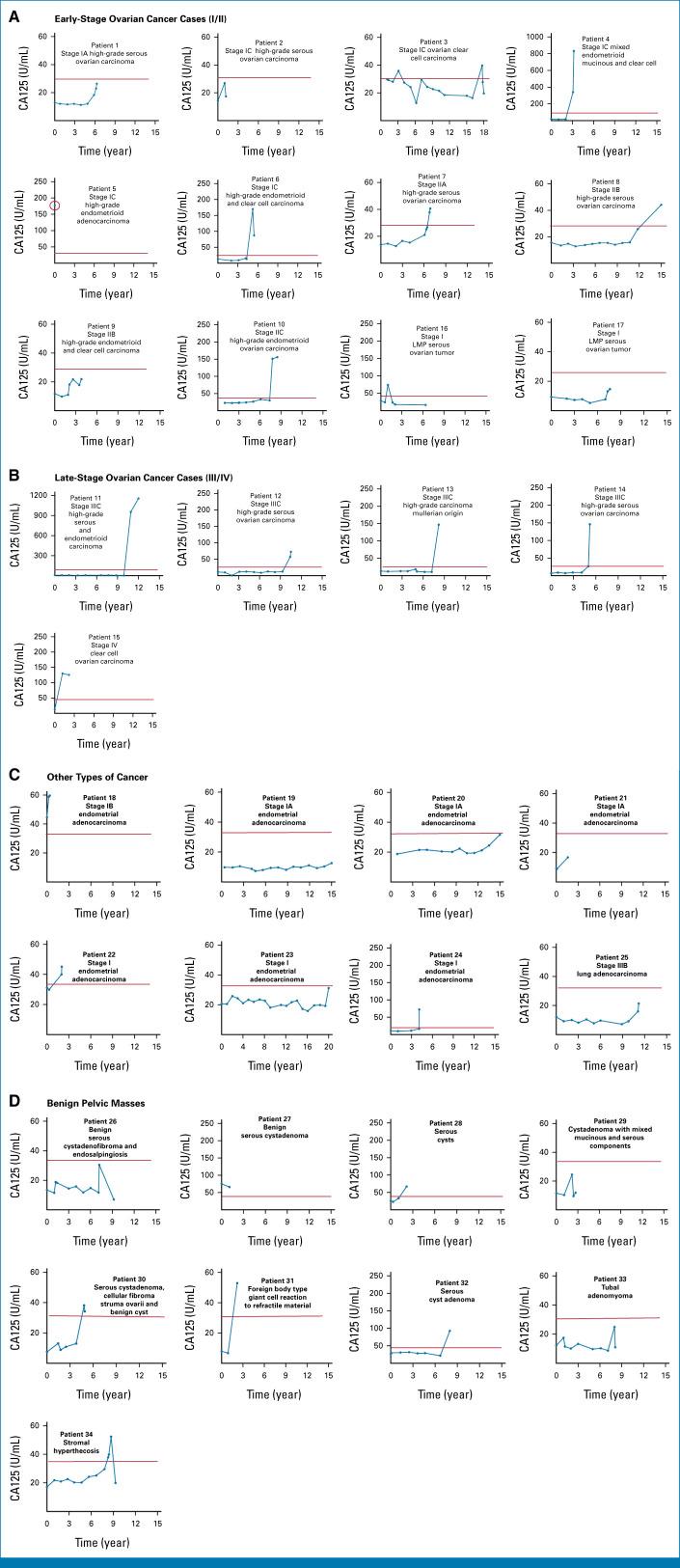
Thirty-four patients were referred for operations detecting 15 ovarian cancers and two borderline tumors with 12 in early stage (I-II). In addition, seven endometrial cancers were detected with six in stage I. As four ovarian cancers and two borderline tumors were diagnosed with a normal ROCA, the sensitivity for detecting ovarian and borderline cancer was 74% (17 of 23), and 70% of ROCA-detected cases (12 of 17) were in stage I-II. NROSS screening reduced late-stage (III-IV) disease by 34% compared with UKCTOCS controls and by 30% compared with US SEER values. The positive predictive value (PPV) was 50% (17 of 34) for detecting ovarian cancer and 74% (25 of 34) for any cancer, far exceeding the minimum acceptable study end point of 10% PPV.
CONCLUSION
While the NROSS trial was not powered to detect reduced mortality, the high specificity, PPV, and marked stage shift support further development of this strategy.
目的
正常风险卵巢筛查研究(NROSS)在具有传统遗传风险的绝经后女性中测试了一种两阶段筛查策略,即癌抗原(CA)-125显著升高时进行经阴道超声检查(TVS),TVS异常时进行手术以检测卵巢癌。
方法
在一项单臂研究中,每年对7856名健康绝经后女性进行筛查,总计50596人年(ClinicalTrials.gov标识符:NCT00539162)。每年使用卵巢癌风险算法(ROCA)分析血清CA125。如果风险不变且<1:2000,女性一年后复查。如果风险升至1:500以上,立即进行TVS;如果风险处于中间水平,3个月后复查CA125,风险进一步升至1:500以上则转诊进行TVS。每年平均2%的参与者被转诊进行TVS。
结果
34例患者被转诊进行手术,检出15例卵巢癌和2例交界性肿瘤,其中12例处于早期(I-II期)。此外,还检出7例子宫内膜癌,其中6例为I期。由于4例卵巢癌和2例交界性肿瘤是在ROCA正常时被诊断出的,检测卵巢癌和交界性癌的敏感性为74%(23例中的17例),ROCA检测出的病例中70%(17例中的12例)处于I-II期。与英国卵巢癌筛查协作试验(UKCTOCS)对照组相比,NROSS筛查使晚期(III-IV期)疾病减少了34%,与美国监测、流行病学和最终结果(SEER)数据相比减少了30%。检测卵巢癌的阳性预测值(PPV)为50%(34例中的17例),检测任何癌症的PPV为74%(34例中的25例),远远超过了可接受的最低研究终点PPV 10%。
结论
虽然NROSS试验没有足够的能力检测出死亡率的降低,但高特异性、PPV和明显的分期转移支持该策略的进一步开发。
 Zotero 插件