
氯化血根碱通过调节前列腺癌中的ROS/BACH1/HMOX1信号通路诱导铁死亡。
Sanguinarine chloride induces ferroptosis by regulating ROS/BACH1/HMOX1 signaling pathway in prostate cancer.
作者信息
Liu Shanhui, Tao Yan, Wu Shan, Lin Jiawei, Fu Shengjun, Lu Jianzhong, Zhang Jing, Fu Beitang, Zhang Erdong, Xu Jing, Wang Jiaxuan, Li Lanlan, Zhang Lei, Wang Zhiping
机构信息
Institute of Urology, Clinical Research Center for Urology in Gansu Province, Key Laboratory of Urological Disease in Gansu Province, Lanzhou University Second Hospital, No. 82 Cuiyingmen, Lanzhou, 730030, Gansu, China.
Gansu Provincial Center for Disease Control and Prevention, Lanzhou, 730000, Gansu, China.
出版信息
Chin Med. 2024 Jan 9;19(1):7. doi: 10.1186/s13020-024-00881-6.
BACKGROUND
Sanguinarine chloride (S.C) is a benzophenanthrine alkaloid derived from the root of sanguinaria canadensis and other poppy-fumaria species. Studies have reported that S.C exhibits antioxidant, anti-inflammatory, proapoptotic, and growth inhibitory effects, which contribute to its anti-cancer properties. Recent studies suggested that the antitumor effect of S.C through inducing ferroptosis in some cancers. Nevertheless, the precise mechanism underlying the regulation of ferroptosis by S.C remains poorly understood.
METHODS
A small molecule library was constructed based on FDA and CFDA approved small molecular drugs. CCK-8 assay was applied to evaluate the effects of the small molecule compound on tumor cell viability. Prostate cancer cells were treated with S.C and then the cell viability and migration ability were assessed using CCK8, colony formation and wound healing assay. Reactive oxygen species (ROS) and iron accumulation were quantified through flow cytometry analysis. The levels of malondialdehyde (MDA) and total glutathione (GSH) were measured using commercially available kits. RNA-seq analysis was performed to identify differentially expressed genes (DEGs) among the treatment groups. Western blotting and qPCR were utilized to investigate the expression of relevant proteins and genes. In vivo experiments employed a xenograft mice model to evaluate the anti-cancer efficacy of S.C.
RESULTS
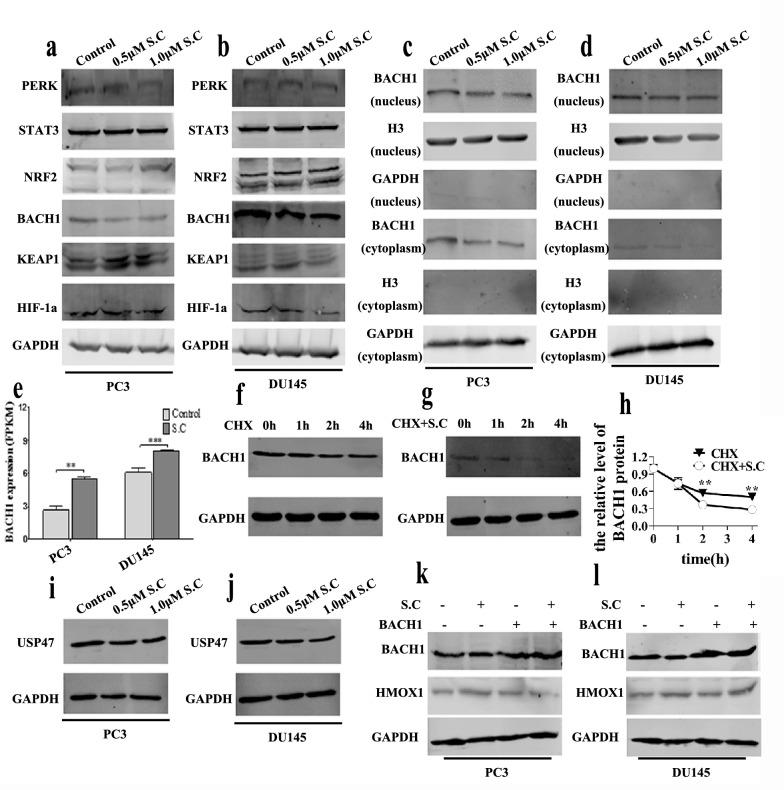
Our study demonstrated that S.C effectively inhibited the viability of various prostate cancer cells. Notably, S.C exhibited the ability to enhance the cytotoxicity of docetaxel in DU145 cells. We found that S.C-induced cell death partially relied on the induction of ferroptosis, which was mediated through up-regulation of HMOX1 protein. Additionally, our investigation revealed that S.C treatment decreased the stability of BACH1 protein, which contributed to HMOX1expression. We further identified that S.C-induced ROS caused BACH1 instability by suppressing USP47expression. Moreover, In DU145 xenograft model, we found S.C significantly inhibited prostate cancer growth, highlighting its potential as a therapeutic strategy. Collectively, these findings provide evidence that S.C could induce regulated cell death (RCD) in prostate cancer cells and effectively inhibit tumor growth via triggering ferroptosis. This study provides evidence that S.C effectively suppresses tumor progression and induces ferroptosis in prostate cancer cells by targeting ROS/USP47/BACH1/HMOX1 axis.
CONCLUSION
This study provides evidence that S.C effectively suppresses tumor progression and induces ferroptosis in prostate cancer cells by targeting the ROS/USP47/BACH1/HMOX1 axis. These findings offer novel insights into the underlying mechanism by which S.C inhibits the progression of prostate cancer. Furthermore, leveraging the potential of S.C in targeting ferroptosis may present a new therapeutic opportunity for prostate cancer. This study found that S.C induces ferroptosis by targeting the ROS/USP47/BACH1/HMOX1 axis in prostate cancer cells.
背景
氯化血根碱(S.C)是一种苯并菲啶生物碱,从加拿大血根草的根以及其他罂粟科紫堇属植物中提取。研究报道,S.C具有抗氧化、抗炎、促凋亡和生长抑制作用,这些作用使其具有抗癌特性。最近的研究表明,S.C在某些癌症中通过诱导铁死亡发挥抗肿瘤作用。然而,S.C调控铁死亡的精确机制仍知之甚少。
方法
基于美国食品药品监督管理局(FDA)和中国国家食品药品监督管理总局(CFDA)批准的小分子药物构建小分子文库。采用CCK-8法评估小分子化合物对肿瘤细胞活力的影响。用S.C处理前列腺癌细胞,然后使用CCK8、集落形成和伤口愈合试验评估细胞活力和迁移能力。通过流式细胞术分析定量活性氧(ROS)和铁积累。使用市售试剂盒测量丙二醛(MDA)和总谷胱甘肽(GSH)水平。进行RNA测序分析以鉴定治疗组之间的差异表达基因(DEG)。利用蛋白质免疫印迹法和定量聚合酶链反应(qPCR)研究相关蛋白质和基因的表达。体内实验采用异种移植小鼠模型评估S.C的抗癌疗效。
结果
我们的研究表明,S.C有效抑制各种前列腺癌细胞的活力。值得注意的是,S.C表现出增强多西他赛对DU145细胞的细胞毒性的能力。我们发现,S.C诱导的细胞死亡部分依赖于铁死亡的诱导,这是通过上调血红素加氧酶1(HMOX1)蛋白介导的。此外,我们的研究表明,S.C处理降低了BACH1蛋白的稳定性,这有助于HMOX1的表达。我们进一步确定,S.C诱导的ROS通过抑制泛素特异性蛋白酶47(USP47)的表达导致BACH1不稳定。此外,在DU145异种移植模型中,我们发现S.C显著抑制前列腺癌生长,突出了其作为一种治疗策略的潜力。总的来说,这些发现证明S.C可以诱导前列腺癌细胞发生调节性细胞死亡(RCD),并通过触发铁死亡有效抑制肿瘤生长。本研究证明,S.C通过靶向ROS/USP47/BACH1/HMOX1轴有效抑制前列腺癌进展并诱导前列腺癌细胞发生铁死亡。
结论
本研究证明,S.C通过靶向ROS/USP47/BACH1/HMOX1轴有效抑制前列腺癌进展并诱导前列腺癌细胞发生铁死亡。这些发现为S.C抑制前列腺癌进展的潜在机制提供了新的见解。此外,利用S.C靶向铁死亡的潜力可能为前列腺癌带来新的治疗机会。本研究发现,S.C通过靶向前列腺癌细胞中的ROS/USP47/BACH1/HMOX1轴诱导铁死亡。



 Zotero 插件