
种群结构和遗传多样性分析为特有物种 Maxim. 及其进化历史提供了新见解。
Population Structure and Genetic Diversity Analyses Provide New Insight into the Endemic Species Maxim. and Its Evolutionary History.
作者信息
Raman Gurusamy, Choi Kyoung Su, Park SeonJoo
机构信息
Department of Life Sciences, Yeungnam University, Gyeongsan 38541, Gyeongsanbuk-do, Republic of Korea.
Plant Research Team, Animal and Plant Research Department, Nakdonggang National Institute of Biological Resources, Sangju 37242, Republic of Korea.
出版信息
Plants (Basel). 2023 Dec 27;13(1):88. doi: 10.3390/plants13010088.
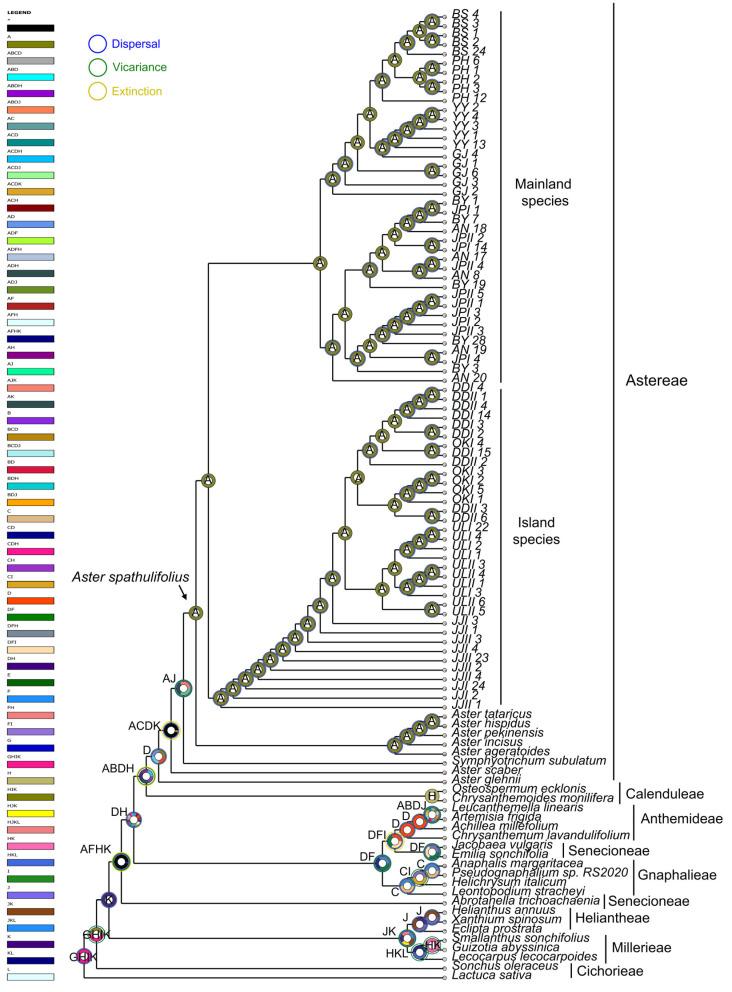
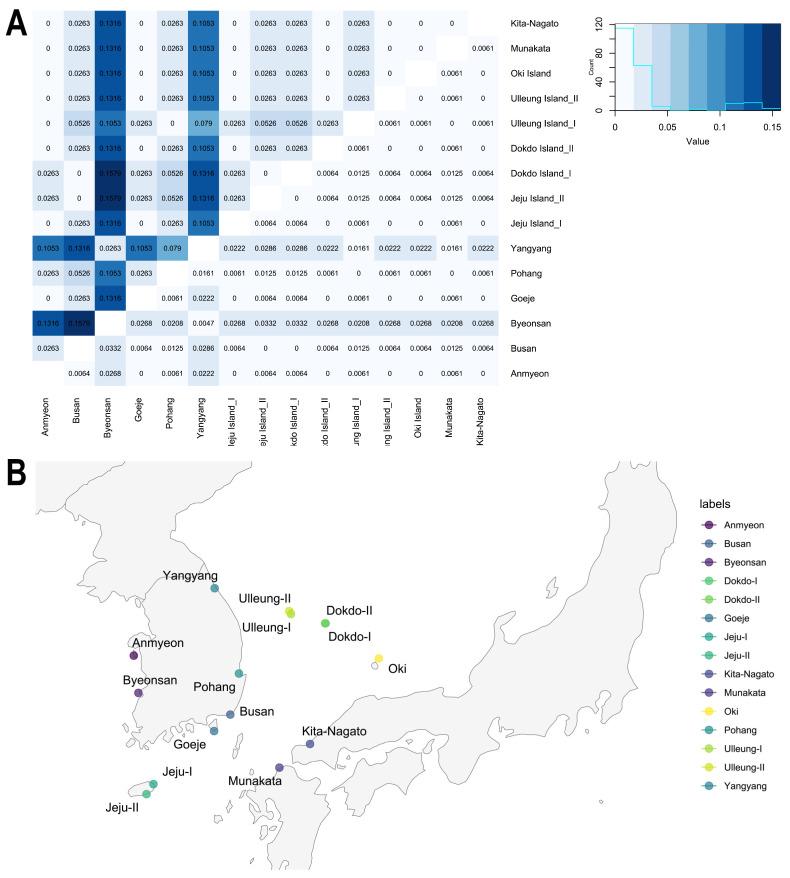
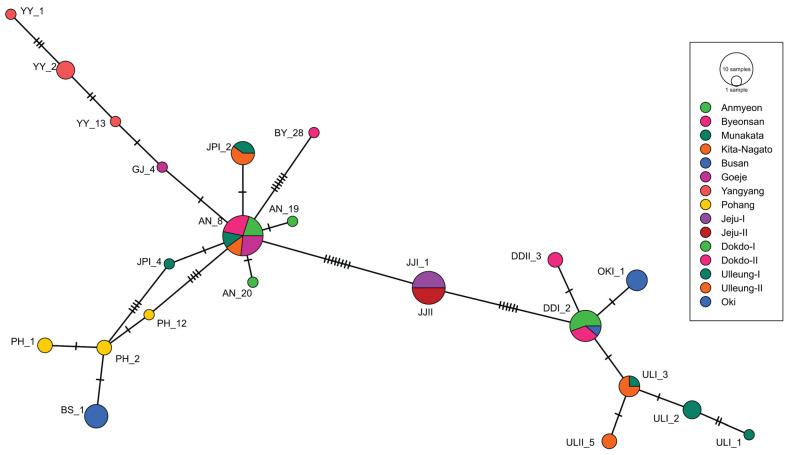
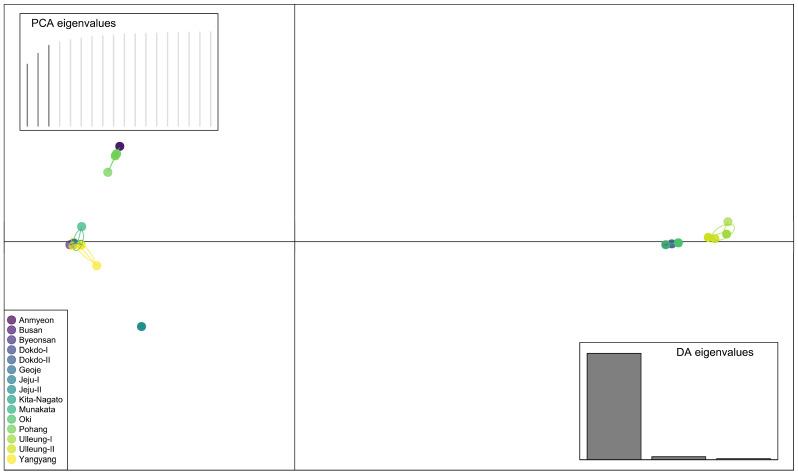
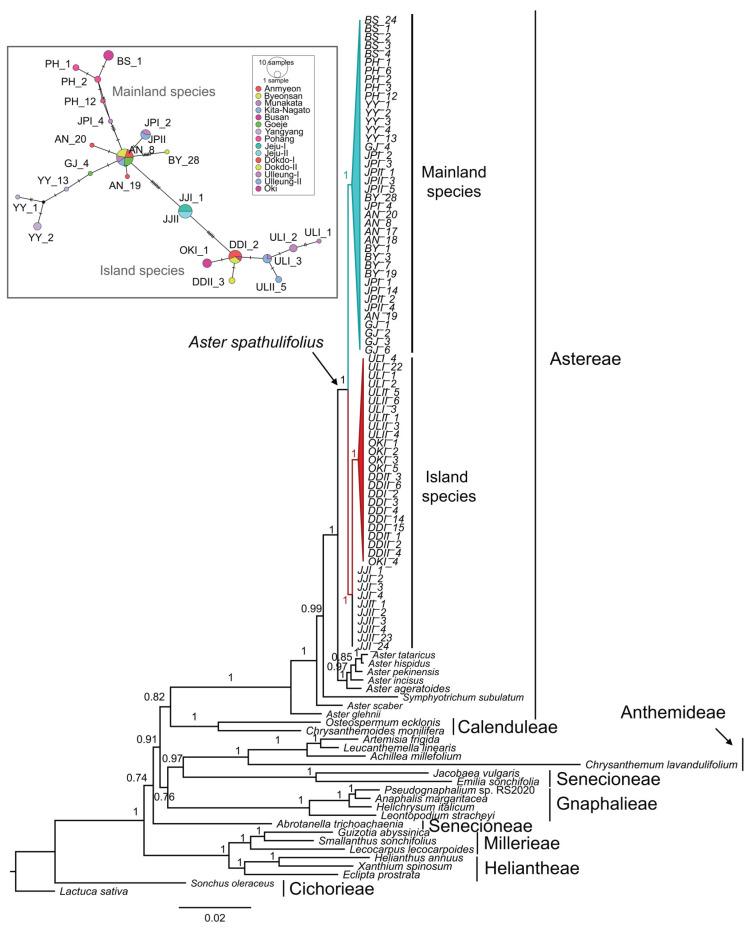
, an ecologically significant plant species native to the coastal regions of Korea and Japan, remains understudied in terms of its genetic structure and evolutionary history. In this study, we employed four chloroplast markers and the nuclear ITS region from 15 populations of . from both Korea and Japan, including their islands, to unravel the spatial genetic structure, differentiation, gene flow, phylogenetic, and biogeographical relationships. Analysis based on multiple methods identified a low level of genetic diversity, genetic differentiation and gene flow among . populations. Network analysis and principal coordinates analysis showed that 15 populations could be divided into two groups: mainland and island. Furthermore, UPGMA, neighbor-net, maximum-likelihood and Bayesian inference-based phylogenetic tree confirmed that these populations formed two distinct clades. Therefore, the island populations might be treated as . populations rather than . populations. Divergence time analysis estimated the divergence of lineages approximately 23.09 million years ago, while ancestral area reconstruction analysis suggested Korea as the potential origin, conflicting with alternative scenarios. These findings contribute to a comprehensive understanding of the evolutionary history, genetic structure, and adaptive strategies of in coastal environments. Our study challenges previous assumptions and underscores the necessity for further population studies to elucidate the intricate dynamics of this distinctive plant species.
[植物名称]是一种原产于韩国和日本沿海地区且具有重要生态意义的植物物种,但其遗传结构和进化历史仍未得到充分研究。在本研究中,我们利用来自韩国和日本(包括其岛屿)的15个[植物名称]种群的四个叶绿体标记和核ITS区域,来揭示其空间遗传结构、分化、基因流、系统发育和生物地理关系。基于多种方法的分析确定了[植物名称]种群间的遗传多样性、遗传分化和基因流水平较低。网络分析和主坐标分析表明,15个种群可分为两组:大陆种群和岛屿种群。此外,基于UPGMA、邻接网络、最大似然法和贝叶斯推断的系统发育树证实,这些种群形成了两个不同的分支。因此,岛屿种群可能应被视为[另一植物名称]种群而非[植物名称]种群。分歧时间分析估计[植物名称]谱系的分歧时间约为2309万年前,而祖先区域重建分析表明韩国是潜在的起源地,这与其他假设情况相矛盾。这些发现有助于全面了解[植物名称]在沿海环境中的进化历史、遗传结构和适应策略。我们的研究挑战了先前的假设,并强调了进一步开展种群研究以阐明这种独特植物物种复杂动态的必要性。




 Zotero 插件