
高血糖和C反应蛋白升高是刚果民主共和国东部南基伍省住院COVID-19患者医院死亡率的独立预测因素:一项横断面研究。
Hyperglycemia and elevated C-reactive protein are independent predictors of hospital mortality in hospitalized COVID-19 patients in South-Kivu, eastern Democratic Republic of the Congo: A cross-sectional study.
作者信息
Tshongo Christian, Baguma Marius, Mateso Guy-Quesney, Makali Samuel Lwamushi, Bedha Aline, Mwene-Batu Pacifique, Mihigo Martine, Nzabara Fabrice, Balola Cordule, Kabuya Pierre, Bapolisi Achille, Masimango Mannix I, Bahizire Esto, Maheshe-Balemba Ghislain, Shindano Tony A, Cirhuza Cikomola
机构信息
Faculty of Medicine Université Catholique de Bukavu (UCB) Bukavu Democratic Republic of the Congo.
Department of Internal Medicine Hôpital Provincial Général de Référence de Bukavu (HPGRB) Bukavu Democratic Republic of the Congo.
出版信息
Health Sci Rep. 2024 Jan 11;7(1):e1803. doi: 10.1002/hsr2.1803. eCollection 2024 Jan.
BACKGROUND AND AIM
The coronavirus disease 2019 (COVID-19) pandemic was a priority public health problem because of its high mortality rate. This study mainly aimed to determine factors associated with a poor outcome in COVID-19 hospitalized patients in South-Kivu, an eastern province of the Democratic Republic of the Congo (DRC).
METHODS
This observational study retrospectively evaluated medical records of patients consecutively admitted for probable or confirmed COVID-19 between May 01 and July 31, 2020 at the Hôpital Provincial Général de Référence de Bukavu (HPGRB), a tertiary hospital located in South-Kivu. A binary logistic regression model was performed to determine the predictors of mortality.
RESULTS
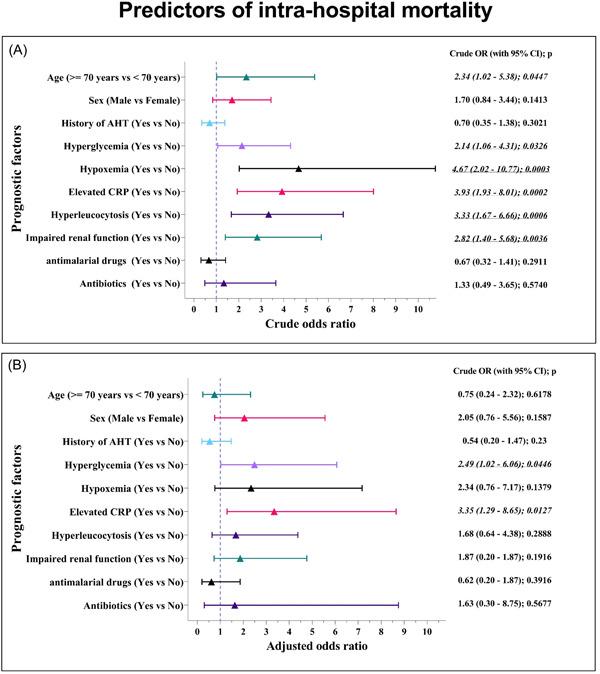
A total of 157 hospitalized COVID-19 patients aged 57.7 (13.2) years were included in this study. Male gender (69.4%), older age (52.9%), medical history of diabetes (38.2%), and arterial hypertension (35.1%) were the most frequent risk factors. Most patients presented with fever (73.3%), cough (72.6%), and dyspnea (66.2%). Overall, 45.1% of patients died. Intrahospital mortality was significantly associated with advanced age [odds ratio, OR (95% confidence interval, CI) = 2.34 (1.06-5.38)], hypoxemia [OR (95% CI) = 4.67 (2.02-10.77)], hyperglycemia [OR (95% CI) = 2.14 (1.06-4.31)], kidney failure [OR (95% CI) = 2.82 (1.4-5.68)], hyperleukocytosis [OR (95% CI) = 3.33 (1.67-6.66)], and higher C-reactive protein (CRP) levels [OR (95% CI) = 3.93 (1.93-8.01)]. After adjustment for various covariates, only higher CRP levels [OR (95% CI) = 3.23 (1.23-8.5)] and hyperglycemia [OR (95% CI) = 2.5 (1.02-6.11)] at admission were independently associated with mortality.
CONCLUSION
Hyperglycemia and marked inflammatory syndrome were the major predictors of poor outcomes in patients hospitalized for COVID-19 in South-Kivu. These two factors should be quantified at hospital admission to establish the patient's prognosis.
背景与目的
2019冠状病毒病(COVID-19)大流行因其高死亡率而成为一个首要的公共卫生问题。本研究主要旨在确定刚果民主共和国(DRC)东部省份南基伍COVID-19住院患者预后不良的相关因素。
方法
这项观察性研究回顾性评估了2020年5月1日至7月31日期间在位于南基伍的三级医院布卡武省级综合参考医院(HPGRB)连续收治的疑似或确诊COVID-19患者的病历。采用二元逻辑回归模型来确定死亡率的预测因素。
结果
本研究共纳入157例年龄为57.7(13.2)岁的COVID-19住院患者。男性(69.4%)、老年(52.9%)、糖尿病病史(38.2%)和动脉高血压(35.1%)是最常见的危险因素。大多数患者表现为发热(73.3%)、咳嗽(72.6%)和呼吸困难(66.2%)。总体而言,有45.1%的患者死亡。院内死亡率与高龄显著相关[比值比,OR(95%置信区间,CI)=2.34(1.06 - 5.38)]、低氧血症[OR(95% CI)=4.67(2.02 - 10.77)]、高血糖[OR(95% CI)=2.14(1.06 - 4.31)]、肾衰竭[OR(95% CI)=2.82(1.4 - 5.68)]、白细胞增多症[OR(95% CI)=3.33(1.67 - 6.66)]以及较高的C反应蛋白(CRP)水平[OR(95% CI)=3.93(1.93 - 8.01)]有关。在对各种协变量进行调整后,仅入院时较高的CRP水平[OR(95% CI)=3.23(1.23 - 8.5)]和高血糖[OR(95% CI)=2.5(1.02 - 6.11)]与死亡率独立相关。
结论
高血糖和明显的炎症综合征是南基伍COVID-19住院患者预后不良的主要预测因素。这两个因素应在入院时进行量化以确定患者的预后。
 Zotero 插件