
仅在活动不足的青少年中,屏幕使用时间与睡眠质量和时长呈负相关:一项巴西基于学校的横断面研究。
Screen time is negatively associated with sleep quality and duration only in insufficiently active adolescents: A Brazilian cross-sectional school-based study.
作者信息
Dos Santos Amanda B, Prado Wagner L, Tebar William R, Ingles Jared, Ferrari Gerson, Morelhão Priscila K, Borges Luan O, Ritti Dias Raphael M, Beretta Victor S, Christofaro Diego G D
机构信息
São Paulo State University (Unesp), School of Technology and Sciences, Presidente Prudente, SP, Brazil.
California State University-San Bernardino, San Bernardino, USA.
出版信息
Prev Med Rep. 2023 Dec 25;37:102579. doi: 10.1016/j.pmedr.2023.102579. eCollection 2024 Jan.
BACKGROUND
Time spent on screen devices affects sleep quality and duration leading to several health impairments in youth. Although physical activity (PA) benefits sleep patterns and decreases screen time in adolescents, it is unclear whether the relationship between sleep quality/duration and screen time could be influenced by PA levels.
OBJECTIVE
To analyze the association between sleep quality and duration with screen time in Brazilian adolescents according PA levels.
METHODS
The sample included 1010 adolescents aged 13.2 ± 2.4 years (n = 556 females - 55 % of the sample). Sleep quality and sleep duration, and PA were assessed by Mini Sleep and Baecke questionnaires, respectively. Participants in the highest quartile were classified as physically active. Screen time was analyzed by the self-reported number of hours spent on different screen devices (i.e., television, computer, videogame, and cellphone/tablet). Participants in the highest tertile were classified as having high screen time. Sex, age, and body mass index were considered covariates in binary logistic regression models.
RESULTS
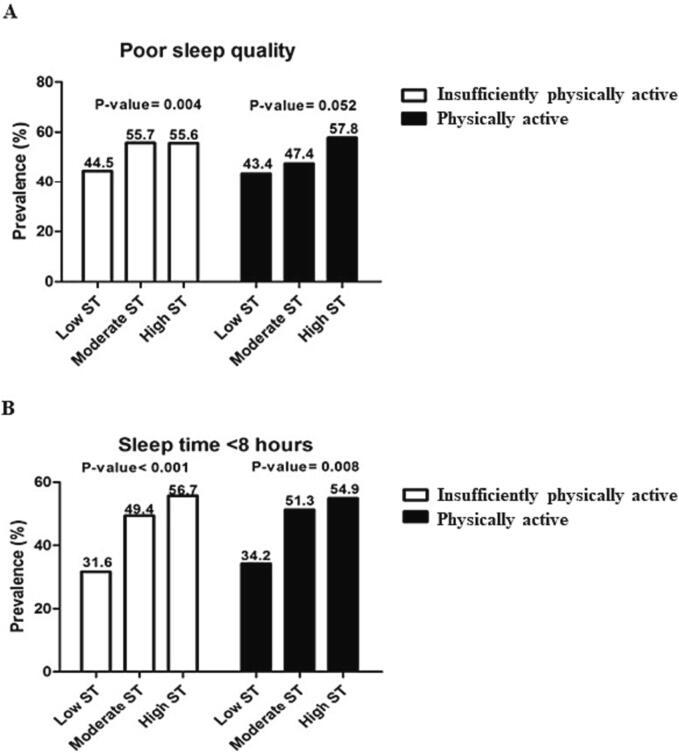
Poor sleep quality was observed in 52.3 % of the sample, whereas 46.6 % reported sleeping less than eight hours/day. High screen time was associated with poor sleep quality (OR = 1.45; 95 %CI = 1.01-2.12) and insufficient sleep duration (OR = 1.52; 95 %CI = 1.01-2.03) in adolescents insufficiently active. There were no associations between screen time and sleep parameters in active adolescents.
CONCLUSION
High screen time was associated with poor sleep quality and insufficient sleep duration only in insufficiently active adolescents. These results suggest that high PA levels may contribute to improving sleep patterns in pediatric population.
背景
花费在电子屏幕设备上的时间会影响睡眠质量和时长,进而对青少年的健康造成多种损害。尽管体育活动(PA)有益于青少年的睡眠模式并能减少其看屏幕的时间,但尚不清楚睡眠质量/时长与看屏幕时间之间的关系是否会受到体育活动水平的影响。
目的
根据体育活动水平分析巴西青少年的睡眠质量和时长与看屏幕时间之间的关联。
方法
样本包括1010名年龄为13.2±2.4岁的青少年(n = 556名女性,占样本的55%)。睡眠质量、睡眠时间和体育活动分别通过Mini Sleep问卷和Baecke问卷进行评估。处于最高四分位数的参与者被归类为体育活动活跃者。通过自我报告在不同电子屏幕设备(即电视、电脑、电子游戏和手机/平板电脑)上花费的小时数来分析看屏幕时间。处于最高三分位数的参与者被归类为看屏幕时间长。在二元逻辑回归模型中,将性别、年龄和体重指数视为协变量。
结果
52.3%的样本存在睡眠质量差的情况,而46.6%的人报告每天睡眠时间不足8小时。在体育活动不足的青少年中,看屏幕时间长与睡眠质量差(OR = 1.45;95%CI = 1.01 - 2.12)和睡眠时间不足(OR = 1.52;95%CI = 1.01 - 2.03)相关。在体育活动活跃的青少年中,看屏幕时间与睡眠参数之间没有关联。
结论
只有在体育活动不足的青少年中,看屏幕时间长才与睡眠质量差和睡眠时间不足相关。这些结果表明,高水平的体育活动可能有助于改善儿童群体的睡眠模式。
 Zotero 插件