
15岁时的屏幕使用情况与睡眠时间及质量:队列研究
Screen use and sleep duration and quality at 15 years old: Cohort study.
作者信息
Echevarria Priscila, Del-Ponte Bianca, Tovo-Rodrigues Luciana, Matijasevich Alicia, Halal Camila S, Santos Iná S
机构信息
Programa de Pós-graduação em Epidemiologia, Universidade Federal de Pelotas, Pelotas, RS, Brazil.
Departamento de Medicina Preventiva, Faculdade de Medicina FMUSP, Universidade de São Paulo, São Paulo, SP, Brazil.
出版信息
Sleep Med X. 2023 May 22;5:100073. doi: 10.1016/j.sleepx.2023.100073. eCollection 2023 Dec.
OBJECTIVE/BACKGROUND: The evidence on the association between screen use and sleep of adolescents is mainly based on studies about time watching television, with a few examining time using computers, videogames, and mobile devices. Our aim was to investigate the association between screen time for entertainment (watching TV, using computer, or playing games on tablets, smartphones, or videogame consoles) and sleep duration and self-reported sleep quality, among adolescents aged 15 years.
METHODS
With data from the 2004 Pelotas Birth Cohort, sleep duration was assessed with questions extracted from the Munich Chronotype Questionnaire and quality was self-reported. Adjusted β coefficients and prevalence ratios (PR) with (95% confidence intervals) were obtained, respectively, by linear and Poisson regressions.
RESULTS
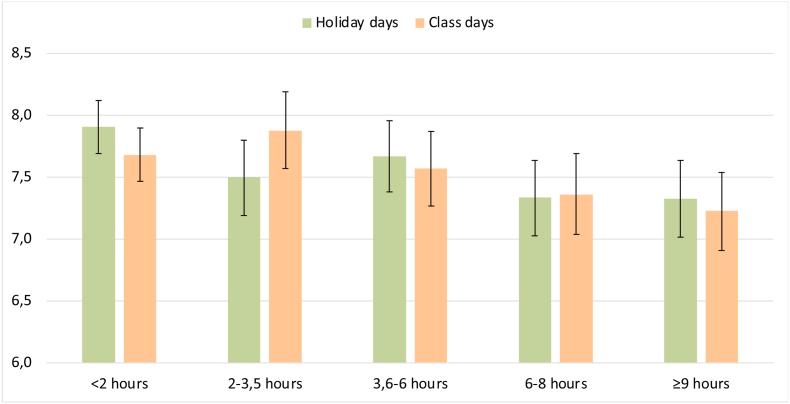
1,949 adolescents had information about screen time and sleep quality, and 1,851 about screen time and sleep duration. The median screen time was 4.5hs/24hs. The mean sleep duration was 7.6hs/24hs and the prevalence of bad sleep was 17.3% (15.7-19.0%). There was an inverse relationship between screen time and sleep duration. When compared with those with less than 2hs/24hs of screen time, adolescents with 6-8.8hs/24hs and ≥9hs experienced, respectively, 23.4 and 32.4 min reduction in sleep duration (β = -0.39; -0.62;-0.16 and β = -0.54; -0.77;-0.30). Adolescents with ≥9hs of screen time were 60% more likely to report bad sleep than those with less than 2hs/24hs (PR: 1.60; 1.10-2.32).
CONCLUSIONS
The median time spent using screens was longer than recommended. Screen use for ≥6hs/24hs was associated with a shorter sleep duration, and ≥9hs/24hs with poor sleep quality.
目的/背景:关于青少年屏幕使用与睡眠之间关联的证据主要基于看电视时间的研究,仅有少数研究考察了使用电脑、电子游戏和移动设备的时间。我们的目的是调查15岁青少年的娱乐屏幕时间(看电视、使用电脑或在平板电脑、智能手机或游戏机上玩游戏)与睡眠时间及自我报告的睡眠质量之间的关联。
方法
利用2004年佩洛塔斯出生队列的数据,通过从慕尼黑昼夜节律问卷中提取的问题评估睡眠时间,并由青少年自我报告睡眠质量。分别通过线性回归和泊松回归获得调整后的β系数和患病率比(PR)及(95%置信区间)。
结果
1949名青少年有关于屏幕时间和睡眠质量的信息,1851名有关于屏幕时间和睡眠时间的信息。屏幕时间中位数为4.5小时/24小时。平均睡眠时间为7.6小时/24小时,睡眠质量差的患病率为17.3%(15.7 - 19.0%)。屏幕时间与睡眠时间呈负相关。与屏幕时间少于2小时/24小时的青少年相比,屏幕时间为6 - 8.8小时/24小时和≥9小时的青少年睡眠时间分别减少了23.4分钟和32.4分钟(β = -0.39;-0.62;-0.16和β = -0.54;-0.77;-0.30)。屏幕时间≥9小时的青少年报告睡眠质量差的可能性比屏幕时间少于2小时/24小时的青少年高60%(PR:1.60;1.10 - 2.32)。
结论
使用屏幕的时间中位数超过了建议时长。每天屏幕使用时间≥6小时与较短的睡眠时间相关,≥9小时与较差的睡眠质量相关。


 Zotero 插件