
澳大利亚儿童侵袭性A组链球菌疾病增加,与北半球疫情激增同时发生。
Increase in invasive group A streptococcal disease among Australian children coinciding with northern hemisphere surges.
作者信息
Abo Yara-Natalie, Oliver Jane, McMinn Alissa, Osowicki Joshua, Baker Ciara, Clark Julia E, Blyth Christopher C, Francis Joshua R, Carr Jeremy, Smeesters Pierre R, Crawford Nigel W, Steer Andrew C
机构信息
Murdoch Children's Research Institute, Melbourne, Victoria, Australia.
Infectious Diseases Unit, Royal Children's Hospital Melbourne, Melbourne, Victoria, Australia.
出版信息
Lancet Reg Health West Pac. 2023 Aug 22;41:100873. doi: 10.1016/j.lanwpc.2023.100873. eCollection 2023 Dec.
BACKGROUND
Increases in invasive group A streptococcal disease (iGAS) have recently been reported in multiple countries in the northern hemisphere, occurring during, and outside of, typical spring peaks. We report the epidemiology of iGAS among children in Australia from 1 July 2018 to 31 December 2022.
METHODS
The Paediatric Active Enhanced Disease Surveillance (PAEDS) Network prospectively collected iGAS patient notifications for children and young people aged less than 18 years admitted to five major Australian paediatric hospitals in Victoria, Queensland, Western Australia and the Northern Territory. Patients were eligible for inclusion if they had GAS isolated from a normally sterile body site, or met clinical criteria for streptococcal toxic shock syndrome or necrotising fasciitis with GAS isolated from a non-sterile site. We report patients' clinical and demographic characteristics, and estimate minimum incidence rates.
FINDINGS
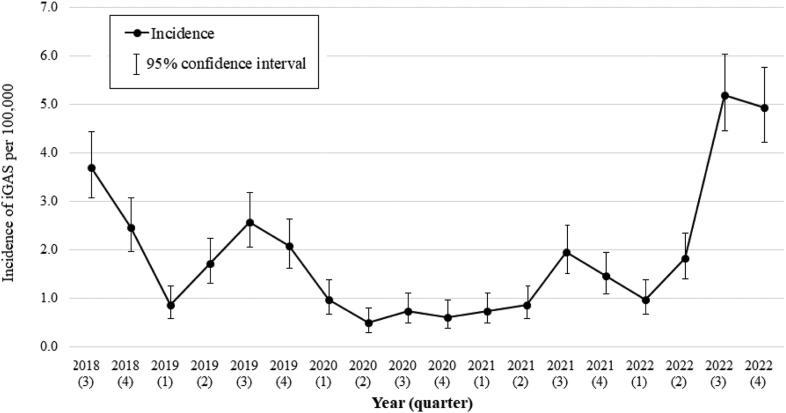
We identified 280 paediatric iGAS patients, median age 4.5 years (interquartile range 1.4-6.4). We observed a pre-pandemic peak annualised incidence of 3.7 per 100,000 (95% CI 3.1-4.4) in the 3rd quarter of 2018, followed by a decline to less than 1.0 per 100,000 per quarter from 2020 to mid-2021. The annualised incidence increased sharply from mid-2022, peaking at 5.2 per 100,000 (95% CI 4.4-6.0) in the 3rd quarter and persisting into the 4th quarter (4.9 per 100,000, 95% CI 4.2-5.7). There were 3 attributable deaths and 84 (32%) patients had severe disease (overall case fatality rate 1%, 95% CI 0.2-3.3). Respiratory virus co-infection, positive in 57 of 119 patients tested, was associated with severe disease (RR 1.9, 95% CI 1.2-3.0). The most common -type was -1 (60 of 163 isolates that underwent typing, 37%), followed by 12 (18%).
INTERPRETATION
Australia experienced an increase in the incidence of iGAS among children and young people in 2022 compared to pandemic years 2020-2021. This is similar to northern hemisphere observations, despite differences in seasons and circulating respiratory viruses. Outbreaks of iGAS continue to occur widely. This emphasises the unmet need for a vaccine to prevent significant morbidity associated with iGAS disease.
FUNDING
Murdoch Children's Research Institute funded open access publishing of this manuscript.
背景
近期北半球多个国家报告侵袭性A组链球菌病(iGAS)病例有所增加,且发病时间不仅局限于典型的春季高峰时段,在高峰时段之外也有发生。我们报告了2018年7月1日至2022年12月31日期间澳大利亚儿童iGAS的流行病学情况。
方法
儿科主动强化疾病监测(PAEDS)网络前瞻性地收集了澳大利亚维多利亚州、昆士兰州、西澳大利亚州和北领地五家主要儿科医院收治的18岁以下儿童和青少年的iGAS患者报告。如果患者从通常无菌的身体部位分离出A组链球菌,或符合链球菌中毒性休克综合征的临床标准,或从非无菌部位分离出A组链球菌且符合坏死性筋膜炎的临床标准,则符合纳入条件。我们报告了患者的临床和人口统计学特征,并估计了最低发病率。
研究结果
我们共识别出280例儿科iGAS患者,中位年龄4.5岁(四分位间距1.4 - 6.4岁)。我们观察到2018年第三季度大流行前的年化发病率峰值为每10万人3.7例(95%置信区间3.1 - 4.4),随后从2020年至2021年年中降至每季度每10万人低于1.0例。年化发病率从2022年年中开始急剧上升,在第三季度达到峰值每10万人5.2例(95%置信区间4.4 - 6.0),并持续到第四季度(每10万人4.9例,95%置信区间4.2 - 5.7)。有3例可归因死亡,84例(32%)患者患有严重疾病(总体病死率1%,95%置信区间0.2 - 3.3)。在119例接受检测的患者中,57例呼吸道病毒合并感染呈阳性,与严重疾病相关(相对风险1.9,95%置信区间1.2 - 3.0)。最常见的类型是 - 1型(163株进行分型的菌株中有60株,占37%),其次是12型(占18%)。
解读
与2020 - 2021年大流行年份相比,2022年澳大利亚儿童和青少年中iGAS的发病率有所上升。尽管季节和流行的呼吸道病毒存在差异,但这与北半球的观察结果相似。iGAS疫情仍在广泛发生。这凸显了对预防与iGAS疾病相关的重大发病情况的疫苗的迫切需求。
资金来源
默多克儿童研究所资助了本手稿的开放获取出版。

 Zotero 插件