
免疫检查点抑制剂单药或联合化疗治疗肺肉瘤样癌的有效性和安全性
Effectiveness and Safety of Immune Checkpoint Inhibitors Alone or in Combination With Chemotherapy in Pulmonary Sarcomatoid Carcinoma.
作者信息
Hazama Daisuke, Nakahama Kenji, Kodama Hiroaki, Miyazaki Akito, Azuma Koichi, Kawashima Yosuke, Sato Yuki, Ito Kentaro, Shiraishi Yoshimasa, Miura Keita, Takahama Takayuki, Oizumi Satoshi, Namba Yoshinobu, Ikeda Satoshi, Yoshioka Hiroshige, Tsuya Asuka, Yasuda Yuichiro, Negi Yoshiki, Hara Ayako, Toda Michihito, Tachihara Motoko
机构信息
Division of Respiratory Medicine, Department of Internal Medicine, Kobe University Graduate School of Medicine, Hyogo, Japan.
Department of Respiratory Medicine, Osaka Metropolitan University Graduate School of Medicine, Osaka, Japan.
出版信息
JTO Clin Res Rep. 2023 Nov 27;5(1):100613. doi: 10.1016/j.jtocrr.2023.100613. eCollection 2024 Jan.
INTRODUCTION
Pulmonary sarcomatoid carcinoma (PSC) is a rare subtype of lung cancer associated with poor prognosis and resistance to conventional chemotherapy. Immune checkpoint inhibitors (ICIs), alone or in combination with chemotherapy, were found to have clinical benefits in PSC in recent studies. Nevertheless, because these studies included a small number of patients owing to disease rarity, larger studies are needed to evaluate the effectiveness and safety of ICI-based therapy for PSC.
METHODS
This multicenter retrospective study evaluated patients with ICI-naive advanced or metastatic PSC who were treated with ICI-based therapy at 25 hospitals in Japan.
RESULTS
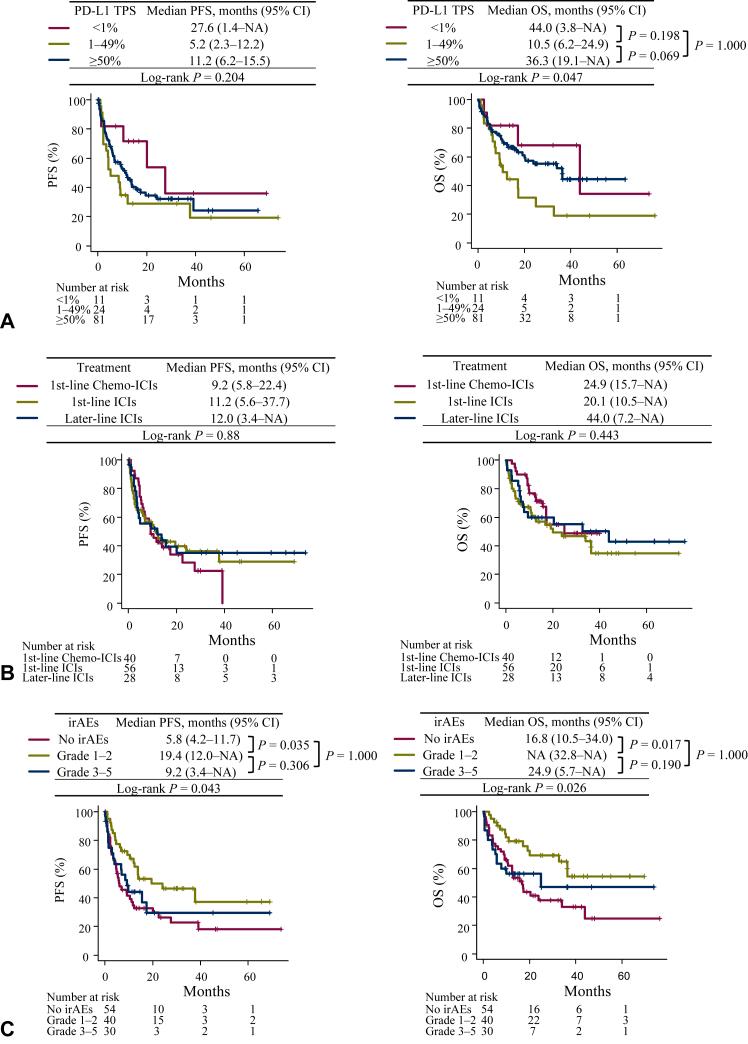
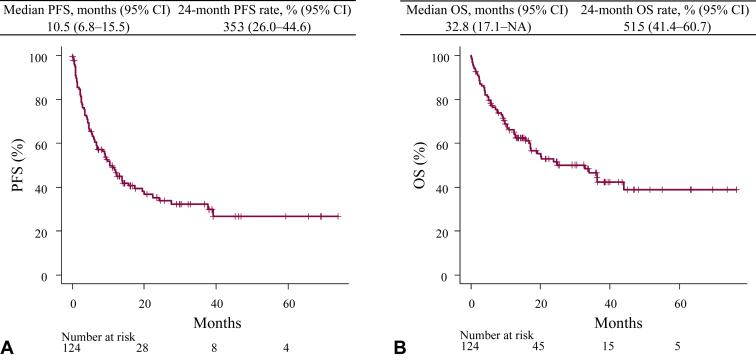
A total of 124 patients were evaluated. The overall response rate, median progression-free survival (PFS), and median overall survival (OS) were 59.0%, 10.5 months, and 32.8 months, respectively. The PFS and OS rates at 24 months were 35.3% and 51.5%, respectively. Programmed death-ligand 1 expression, concomitant chemotherapy, and the treatment line were not significantly associated with PFS or OS. Immune-related adverse events (irAEs) were observed in 70 patients (56.5%), including 30 (24.2%) with grade 3 to 5 events. Patients with mild irAEs (grades 1-2) had longer PFS and OS than did those with severe (grades 3-5) or no irAEs. In a multivariate analysis, any-grade irAEs and the absence of liver metastases were independently associated with PFS, whereas any-grade irAEs and Eastern Cooperative Oncology Group performance status less than or equal to 1 were independently associated with OS.
CONCLUSIONS
ICI-based therapy was found to have promising effectiveness in patients with advanced or metastatic PSC, regardless of programmed death-ligand 1 expression, concomitant chemotherapy, or treatment line.
引言
肺肉瘤样癌(PSC)是肺癌的一种罕见亚型,预后较差且对传统化疗耐药。近期研究发现,免疫检查点抑制剂(ICI)单独或与化疗联合应用于PSC具有临床获益。然而,由于疾病罕见,这些研究纳入的患者数量较少,因此需要更大规模的研究来评估基于ICI的治疗方案对PSC的有效性和安全性。
方法
这项多中心回顾性研究评估了在日本25家医院接受基于ICI治疗的初治晚期或转移性PSC患者。
结果
共评估了124例患者。总体缓解率、中位无进展生存期(PFS)和中位总生存期(OS)分别为59.0%、10.5个月和32.8个月。24个月时的PFS率和OS率分别为35.3%和51.5%。程序性死亡配体1表达、同步化疗及治疗线数与PFS或OS均无显著相关性。70例患者(56.5%)发生了免疫相关不良事件(irAE),其中30例(24.2%)为3-5级事件。轻度irAE(1-2级)患者的PFS和OS长于重度(3-5级)或无irAE的患者。多因素分析显示,任何级别的irAE和无肝转移独立与PFS相关,而任何级别的irAE和东部肿瘤协作组体能状态小于或等于1独立与OS相关。
结论
无论程序性死亡配体1表达、同步化疗或治疗线数如何,基于ICI的治疗方案在晚期或转移性PSC患者中均显示出有前景的有效性。
 Zotero 插件