
模拟农业食品样本中抗微生物药物耐药基因的检测极限:生物信息学工具的比较分析。
Modeling the limits of detection for antimicrobial resistance genes in agri-food samples: a comparative analysis of bioinformatics tools.
机构信息
Research and Development, Ottawa Laboratory (Carling), Canadian Food Inspection Agency, Ottawa, ON, Canada.
Department of Biology, Carleton University, Ottawa, ON, Canada.
出版信息
BMC Microbiol. 2024 Jan 20;24(1):31. doi: 10.1186/s12866-023-03148-6.
BACKGROUND
Although the spread of antimicrobial resistance (AMR) through food and its production poses a significant concern, there is limited research on the prevalence of AMR bacteria in various agri-food products. Sequencing technologies are increasingly being used to track the spread of AMR genes (ARGs) in bacteria, and metagenomics has the potential to bypass some of the limitations of single isolate characterization by allowing simultaneous analysis of the agri-food product microbiome and associated resistome. However, metagenomics may still be hindered by methodological biases, presence of eukaryotic DNA, and difficulties in detecting low abundance targets within an attainable sequence coverage. The goal of this study was to assess whether limits of detection of ARGs in agri-food metagenomes were influenced by sample type and bioinformatic approaches.
RESULTS
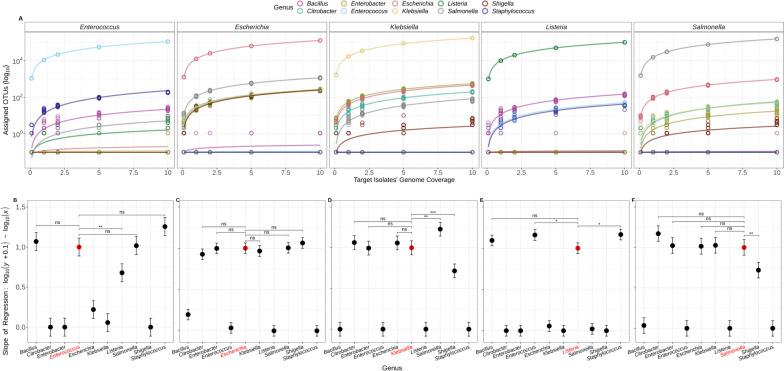
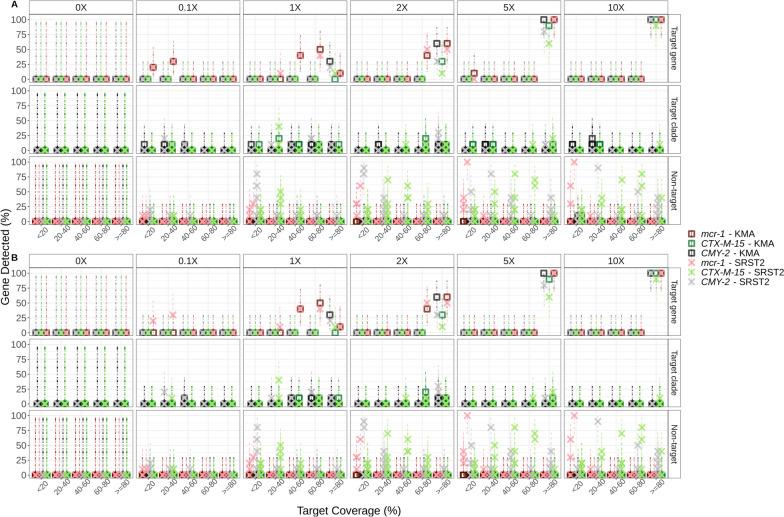
We simulated metagenomes containing different proportions of AMR pathogens and analysed them for taxonomic composition and ARGs using several common bioinformatic tools. Kraken2/Bracken estimates of species abundance were closest to expected values. However, analysis by both Kraken2/Bracken indicated presence of organisms not included in the synthetic metagenomes. Metaphlan3/Metaphlan4 analysis of community composition was more specific but with lower sensitivity than the Kraken2/Bracken analysis. Accurate detection of ARGs dropped drastically below 5X isolate genome coverage. However, it was sometimes possible to detect ARGs and closely related alleles at lower coverage levels if using a lower ARG-target coverage cutoff (< 80%). While KMA and CARD-RGI only predicted presence of expected ARG-targets or closely related gene-alleles, SRST2 (which allows read to map to multiple targets) falsely reported presence of distantly related ARGs at all isolate genome coverage levels. The presence of background microbiota in metagenomes influenced the accuracy of ARG detection by KMA, resulting in mcr-1 detection at 0.1X isolate coverage in the lettuce but not in the beef metagenome.
CONCLUSIONS
This study demonstrates accurate detection of ARGs in synthetic metagenomes using various bioinformatic methods, provided that reads from the ARG-encoding organism exceed approximately 5X isolate coverage (i.e. 0.4% of a 40 million read metagenome). While lowering thresholds for target gene detection improved sensitivity, this led to the identification of alternative ARG-alleles, potentially confounding the identification of critical ARGs in the resistome. Further advancements in sequencing technologies providing increased coverage depth or extended read lengths may improve ARG detection in agri-food metagenomic samples, enabling use of this approach for tracking clinically important ARGs in agri-food samples.
背景
尽管食源性抗菌药物耐药性(AMR)的传播及其对食品生产的影响引起了人们的高度关注,但有关各种农业食品产品中 AMR 细菌流行情况的研究却相对较少。测序技术越来越多地被用于跟踪 AMR 基因(ARGs)在细菌中的传播,而宏基因组学通过同时分析农业食品产品微生物组和相关耐药组,有可能克服单一分离物特征描述的一些局限性。然而,宏基因组学可能仍然受到方法学偏差、真核 DNA 的存在以及在可达到的序列覆盖范围内检测低丰度靶标困难的限制。本研究旨在评估农业食品宏基因组中 ARG 的检测限是否受样本类型和生物信息学方法的影响。
结果
我们模拟了含有不同比例 AMR 病原体的宏基因组,并使用几种常见的生物信息学工具对其进行了分类组成和 ARG 分析。Kraken2/Bracken 对物种丰度的估计最接近预期值。然而,Kraken2/Bracken 的分析均表明存在未包含在合成宏基因组中的生物体。Metaphlan3/Metaphlan4 对群落组成的分析比 Kraken2/Bracken 分析更具特异性,但敏感性较低。如果使用较低的 ARG 目标覆盖度截止值(<80%),则准确检测 ARG 的能力会急剧下降。然而,如果使用较低的 ARG 目标覆盖度截止值(<80%),则有时可以在较低的覆盖度水平下检测到 ARG 和密切相关的等位基因。虽然 KMA 和 CARD-RGI 仅预测了预期 ARG 目标或密切相关基因等位基因的存在,但 SRST2(允许读取映射到多个目标)在所有分离株基因组覆盖度水平下错误报告了远距离相关 ARG 的存在。宏基因组中背景微生物群的存在影响了 KMA 对 ARG 检测的准确性,导致在生菜宏基因组中以 0.1X 分离株覆盖度检测到 mcr-1,但在牛肉宏基因组中则未检测到。
结论
本研究使用各种生物信息学方法证明了在合成宏基因组中准确检测 ARG 的能力,前提是来自 ARG 编码生物体的读取数超过大约 5X 分离株覆盖度(即 4000 万读取宏基因组的 0.4%)。虽然降低目标基因检测的阈值可以提高敏感性,但这会导致替代 ARG 等位基因的识别,从而可能混淆耐药组中关键 ARG 的识别。测序技术的进一步发展提供了更高的覆盖深度或更长的读取长度,可能会提高农业食品宏基因组样本中 ARG 的检测能力,从而使这种方法能够用于跟踪农业食品样本中临床重要的 ARG。



 Zotero 插件