
肠道微生物群驱动的代谢改变揭示了阿尔茨海默病模型小鼠的肠道-大脑通讯。
Gut microbiota-driven metabolic alterations reveal gut-brain communication in Alzheimer's disease model mice.
机构信息
Chinese Academy of Sciences Key Laboratory of Brain Connectome and Manipulation, Shenzhen Key Laboratory of Translational Research for Brain Diseases, The Brain Cognition and Brain Disease Institute, Shenzhen Institute of Advanced Technology, Chinese Academy of Sciences, Shenzhen-Hong Kong Institute of Brain Science-Shenzhen Fundamental Research Institutions, Shenzhen, China.
Guangdong Provincial Key Laboratory of Brain Science, Disease and Drug Development, HKUST Shenzhen Research Institute, Shenzhen, China.
出版信息
Gut Microbes. 2024 Jan-Dec;16(1):2302310. doi: 10.1080/19490976.2024.2302310. Epub 2024 Jan 23.
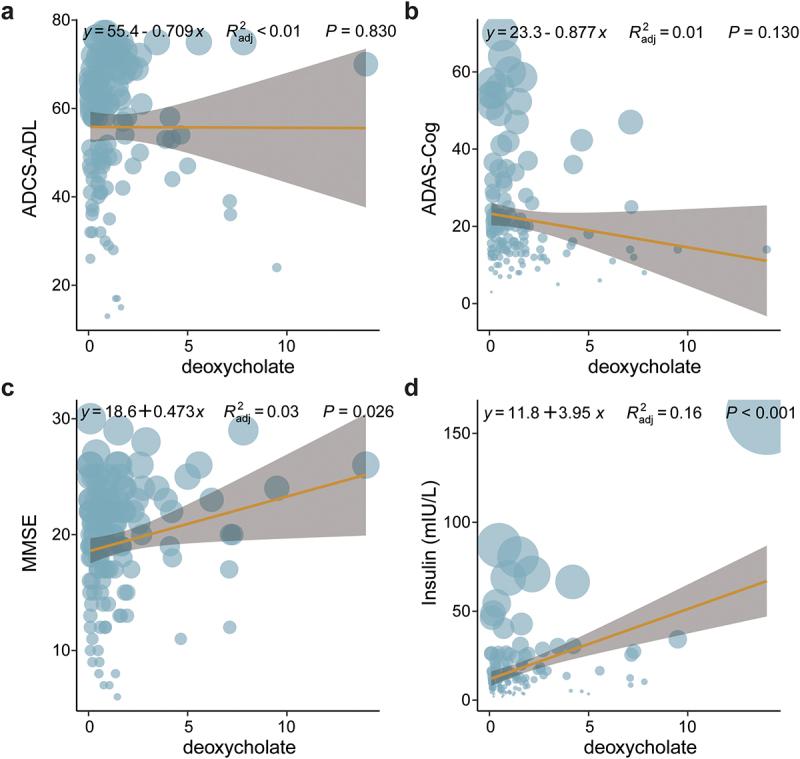
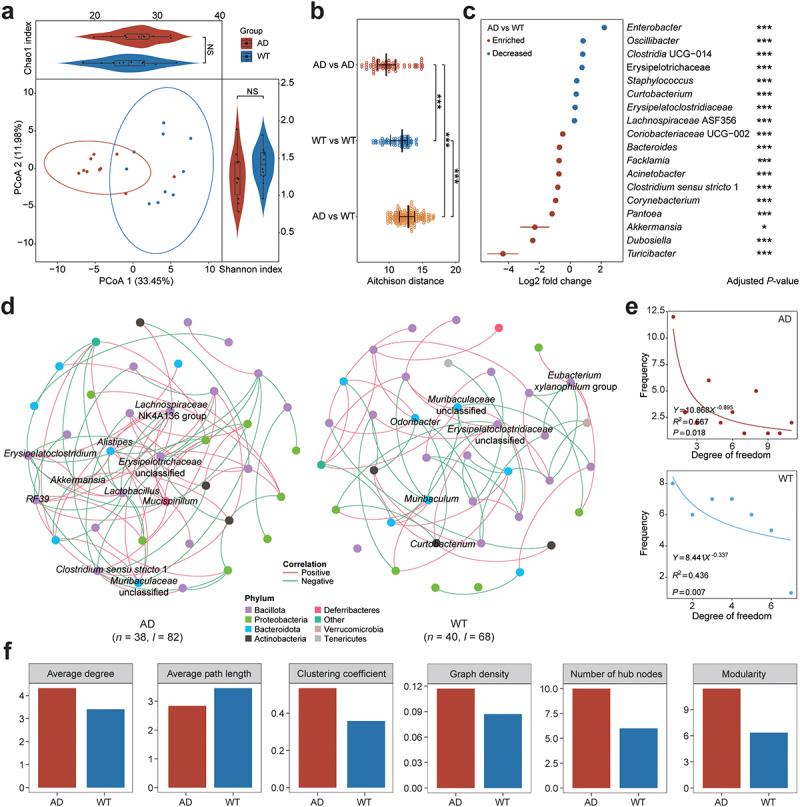
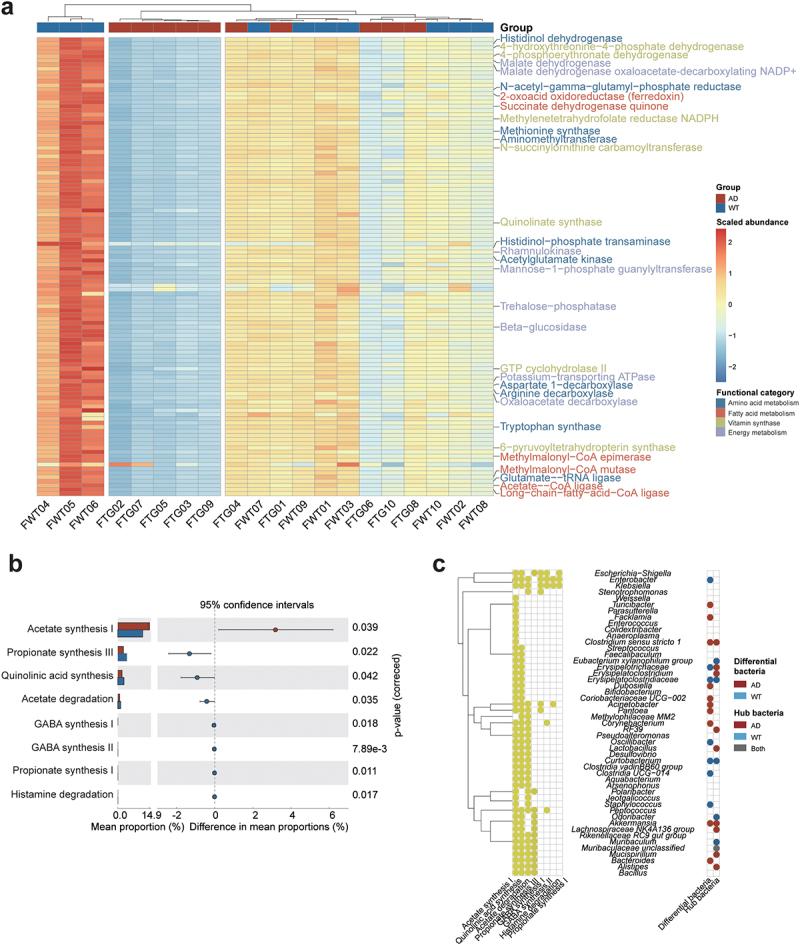
The gut microbiota (GM) and its metabolites affect the host nervous system and are involved in the pathogeneses of various neurological diseases. However, the specific GM alterations under pathogenetic pressure and their contributions to the "microbiota - metabolite - brain axis" in Alzheimer's disease (AD) remain unclear. Here, we investigated the GM and the fecal, serum, cortical metabolomes in APP/PS1 and wild-type (WT) mice, revealing distinct hub bacteria in AD mice within scale-free GM networks shared by both groups. Moreover, we identified diverse peripheral - central metabolic landscapes between AD and WT mice that featured bile acids (e.g. deoxycholic and isodeoxycholic acid) and unsaturated fatty acids (e.g. 11Z-eicosenoic and palmitoleic acid). Machine-learning models revealed the relationships between the differential/hub bacteria and these metabolic signatures from the periphery to the brain. Notably, AD-enriched affected AD occurrence via cortical palmitoleic acid and vice versa. Considering the transgenic background of the AD mice, we propose that enrichment impedes AD progression via the synthesis of palmitoleic acid, which has protective properties against inflammation and metabolic disorders. We identified another association involving fecal deoxycholic acid-mediated interactions between the AD hub bacteria and AD occurrence, which was corroborated by the correlation between deoxycholate levels and cognitive scores in humans. Overall, this study elucidated the GM network alterations, contributions of the GM to peripheral - central metabolic landscapes, and mediatory roles of metabolites between the GM and AD occurrence, thus revealing the critical roles of bacteria in AD pathogenesis and gut - brain communications under pathogenetic pressure.
肠道微生物群(GM)及其代谢物会影响宿主的神经系统,并参与各种神经疾病的发病机制。然而,在致病压力下特定的 GM 变化及其在阿尔茨海默病(AD)中的“微生物群-代谢物-大脑轴”中的作用仍不清楚。在这里,我们研究了 APP/PS1 和野生型(WT)小鼠的 GM 以及粪便、血清、皮质代谢组学,揭示了 AD 小鼠在两组共享的无标度 GM 网络中存在不同的核心细菌。此外,我们还发现了 AD 和 WT 小鼠之间不同的外周-中枢代谢图谱,其特征在于胆汁酸(如脱氧胆酸和异脱氧胆酸)和不饱和脂肪酸(如 11Z-二十碳烯酸和棕榈油酸)。机器学习模型揭示了差异/核心细菌与这些从外周到大脑的代谢特征之间的关系。值得注意的是,AD 富集的 通过皮质棕榈油酸影响 AD 的发生,反之亦然。考虑到 AD 小鼠的转基因背景,我们提出, 通过合成具有抗炎和代谢紊乱保护特性的棕榈油酸,丰富会阻碍 AD 的进展。我们还发现了另一个与 AD 相关的关联,涉及粪便脱氧胆酸介导的 AD 核心细菌 与 AD 发生之间的相互作用,这在人类中脱氧胆酸水平与认知评分之间的相关性中得到了证实。总体而言,这项研究阐明了 GM 网络的改变、GM 对外周-中枢代谢图谱的贡献,以及 GM 与 AD 发生之间代谢物的中介作用,从而揭示了细菌在 AD 发病机制和在致病压力下肠道-大脑通讯中的关键作用。


 Zotero 插件