
免疫细胞在广泛性焦虑障碍中的因果作用:孟德尔随机化研究。
Causal role of immune cells in generalized anxiety disorder: Mendelian randomization study.
机构信息
Department of Neurology, The First Affiliated Hospital of Henan University of Traditional Chinese Medicine, Zhengzhou, China.
Department of Neurology, Henan Provincial Hospital of Traditional Chinese Medicine, Zhengzhou, China.
出版信息
Front Immunol. 2024 Jan 9;14:1338083. doi: 10.3389/fimmu.2023.1338083. eCollection 2023.
BACKGROUND
Generalized anxiety disorder (GAD) is a prevalent emotional disorder that has received relatively little attention regarding its immunological basis. Recent years have seen the widespread use of high-density genetic markers such as SNPs or CNVs for genotyping, as well as the advancement of genome-wide association studies (GWAS) technologies, which have facilitated the understanding of immunological mechanisms underlying several major psychiatric disorders. Despite these advancements, the immunological basis of GAD remains poorly understood. In light of this, we aimed to explore the causal relationship between immune cells and the disease through a Mendelian randomization study.
METHODS
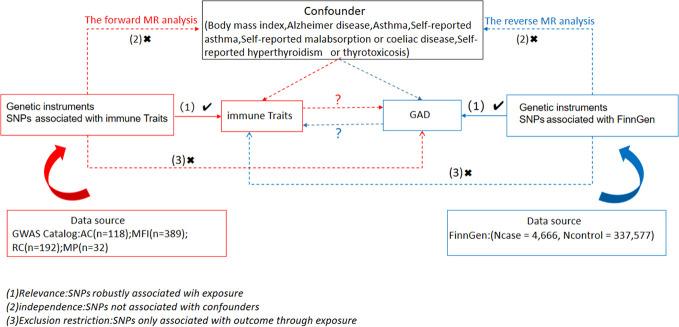
The summary information for GAD (Ncase=4,666, Ncontrol=337,577) was obtained from the FinnGen dataset. Summary statistics for the characterization of 731 immune cells, including morphological parameters (MP=32), median fluorescence intensity (MFI=389), absolute cells (AC=118), and relative cells (RC=192), were derived from the GWAS catalog. The study involved both forward MR analysis, with immune cell traits as the exposure and GAD as the outcome, and reverse MR analysis, with GAD as the exposure and immune cell traits as the outcome. We performed extensive sensitivity analyses to confirm the robustness, heterogeneity, and potential multi-biological effects of the study results. Also, to control for false positive results during multiple hypothesis testing, we adopted a false discovery rate (FDR) to control for statistical bias due to multiple comparisons.
RESULTS
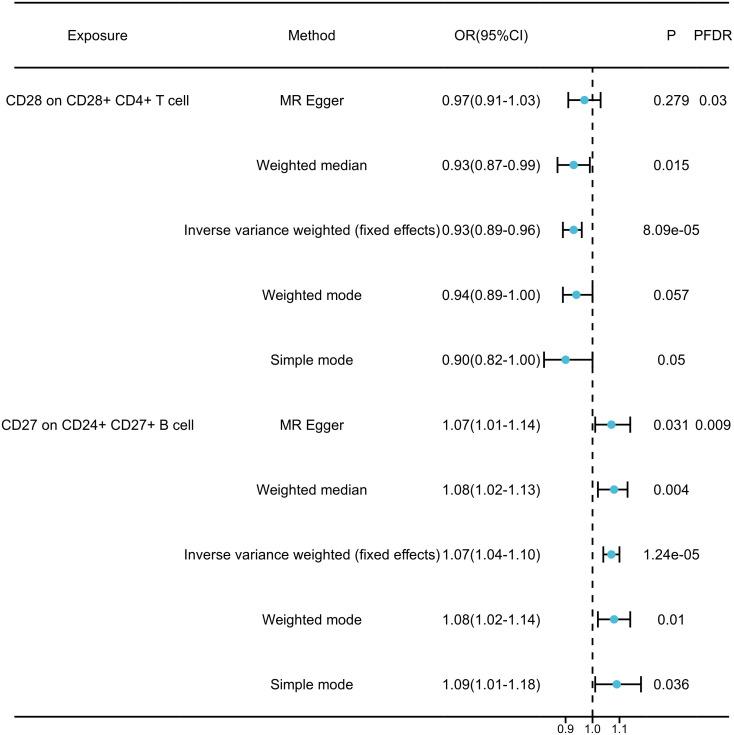
After FDR correction, GAD had no statistically significant effect on immunophenotypes. Several phenotypes with unadjusted low P-values are worth mentioning, including decreased PB/PC levels on B cells(β=-0.289, 95%CI=0.0440.194, =0.002), reduced PB/PC AC in GAD patients (β=-0.270, 95% CI=0.770.92, =0.000), and diminished PB/PC on lymphocytes (β=-0.315, 95% CI=0.770.93, =0.001). GAD also exerted a causal effect on CD27 on IgD-CD38br (β=-0.155,95%CI=0.780.94,=0.002), CD20-%B cell (β= -0.105,95% CI=0.770.94, =0.002), IgD-CD38br%lymphocyte(β=-0.305, 95%CI=0.790.95, =0.002), FSC-A level on granulocytes (β=0.200, 95%CI=0.750.91, =8.35×10), and CD4RA on TD CD4+(β=-0.150, 95% CI=0.821.02, =0.099). Furthermore, Two lymphocyte subsets were identified to be significantly associated with GAD risk: CD24+ CD27+ B cell (OR=1.066,95%CI=1.041.10,=1.237×10),CD28+CD4+T cell (OR=0.927, 95%CI=0.890.96, =8.085×10).
CONCLUSION
The study has shown the close association between immune cells and GAD through genetic methods, thereby offering direction for future clinical research.
背景
广泛性焦虑障碍(GAD)是一种常见的情绪障碍,但其免疫学基础受到的关注相对较少。近年来,人们广泛使用高密度遗传标记物,如 SNP 或 CNV 进行基因分型,以及推进全基因组关联研究(GWAS)技术,这些都有助于理解几种主要精神疾病的免疫学机制。尽管取得了这些进展,但 GAD 的免疫学基础仍知之甚少。有鉴于此,我们旨在通过孟德尔随机化研究探讨免疫细胞与疾病之间的因果关系。
方法
从 FinnGen 数据集获得 GAD(Ncase=4666,Ncontrol=337577)的汇总信息。从 GWAS 目录中得出 731 种免疫细胞的特征信息,包括形态参数(MP=32)、中荧光强度(MFI=389)、绝对细胞(AC=118)和相对细胞(RC=192)。研究涉及正向 MR 分析,将免疫细胞特征作为暴露因素,GAD 作为结果,以及反向 MR 分析,将 GAD 作为暴露因素,免疫细胞特征作为结果。我们进行了广泛的敏感性分析,以确认研究结果的稳健性、异质性和潜在的多生物学效应。此外,为了控制多重假设检验中的假阳性结果,我们采用了错误发现率(FDR)来控制由于多重比较而导致的统计偏差。
结果
经 FDR 校正后,GAD 对免疫表型没有统计学意义。有几个未经调整的低 P 值的表型值得一提,包括 B 细胞 PB/PC 水平降低(β=-0.289,95%CI=0.0440.194,=0.002)、GAD 患者 PB/PC AC 减少(β=-0.270,95%CI=0.770.92,=0.000)和淋巴细胞 PB/PC 减少(β=-0.315,95%CI=0.770.93,=0.001)。GAD 对 IgD-CD38br 上的 CD27(β=-0.155,95%CI=0.780.94,=0.002)、CD20-%B 细胞(β=-0.105,95%CI=0.770.94,=0.002)、IgD-CD38br%淋巴细胞(β=-0.305,95%CI=0.790.95,=0.002)、粒细胞上的 FSC-A 水平(β=0.200,95%CI=0.750.91,=8.35×10)和 TD CD4+上的 CD4RA(β=-0.150,95%CI=0.821.02,=0.099)也有因果效应。此外,还确定了两个淋巴细胞亚群与 GAD 风险显著相关:CD24+CD27+B 细胞(OR=1.066,95%CI=1.041.10,=1.237×10)和 CD28+CD4+T 细胞(OR=0.927,95%CI=0.890.96,=8.085×10)。
结论
该研究通过遗传方法表明了免疫细胞与 GAD 之间的密切关联,从而为未来的临床研究提供了方向。

 Zotero 插件