
免疫细胞在精神分裂症中的因果作用:孟德尔随机化(MR)研究。
Causal role of immune cells in schizophrenia: Mendelian randomization (MR) study.
机构信息
Department of Psychiatry, The Affiliated Xuzhou Oriental Hospital of Xuzhou Medical University, Xuzhou, Jiangsu, 221004, China.
School of Psychology, Xinxiang Medical University, Xinxiang, Henan, 453003, China.
出版信息
BMC Psychiatry. 2023 Aug 15;23(1):590. doi: 10.1186/s12888-023-05081-4.
BACKGROUND
Complex immune-brain interactions that affect neural development, survival and function might have causal and therapeutic implications for psychiatric illnesses. However, previous studies examining the association between immune inflammation and schizophrenia (SCZ) have yielded inconsistent findings.
METHODS
Comprehensive two-sample Mendelian randomization (MR) analysis was performed to determine the causal association between immune cell signatures and SCZ in this study. Based on publicly available genetic data, we explored causal associations between 731 immune cell signatures and SCZ risk. A total of four types of immune signatures (median fluorescence intensities (MFI), relative cell (RC), absolute cell (AC), and morphological parameters (MP)) were included. Comprehensive sensitivity analyses were used to verify the robustness, heterogeneity, and horizontal pleiotropy of the results.
RESULTS
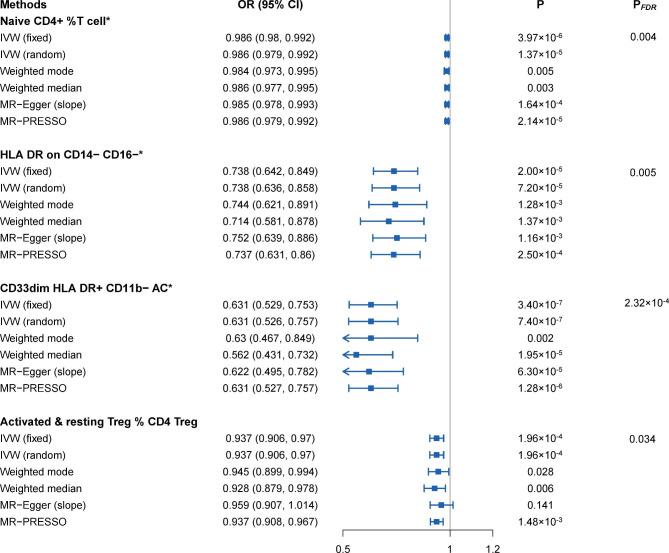
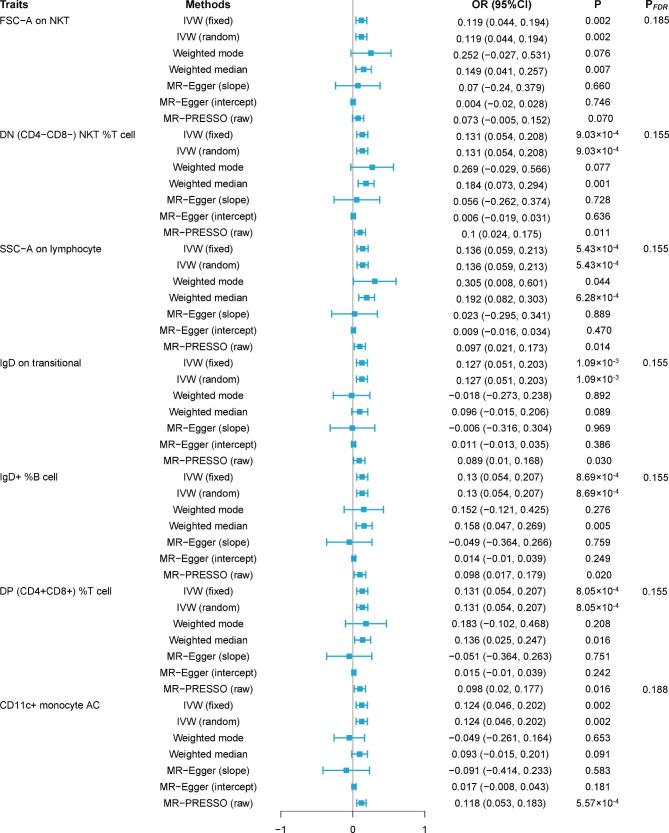
After FDR correction, SCZ had no statistically significant effect on immunophenotypes. It was worth mentioning some phenotypes with unadjusted low P-values, including FSC-A on NKT (β = 0.119, 95% CI = 0.044 ~ 0.194, P = 0.002), DN (CD4-CD8-) NKT %T cell (β = 0.131, 95% CI = 0.054 ~ 0.208, P = 9.03 × 10), and SSC-A on lymphocytes (β = 0.136, 95% CI = 0.059 ~ 0.213, P = 5.43 × 10). The causal effect of SCZ IgD on transitional was estimated to 0.127 (95% CI = 0.051 ~ 0.203, P = 1.09 × 10). SCZ also had a causal effect on IgD+ %B cell (β = 0.130, 95% CI = 0.054 ~ 0.207, P = 8.69 × 10), and DP (CD4CD8) %T cell (β = 0.131, 95% CI = 0.054 ~ 0.207, P = 8.05 × 10). Furthermore, four immunophenotypes were identified to be significantly associated with SCZ risk: naive CD4 %T cell (OR = 0.986, 95% CI = 0.979 ~ 0.992, P = 1.37 × 10), HLA DR on CD14 CD16 (OR = 0.738 (95% CI = 0.642 ~ 0.849, P = 2.00 × 10), CD33 HLA DR CD11b AC (OR = 0.631, 95% CI = 0.529 ~ 0.753, P = 3.40 × 10) and activated & resting Treg % CD4 Treg (OR = 0.937, 95% CI = 0.906 ~ 0.970, P = 1.96 × 10).
CONCLUSIONS
Our study has demonstrated the close connection between immune cells and SCZ by genetic means, thus providing guidance for future clinical research.
背景
复杂的免疫-大脑相互作用影响着神经的发育、存活和功能,这可能与精神疾病的病因和治疗有关。然而,之前研究免疫炎症与精神分裂症(SCZ)之间的关联的研究结果并不一致。
方法
本研究采用综合两样本孟德尔随机化(MR)分析来确定免疫细胞特征与 SCZ 之间的因果关系。基于公开的遗传数据,我们探索了 731 种免疫细胞特征与 SCZ 风险之间的因果关系。共纳入了四种免疫特征(中荧光强度(MFI)、相对细胞(RC)、绝对细胞(AC)和形态学参数(MP))。综合敏感性分析用于验证结果的稳健性、异质性和水平多效性。
结果
经 FDR 校正后,SCZ 对免疫表型没有统计学意义。值得注意的是,一些表型的未调整 P 值较低,包括 NKT 上的 FSC-A(β=0.119,95%CI=0.0440.194,P=0.002)、DN(CD4-CD8-)NKT %T 细胞(β=0.131,95%CI=0.0540.208,P=9.03×10)和淋巴细胞上的 SSC-A(β=0.136,95%CI=0.0590.213,P=5.43×10)。SCZ IgD 对过渡的因果效应估计为 0.127(95%CI=0.0510.203,P=1.09×10)。SCZ 对 IgD+B 细胞(β=0.130,95%CI=0.0540.207,P=8.69×10)和 DP(CD4CD8)%T 细胞(β=0.131,95%CI=0.0540.207,P=8.05×10)也有因果效应。此外,还确定了四个与 SCZ 风险显著相关的免疫表型:幼稚 CD4+%T 细胞(OR=0.986,95%CI=0.9790.992,P=1.37×10)、CD14CD16 上的 HLA DR(OR=0.738(95%CI=0.6420.849,P=2.00×10)、CD33 HLA DR CD11b AC(OR=0.631,95%CI=0.5290.753,P=3.40×10)和活化和静止 Treg%CD4 Treg(OR=0.937,95%CI=0.9060.970,P=1.96×10)。
结论
本研究通过遗传手段证明了免疫细胞与 SCZ 之间的密切联系,为未来的临床研究提供了指导。
 Zotero 插件