
免疫因素对肾结石病有复杂的因果调节作用:一项孟德尔随机化研究。
The immune factors have complex causal regulation effects on kidney stone disease: a mendelian randomization study.
机构信息
Department of Urology, Institute of Urology, Tongji Hospital, Tongji Medical College, Huazhong University of Science and Technology, Wuhan, 430030, China.
Department of Urology, Tongji Hospital, Tongji Medical College, Huazhong University of Science and Technology, Liberalization Ave, No. 1095, Wuhan, 430030, China.
出版信息
BMC Immunol. 2024 Jun 14;25(1):34. doi: 10.1186/s12865-024-00627-x.
PURPOSE
Previous studies have reported the potential impact of immune cells on kidney stone disease (KSD), but definitive causal relationships have yet to be established. The purpose of this paper is to elucidate the potential causal association between immune cells and KSD by Mendelian randomization (MR) analysis.
METHODS
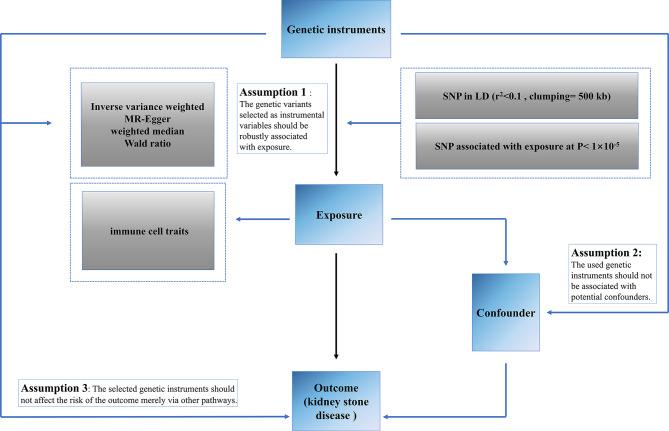
In our study, a thorough two-sample Mendelian randomization (MR) analysis was performed by us to determine the potential causal relationship between immune cell traits and kidney stone disease. We included a total of four immune traits (median fluorescence intensity (MFI), relative cellular (RC), absolute cellular (AC), and morphological parameters (MP)), which are publicly available data. GWAS summary data related to KSD (9713 cases and 366,693 controls) were obtained from the FinnGen consortium. The primary MR analysis method was Inverse variance weighted. Cochran's Q test, MR Egger, and MR-Pleiotropy RESidual Sum and Outlier (MR-PRESSO) were used to assess the stability of the results.
RESULTS
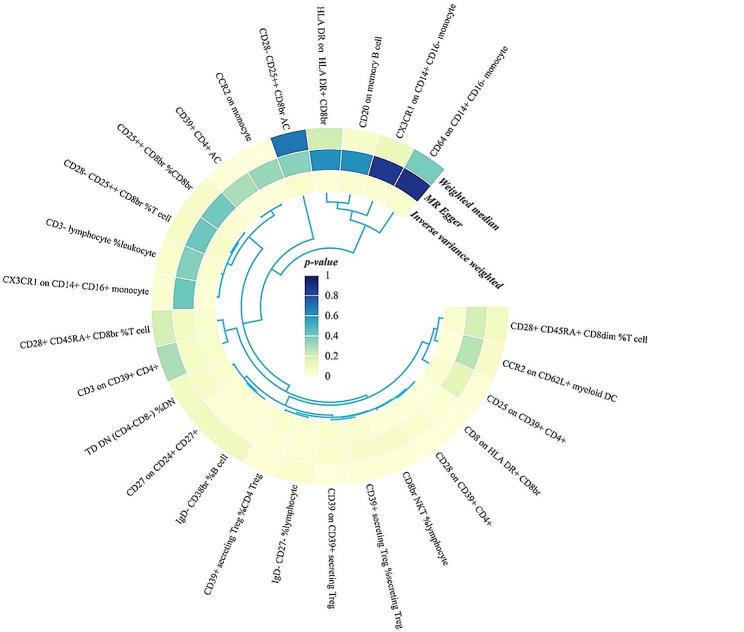
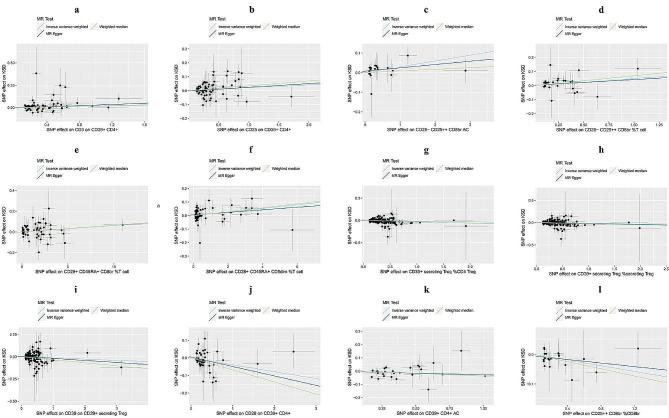
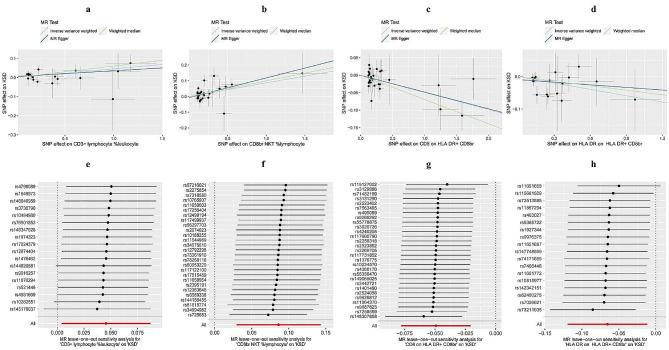
After FDR correction, the CD8 on HLA DR + CD8br (OR = 0.95, 95% CI = 0.93-0.98, p-value = 7.20 × 10, q-value = 0.088) was determined to be distinctly associated with KSD, and we also found other 25 suggestive associations between immune cells and KSD, of which 13 associations were suggested as protective factors and 12 associations were suggested as risk factors. There was no horizontal pleiotropy or significant heterogeneity in our MR analysis, as determined by the p-value results of our Cochrane Q-test, MR Egger's intercept test, and MR-PRESSO, which were all > 0.05.
CONCLUSIONS
Our study has explored the potential causal connection between immune cells and KSD by Mendelian randomization analysis, thus providing some insights for future clinical studies.
目的
先前的研究已经报道了免疫细胞对肾结石病(KSD)的潜在影响,但尚未确定明确的因果关系。本文的目的是通过孟德尔随机化(MR)分析阐明免疫细胞与 KSD 之间潜在的因果关联。
方法
我们进行了一项全面的两样本孟德尔随机化(MR)分析,以确定免疫细胞特征与肾结石病之间的潜在因果关系。我们纳入了总共四个免疫特征(中荧光强度(MFI)、相对细胞(RC)、绝对细胞(AC)和形态参数(MP)),这些都是公开可用的数据。从 FinnGen 联盟获得了与 KSD 相关的 GWAS 汇总数据(9713 例病例和 366693 例对照)。主要的 MR 分析方法是逆方差加权。使用 Cochran's Q 检验、MR Egger 和 MR-Pleiotropy RESidual Sum and Outlier(MR-PRESSO)来评估结果的稳定性。
结果
在 FDR 校正后,发现 HLA-DR+CD8br 上的 CD8(OR=0.95,95%CI=0.93-0.98,p 值=7.20×10,q 值=0.088)与 KSD 明显相关,我们还发现了免疫细胞与 KSD 之间的其他 25 个提示性关联,其中 13 个关联被认为是保护因素,12 个关联被认为是危险因素。我们的 MR 分析没有发现水平遗传异质性或显著的异质性,这可以从我们的 Cochrane Q 检验、MR Egger 截距检验和 MR-PRESSO 的 p 值结果中看出,这些结果都大于 0.05。
结论
本研究通过孟德尔随机化分析探讨了免疫细胞与 KSD 之间的潜在因果关系,为未来的临床研究提供了一些见解。
 Zotero 插件