
匈牙利 2 型糖尿病患者中 SARS-CoV-2 初级疫苗和加强针的有效性(HUN-VE 4 研究)。
Effectiveness of SARS-CoV-2 primary vaccines and boosters in patients with type 2 diabetes mellitus in Hungary (HUN-VE 4 Study).
机构信息
Second Department of Medicine and Nephrology-Diabetes Center, University of Pécs Medical School, Pécs, Hungary.
Center for Health Technology Assessment, Semmelweis University, Budapest, Hungary.
出版信息
BMJ Open Diabetes Res Care. 2024 Jan 24;12(1):e003777. doi: 10.1136/bmjdrc-2023-003777.
INTRODUCTION
Type 2 diabetes mellitus is a risk factor for severe COVID-19 infection and is associated with increased risk of complications. The present study aimed to investigate effectiveness and persistence of different COVID vaccines in persons with or without diabetes during the Delta wave in Hungary.
RESEARCH DESIGN AND METHODS
Data sources were the national COVID-19 registry data from the National Public Health Center and the National Health Insurance Fund on the total Hungarian population. The adjusted incidence rate ratios and corresponding 95% CIs were derived from a mixed-effect negative binomial regression model.
RESULTS
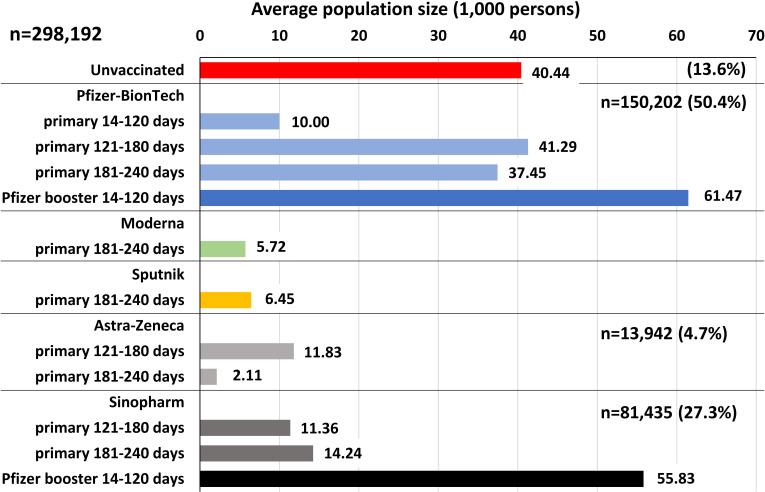
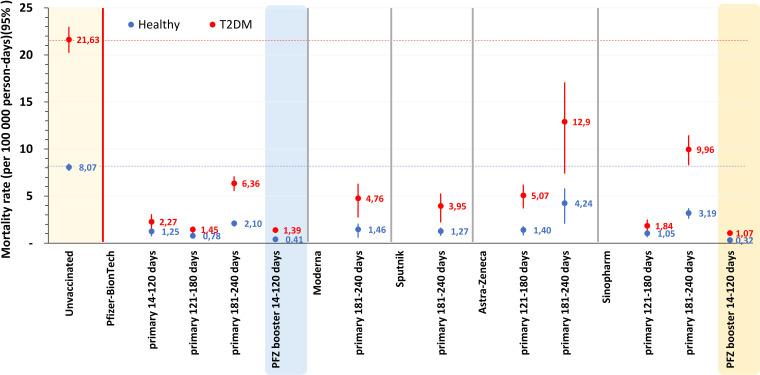
A population of 672 240 cases with type 2 diabetes and a control group of 2 974 102 non-diabetic persons free from chronic diseases participated. Unvaccinated elderly persons with diabetes had 2.68 (95% CI 2.47 to 2.91) times higher COVID-19-related mortality rate as the 'healthy' controls. Primary immunization effectively equalized the risk of COVID-19 mortality between the two groups. Vaccine effectiveness declined over time, but the booster restored the effectiveness against mortality to over 90%. The adjusted vaccine effectiveness of the primary Pfizer-BioNTech against infection in the 14-120 days of postvaccination period was 71.6 (95% CI 66.3 to 76.1)% in patients aged 65-100 years with type 2 diabetes and 64.52 (95% CI 59.2 to 69.2)% in the controls. Overall, the effectiveness tended to be higher in individuals with diabetes than in controls. The booster vaccines could restore vaccine effectiveness to over 80% concerning risk of infection (eg, patients with diabetes aged 65-100 years: 89.1 (88.1-89.9)% with Pfizer-on-Pfizer, controls 65-100 years old: 86.9 (85.8-88.0)% with Pfizer-on-Pfizer, or patients with diabetes aged 65-100 years: 88.3 (87.2-89.2)% with Pfizer-on-Sinopharm, controls 65-100 years old: 87.8 (86.8-88.7)% with Pfizer-on-Sinopharm).
CONCLUSIONS
Our data suggest that people with type 2 diabetes may have even higher health gain when getting vaccinated as compared with non-diabetic persons, eliminating the marked, COVID-19-related excess risk of this population. Boosters could restore protection.
简介
2 型糖尿病是 COVID-19 严重感染的危险因素,并与并发症风险增加相关。本研究旨在调查在匈牙利德尔塔波期间,不同 COVID 疫苗在有或没有糖尿病的人群中的有效性和持久性。
研究设计和方法
数据来源为国家公共卫生中心和国家健康保险基金的全国 COVID-19 登记数据,涵盖了匈牙利全部人口。通过混合效应负二项式回归模型得出调整后的发病率比值比及其相应的 95%置信区间。
结果
本研究纳入了 672240 例 2 型糖尿病患者和 2974102 例无慢性疾病的非糖尿病对照人群。未接种疫苗的老年糖尿病患者 COVID-19 相关死亡率是“健康”对照组的 2.68 倍(95%CI 2.47 至 2.91)。初级免疫可有效平衡两组 COVID-19 死亡率风险。疫苗有效性随时间下降,但加强针可使死亡率的保护作用恢复至 90%以上。在接种后 14-120 天内,年龄在 65-100 岁的 2 型糖尿病患者中,初级辉瑞-生物科技对感染的调整疫苗有效性为 71.6%(95%CI 66.3%至 76.1%),对照组为 64.52%(95%CI 59.2%至 69.2%)。总体而言,糖尿病患者的疫苗有效性倾向高于对照组。加强针疫苗可使感染风险的疫苗有效性恢复至 80%以上(例如,年龄在 65-100 岁的糖尿病患者:接种辉瑞-辉瑞的加强针后为 89.1%(88.1%至 89.9%),年龄在 65-100 岁的对照组为 86.9%(85.8%至 88.0%),或年龄在 65-100 岁的糖尿病患者:接种辉瑞-科兴的加强针后为 88.3%(87.2%至 89.2%),年龄在 65-100 岁的对照组为 87.8%(86.8%至 88.7%))。
结论
我们的数据表明,与非糖尿病患者相比,2 型糖尿病患者接种疫苗可能会获得更高的健康收益,消除了该人群 COVID-19 相关的显著超额风险。加强针可恢复保护作用。


 Zotero 插件