
公共卫生干预措施及新冠清零政策对儿科疾病的影响:一项中国南方地区的研究。
Effects of public health interventions and zero COVID policy on paediatric diseases: A Southern China study.
作者信息
Huang Li, Yang Chen, Pan Huoyun, Gu Yiling, Li Ling, Kou Meng, Chen Shaoxiang, Wu Jianlong, Lian Jiacee, Zhang Jinqiu, Gu Jiaowei, Wei Rui, Chen Hao, Gong Sitang, Zhang Hongwei, Xu Yi, Lian Qizhou
机构信息
Prenatal Diagnostic Center and Cord Blood Bank, Guangzhou Women and Children's Medical Center, Guangzhou Medical University, Guangzhou, China.
Faculty of Synthetic Biology, Shenzhen Institute of Advanced Technology, Chinese Academy of Sciences, Shenzhen, China.
出版信息
J Glob Health. 2024 Jan 26;14:05011. doi: 10.7189/jogh.14.05011.
BACKGROUND
With the spread of the severe acute respiratory syndrome coronavirus 2 (SARS-CoV-2) pandemic in schools and communities, clinical evidence is needed to determine the impact of the pandemic and public health interventions under the zero coronavirus disease policy on the occurrence of common infectious diseases and non-infectious diseases among children.
METHODS
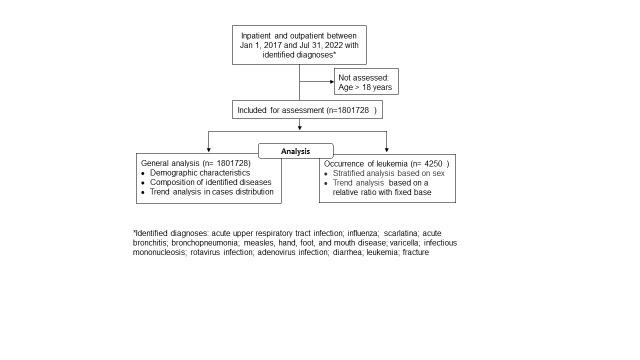
The current study was designed to analyse the occurrence of common infectious diseases before and after the pandemic outbreak in southern China. Data was obtained for 1 801 728 patients admitted into children's hospitals in Guangzhou between January 2017 and July 2022. Regression analysis was performed for data analysis.
RESULTS
The annual occurrence of common paediatric infectious diseases remarkably decreased after the pandemic compared to the baseline before the pandemic and the monthly occurrence. Cases per month of common paediatric infectious diseases were significantly lower in five periods during the local outbreak when enhanced public health measures were in place. Cases of acute non-infectious diseases such as bone fractures were not reduced. Non-pharmaceutical interventions decreased annual and monthly cases of paediatric respiratory and intestinal infections during the coronavirus disease 2019 (COVID-19) pandemic, especially when enhanced public health interventions were in place.
CONCLUSIONS
Our findings provide clinical evidence that public health interventions under the dynamic zero COVID policy in the past three years had significant impacts on the occurrence of common respiratory and intestinal infectious diseases among children and adolescents but little impact on reducing non-infectious diseases such as leukaemia and bone fracture.
背景
随着严重急性呼吸综合征冠状病毒2(SARS-CoV-2)大流行在学校和社区的蔓延,需要临床证据来确定大流行以及在新冠疫情防控政策下的公共卫生干预措施对儿童常见传染病和非传染病发生情况的影响。
方法
本研究旨在分析中国南方大流行爆发前后常见传染病的发生情况。获取了2017年1月至2022年7月期间广州儿童医院收治的1801728例患者的数据。采用回归分析进行数据分析。
结果
与大流行前的基线水平和每月发病率相比,大流行后常见儿科传染病的年发病率显著下降。在当地爆发期间实施强化公共卫生措施的五个时期,常见儿科传染病的每月病例数显著降低。急性非传染病如骨折的病例数并未减少。在2019冠状病毒病(COVID-19)大流行期间,非药物干预措施减少了儿科呼吸道和肠道感染的年度和月度病例数,尤其是在实施强化公共卫生干预措施时。
结论
我们的研究结果提供了临床证据,表明过去三年动态清零政策下的公共卫生干预措施对儿童和青少年常见呼吸道和肠道传染病的发生有显著影响,但对减少白血病和骨折等非传染病的影响较小。


 Zotero 插件