
肺腺癌鼻窦转移:一例报告
Sinus metastasis of lung adenocarcinoma: a case report.
作者信息
Xu Mingyuan, Sun Qi, Lv Xin, Chen Fangjun, Su Shu, Wang Lifeng
机构信息
Comprehensive Cancer Center, Nanjing Drum Tower Hospital, Nanjing, Jiangsu Province, China.
Department of Pathology, Nanjing Drum Tower Hospital, Nanjing, Jiangsu Province, China.
出版信息
Front Med (Lausanne). 2024 Jan 11;10:1323222. doi: 10.3389/fmed.2023.1323222. eCollection 2023.
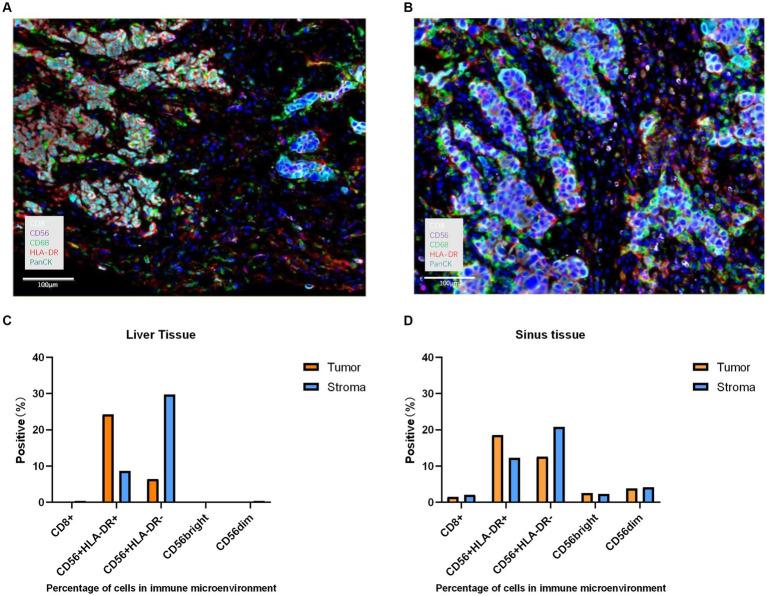
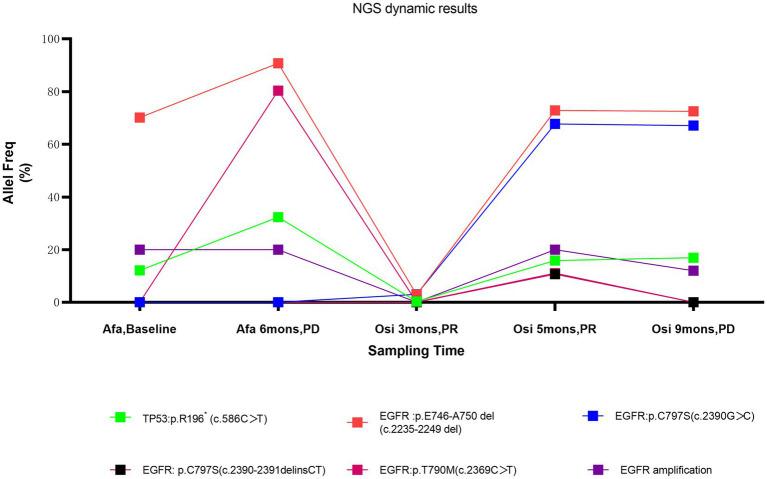
Metastatic carcinoma of the paranasal sinuses in lung cancer is an extremely uncommon condition. We report here a 57-year-old female patient with epidermal growth factor receptor (EGFR)-positive stage IV non-small cell lung cancer (NSCLC) with multiple bone metastases. After resistance to second- and third-generation EGFR-tyrosine kinase inhibitors (TKIs), the patient presented with headache accompanied by progressively enlarging lesions of the nasal cavity on CT scan. Further endoscopic sinus neoplasmectomy confirmed sinus metastasis of lung adenocarcinoma. Although subsequent chemotherapy and immunotherapy were both administered, the disease continued to progress, and the patient passed away 21 months after diagnosis. Combined with real-time dynamic next-generation sequencing (NGS) during the different generations of EGFR-TKI treatments and dynamic tumour microenvironment analysis, we discussed the clinical manifestations of sinus metastasis and the molecular biology and tumour immune microenvironment changes after resistance to the second-and third- generation of EGFR-TKI therapy.
肺癌伴鼻窦转移癌极为罕见。我们在此报告一名57岁女性患者,患有表皮生长因子受体(EGFR)阳性的IV期非小细胞肺癌(NSCLC)并伴有多处骨转移。在对第二代和第三代EGFR酪氨酸激酶抑制剂(TKIs)耐药后,患者出现头痛,CT扫描显示鼻腔病变逐渐增大。进一步的鼻窦肿瘤内镜切除术证实为肺腺癌鼻窦转移。尽管随后进行了化疗和免疫治疗,但疾病仍继续进展,患者在诊断后21个月去世。结合不同代EGFR-TKI治疗期间的实时动态下一代测序(NGS)和动态肿瘤微环境分析,我们讨论了鼻窦转移的临床表现以及对第二代和第三代EGFR-TKI治疗耐药后的分子生物学和肿瘤免疫微环境变化。

 Zotero 插件