
利奈唑胺敏感菌中的利奈唑胺耐药基因与突变——一个难以控制的因素?
Linezolid Resistance Genes and Mutations among Linezolid-Susceptible spp.-A Loose Cannon?
作者信息
Bender Jennifer K, Fleige Carola, Funk Finn, Moretó-Castellsagué Clara, Fischer Martin A, Werner Guido
机构信息
Nosocomial Pathogens and Antibiotic Resistances Unit, Department of Infectious Diseases, Robert Koch Institute, 38855 Wernigerode, Germany.
Department of Microbiology and Parasitology, University Hospital of Bellvitge, 08907 Barcelona, Spain.
出版信息
Antibiotics (Basel). 2024 Jan 19;13(1):101. doi: 10.3390/antibiotics13010101.
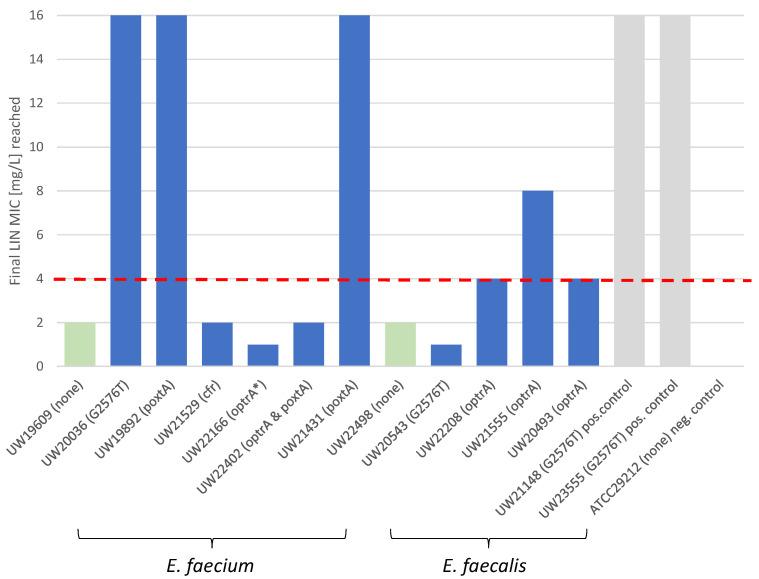
The National Reference Centre for Enterococci receives an increasing number of linezolid-resistant isolates. Linezolid (LIN) resistance is mediated by G2576T 23S rDNA gene mutations and/or acquisition of resistance genes (). There are anecdotal reports that those resistance traits may be present in phenotypically linezolid-susceptible isolates. We aimed to determine the prevalence of LIN resistance genes and mutations in enterococci with a LIN MIC of 4 mg/L in broth microdilution (EUCAST = susceptible) isolated from German hospital patients 2019-2021. LIN MICs were additionally determined by ETEST and VITEK2. Selected strains were subjected to LIN selective pressure and growth was monitored with increasing antibiotic concentrations. We received 195 isolates (LIN MIC = 4 mg/L). In total, 78/195 (40%) isolates contained either a putative resistance gene, the G2576T mutation, or a combination thereof. Very major error was high for broth microdilution. The ability to predict phenotypic resistance from genotypic profile was highest for G2576T-mediated resistance. Selection experiments revealed that, in particular, isolates with resistance gene mutations or rapidly adapt to MICs above the clinical breakpoint. In conclusion, LIN resistance genes and mutations can be observed in phenotypically linezolid-susceptible enterococci. Those isolates may rapidly develop resistance under LIN selective pressure potentially leading to treatment failure.
国家肠球菌参考中心收到的耐利奈唑胺分离株数量日益增加。利奈唑胺(LIN)耐药性由G2576T 23S rDNA基因突变和/或耐药基因的获得介导()。有零星报道称,这些耐药性状可能存在于表型上对利奈唑胺敏感的分离株中。我们旨在确定2019 - 2021年从德国医院患者中分离出的肉汤微量稀释法中利奈唑胺MIC为4 mg/L(EUCAST = 敏感)的肠球菌中利奈唑胺耐药基因和突变的流行情况。利奈唑胺MIC还通过ETEST和VITEK2进行测定。对选定菌株施加利奈唑胺选择压力,并随着抗生素浓度增加监测生长情况。我们收到了195株分离株(利奈唑胺MIC = 4 mg/L)。总共,78/195(40%)的分离株含有推定的耐药基因、G2576T突变或两者的组合。肉汤微量稀释法的极重大误差较高。从基因型谱预测表型耐药性的能力在G2576T介导的耐药性方面最高。选择实验表明,特别是具有耐药基因突变的分离株或 迅速适应高于临床断点的MIC。总之,在表型上对利奈唑胺敏感的肠球菌中可观察到利奈唑胺耐药基因和突变。这些分离株在利奈唑胺选择压力下可能迅速产生耐药性,潜在地导致治疗失败。
 Zotero 插件