
TAZ 作为一种潜在的致病生物标志物,促进扁平苔藓的发展。
TAZ acting as a potential pathogenic biomarker to promote the development of lichen planus.
机构信息
Department of Dermatology, the First Affiliated Hospital of Xi'an Jiaotong University, Xi'an, China.
出版信息
Skin Res Technol. 2024 Feb;30(2):e13597. doi: 10.1111/srt.13597.
BACKGROUND
Lichen planus is a chronic inflammatory disorder. Transcriptional coactivator with PDZ-binding motif (TAZ/WWTR1) is an important downstream effector of the Hippo pathway which regulates organ size and tissue homeostasis. But little is known about the role of TAZ in lichen planus so far.
OBJECTIVE
To explore the expression of TAZ in lichen planus and normal skin, and to discover the relationship between TAZ expression and the clinical characteristics of lichen planus patients.
METHODS
The method of immunohistochemistry was performed to quantify the expression of TAZ in 262 patients with lichen planus and 90 control tissues. Western blot and quantitative real-time reverse transcriptase-PCR (qRT-PCR) analysis were performed to examine and compare TAZ expression in 4 cases of fresh lichen planus lesions and normal skin tissues.
RESULTS
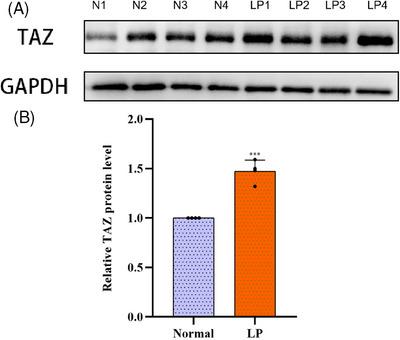
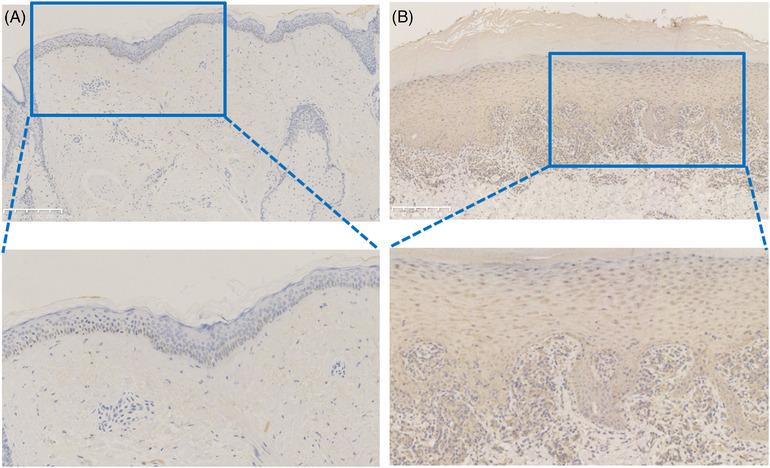
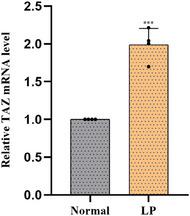
TAZ was weakly expressed in the basal layers of the epidermis in normal skin tissues with a positive rate of 52.22% (47/90). But in lichen planus, TAZ was strongly expressed in almost the entire epidermis with a positive rate of 81.30% (213/262), and the difference between the two groups was statistically significant (p<0.05). Additionally, TAZ expression was significantly related to the location of the lichen planus, clinical phenotype, smoking, and alcohol preference (p<0.05). Western blot and qRT-PCR showed that the expression of TAZ in protein and mRNA levels in four cases of lichen planus lesions was significantly higher than that in normal skin tissues.
CONCLUSION
TAZ may play a regulatory role in the occurrence and development of lichen planus, which might provide a new perspective for studying pathogenesis and theoretical treatment targets.
背景
扁平苔藓是一种慢性炎症性疾病。转录共激活因子与 PDZ 结合基序(TAZ/WWTR1)是 Hippo 通路的一个重要下游效应物,调节器官大小和组织稳态。但到目前为止,关于 TAZ 在扁平苔藓中的作用知之甚少。
目的
探讨 TAZ 在扁平苔藓及正常皮肤中的表达,发现 TAZ 表达与扁平苔藓患者临床特征的关系。
方法
采用免疫组织化学方法检测 262 例扁平苔藓患者和 90 例对照组织中 TAZ 的表达,采用 Western blot 和实时定量逆转录 PCR(qRT-PCR)分析 4 例新鲜扁平苔藓皮损和正常皮肤组织中 TAZ 的表达并进行比较。
结果
正常皮肤组织中 TAZ 在表皮基底层呈弱阳性表达,阳性率为 52.22%(47/90);而在扁平苔藓中,TAZ 几乎在整个表皮呈强阳性表达,阳性率为 81.30%(213/262),两组比较差异有统计学意义(p<0.05)。此外,TAZ 表达与扁平苔藓的部位、临床表型、吸烟、饮酒偏好显著相关(p<0.05)。Western blot 和 qRT-PCR 显示,4 例扁平苔藓皮损组织中 TAZ 在蛋白和 mRNA 水平的表达均明显高于正常皮肤组织。
结论
TAZ 可能在扁平苔藓的发生发展中起调节作用,为研究发病机制和理论治疗靶点提供了新视角。

 Zotero 插件