
经皮星状神经节阻滞治疗电风暴:STAR 研究。
Electrical storm treatment by percutaneous stellate ganglion block: the STAR study.
机构信息
Division of Cardiology, Fondazione IRCCS Policlinico San Matteo, Viale Golgi 19, 27100 Pavia, Italy.
Department of Molecular Medicine, Section of Cardiology, University of Pavia, Pavia, Italy.
出版信息
Eur Heart J. 2024 Mar 7;45(10):823-833. doi: 10.1093/eurheartj/ehae021.
BACKGROUND AND AIMS
An electrical storm (ES) is a clinical emergency with a paucity of established treatment options. Despite initial encouraging reports about the safety and effectiveness of percutaneous stellate ganglion block (PSGB), many questions remained unsettled and evidence from a prospective multicentre study was still lacking. For these purposes, the STAR study was designed.
METHODS
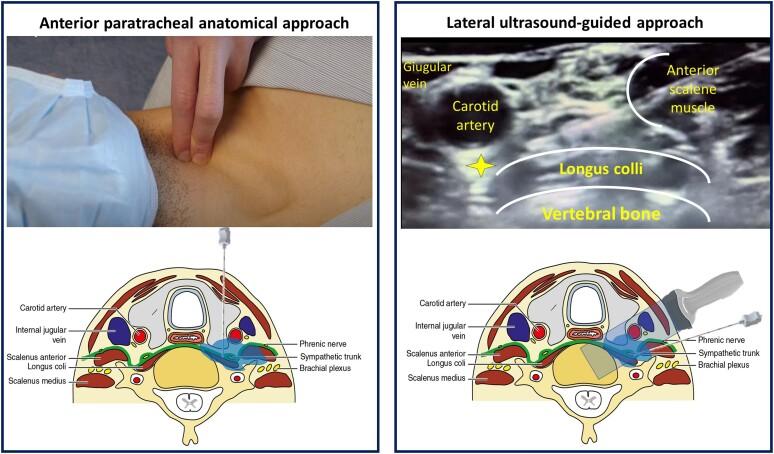
This is a multicentre observational study enrolling patients suffering from an ES refractory to standard treatment from 1 July 2017 to 30 June 2023. The primary outcome was the reduction of treated arrhythmic events by at least 50% comparing the 12 h following PSGB with the 12 h before the procedure. STAR operators were specifically trained to both the anterior anatomical and the lateral ultrasound-guided approach.
RESULTS
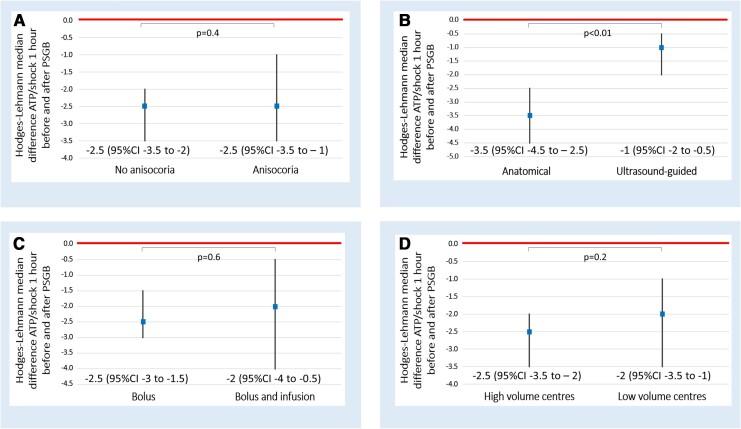
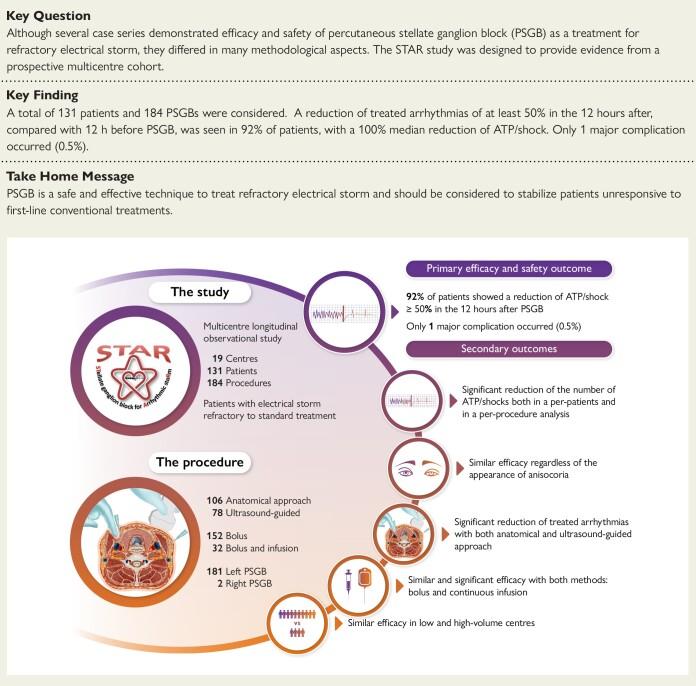
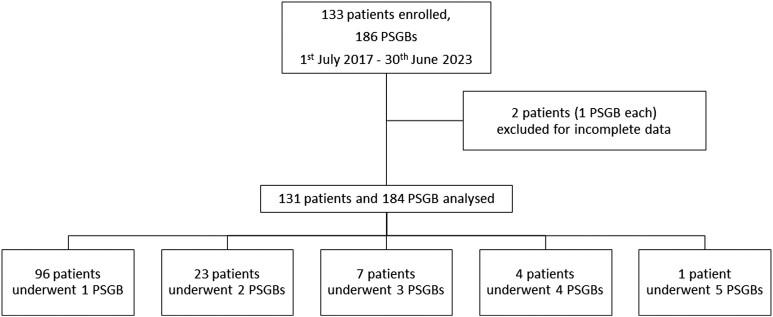
A total of 131 patients from 19 centres were enrolled and underwent 184 PSGBs. Patients were mainly male (83.2%) with a median age of 68 (63.8-69.2) years and a depressed left ventricular ejection fraction (25.0 ± 12.3%). The primary outcome was reached in 92% of patients, and the median reduction of arrhythmic episodes between 12 h before and after PSGB was 100% (interquartile range -100% to -92.3%). Arrhythmic episodes requiring treatment were significantly reduced comparing 12 h before the first PSGB with 12 h after the last procedure [six (3-15.8) vs. 0 (0-1), P < .0001] and comparing 1 h before with 1 h after each procedure [2 (0-6) vs. 0 (0-0), P < .001]. One major complication occurred (0.5%).
CONCLUSIONS
The findings of this large, prospective, multicentre study provide evidence in favour of the effectiveness and safety of PSGB for the treatment of refractory ES.
背景和目的
电风暴(ES)是一种临床急症,治疗方法有限。尽管经皮星状神经节阻滞(PSGB)的安全性和有效性的初步报告令人鼓舞,但仍有许多问题悬而未决,并且缺乏来自前瞻性多中心研究的证据。出于这些目的,设计了 STAR 研究。
方法
这是一项多中心观察性研究,纳入了 2017 年 7 月 1 日至 2023 年 6 月 30 日期间接受标准治疗后仍无法控制的 ES 患者。主要结局是比较 PSGB 后 12 小时和操作前 12 小时治疗性心律失常事件减少至少 50%。STAR 操作者专门接受了前解剖和侧超声引导方法的培训。
结果
共有 19 个中心的 131 名患者入组并接受了 184 次 PSGB。患者主要为男性(83.2%),中位年龄为 68(63.8-69.2)岁,左心室射血分数降低(25.0±12.3%)。92%的患者达到了主要结局,PSGB 前后 12 小时心律失常发作的中位数减少 100%(四分位距-100%至-92.3%)。与首次 PSGB 前 12 小时相比,最后一次操作后 12 小时心律失常发作的数量明显减少[6 次(3-15.8)比 0 次(0-1),P<0.0001],与每次操作前 1 小时和操作后 1 小时相比[2 次(0-6)比 0 次(0-0),P<0.001]。发生 1 例主要并发症(0.5%)。
结论
这项大型、前瞻性、多中心研究的结果提供了证据支持 PSGB 治疗难治性 ES 的有效性和安全性。

 Zotero 插件