
在精准医学和机器学习背景下研究胃肠道微生物组的多组学方法。
Multi-omics approaches to studying gastrointestinal microbiome in the context of precision medicine and machine learning.
作者信息
Wu Jingyue, Singleton Stephanie S, Bhuiyan Urnisha, Krammer Lori, Mazumder Raja
机构信息
Department of Biochemistry and Molecular Medicine, School of Medicine and Health Sciences, The George Washington University, Washington, DC, United States.
Milken Institute School of Public Health, The George Washington University, Washington, DC, United States.
出版信息
Front Mol Biosci. 2024 Jan 19;10:1337373. doi: 10.3389/fmolb.2023.1337373. eCollection 2023.
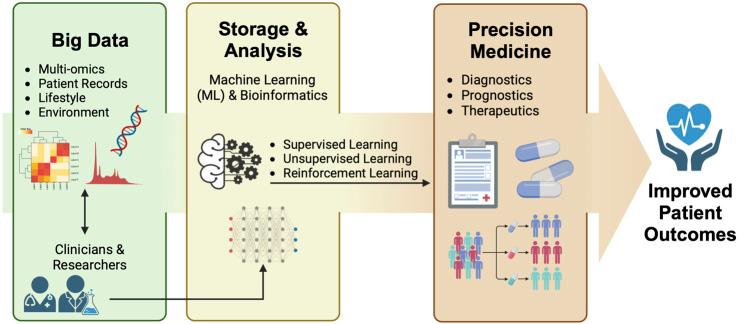
The human gastrointestinal (gut) microbiome plays a critical role in maintaining host health and has been increasingly recognized as an important factor in precision medicine. High-throughput sequencing technologies have revolutionized -omics data generation, facilitating the characterization of the human gut microbiome with exceptional resolution. The analysis of various -omics data, including metatranscriptomics, metagenomics, glycomics, and metabolomics, holds potential for personalized therapies by revealing information about functional genes, microbial composition, glycans, and metabolites. This multi-omics approach has not only provided insights into the role of the gut microbiome in various diseases but has also facilitated the identification of microbial biomarkers for diagnosis, prognosis, and treatment. Machine learning algorithms have emerged as powerful tools for extracting meaningful insights from complex datasets, and more recently have been applied to metagenomics data via efficiently identifying microbial signatures, predicting disease states, and determining potential therapeutic targets. Despite these rapid advancements, several challenges remain, such as key knowledge gaps, algorithm selection, and bioinformatics software parametrization. In this mini-review, our primary focus is metagenomics, while recognizing that other -omics can enhance our understanding of the functional diversity of organisms and how they interact with the host. We aim to explore the current intersection of multi-omics, precision medicine, and machine learning in advancing our understanding of the gut microbiome. A multidisciplinary approach holds promise for improving patient outcomes in the era of precision medicine, as we unravel the intricate interactions between the microbiome and human health.
人类胃肠道微生物群落在维持宿主健康方面发挥着关键作用,并且越来越被视为精准医学中的一个重要因素。高通量测序技术彻底改变了组学数据的生成方式,以卓越的分辨率促进了对人类肠道微生物群的特征描述。对包括宏转录组学、宏基因组学、糖组学和代谢组学在内的各种组学数据进行分析,通过揭示有关功能基因、微生物组成、聚糖和代谢物的信息,为个性化治疗带来了潜力。这种多组学方法不仅深入了解了肠道微生物群在各种疾病中的作用,还促进了用于诊断、预后和治疗的微生物生物标志物的识别。机器学习算法已成为从复杂数据集中提取有意义见解的强大工具,最近还通过有效识别微生物特征、预测疾病状态和确定潜在治疗靶点应用于宏基因组学数据。尽管取得了这些快速进展,但仍存在一些挑战,例如关键知识空白、算法选择和生物信息学软件参数化。在本综述中,我们主要关注宏基因组学,同时认识到其他组学可以增强我们对生物体功能多样性以及它们如何与宿主相互作用的理解。我们旨在探索多组学、精准医学和机器学习在推进我们对肠道微生物群理解方面的当前交叉点。随着我们解开微生物群与人类健康之间复杂的相互作用,多学科方法有望在精准医学时代改善患者预后。
 Zotero 插件