
肠道微生物遇见机器学习:在健康和疾病中深入了解肠道微生物组的下一步。
Gut Microbes Meet Machine Learning: The Next Step towards Advancing Our Understanding of the Gut Microbiome in Health and Disease.
机构信息
Department of Medical, Surgical and Health Sciences, University of Trieste, 34149 Trieste, Italy.
Department of Internal Medicine, Yale School of Medicine, Yale University, New Haven, CT 06510, USA.
出版信息
Int J Mol Sci. 2023 Mar 9;24(6):5229. doi: 10.3390/ijms24065229.
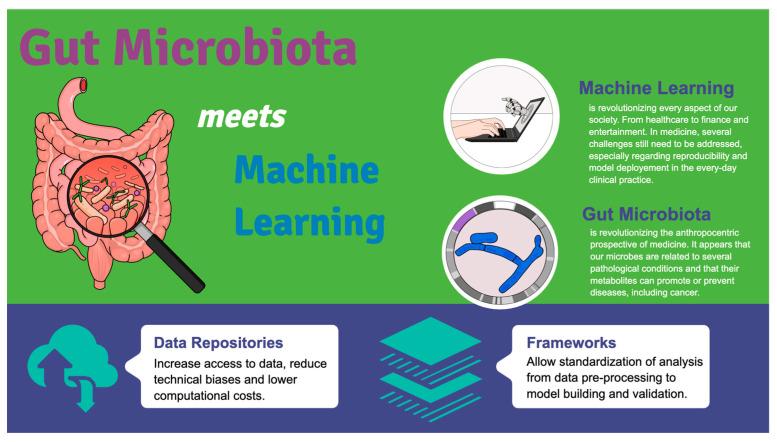
The human gut microbiome plays a crucial role in human health and has been a focus of increasing research in recent years. Omics-based methods, such as metagenomics, metatranscriptomics, and metabolomics, are commonly used to study the gut microbiome because they provide high-throughput and high-resolution data. The vast amount of data generated by these methods has led to the development of computational methods for data processing and analysis, with machine learning becoming a powerful and widely used tool in this field. Despite the promising results of machine learning-based approaches for analyzing the association between microbiota and disease, there are several unmet challenges. Small sample sizes, disproportionate label distribution, inconsistent experimental protocols, or a lack of access to relevant metadata can all contribute to a lack of reproducibility and translational application into everyday clinical practice. These pitfalls can lead to false models, resulting in misinterpretation biases for microbe-disease correlations. Recent efforts to address these challenges include the construction of human gut microbiota data repositories, improved data transparency guidelines, and more accessible machine learning frameworks; implementation of these efforts has facilitated a shift in the field from observational association studies to experimental causal inference and clinical intervention.
人类肠道微生物组在人类健康中起着至关重要的作用,近年来已成为研究的焦点。基于组学的方法,如宏基因组学、宏转录组学和代谢组学,常用于研究肠道微生物组,因为它们提供高通量和高分辨率的数据。这些方法产生的大量数据导致了数据处理和分析的计算方法的发展,机器学习成为该领域强大且广泛使用的工具。尽管基于机器学习的方法在分析微生物组与疾病之间的关联方面取得了有希望的结果,但仍存在一些未满足的挑战。小样本量、标签分布不均、实验方案不一致或无法访问相关元数据,都可能导致缺乏可重复性和向日常临床实践的转化应用。这些缺陷可能导致错误的模型,从而导致对微生物-疾病相关性的误解偏差。最近为解决这些挑战所做的努力包括构建人类肠道微生物组数据存储库、改进数据透明度指南和更易于访问的机器学习框架;这些努力的实施促进了该领域从观察性关联研究向实验因果推断和临床干预的转变。
 Zotero 插件