
肠道微生物群是非小细胞肺癌(NSCLC)免疫治疗生物标志物的新来源。
Gut Microbiota Are a Novel Source of Biomarkers for Immunotherapy in Non-Small-Cell Lung Cancer (NSCLC).
作者信息
Del Giudice Teresa, Staropoli Nicoletta, Tassone Pierfrancesco, Tagliaferri Pierosandro, Barbieri Vito
机构信息
Department of Hematology-Oncology, Azienda Ospedaliera Renato Dulbecco, 88100 Catanzaro, Italy.
Department of Experimental and Clinical Medicine, Magna Graecia University, 88100 Catanzaro, Italy.
出版信息
Cancers (Basel). 2024 May 9;16(10):1806. doi: 10.3390/cancers16101806.
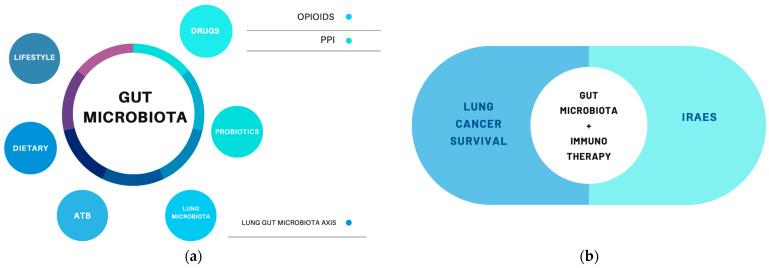
Despite the recent availability of immune checkpoint inhibitors, not all patients affected by Non-Small-Cell Lung Cancer (NSCLC) benefit from immunotherapy. The reason for this variability relies on a variety of factors which may allow for the identification of novel biomarkers. Presently, a variety of biomarkers are under investigation, including the PD1/PDL1 axis, the tumor mutational burden, and the microbiota. The latter is made by all the bacteria and other microorganisms hosted in our body. The gut microbiota is the most represented and has been involved in different physiological and pathological events, including cancer. In this light, it appears that all conditions modifying the gut microbiota can influence cancer, its treatment, and its treatment-related toxicities. The aim of this review is to analyze all the conditions influencing the gut microbiota and, therefore, affecting the response to immunotherapy, iRAEs, and their management in NSCLC patients. The investigation of the landscape of these biological events can allow for novel insights into the optimal management of NSCLC immunotherapy.
尽管近期免疫检查点抑制剂已可获得,但并非所有非小细胞肺癌(NSCLC)患者都能从免疫治疗中获益。这种差异的原因取决于多种因素,这些因素可能有助于识别新的生物标志物。目前,多种生物标志物正在研究中,包括PD1/PDL1轴、肿瘤突变负荷和微生物群。后者由我们体内存在的所有细菌和其他微生物组成。肠道微生物群最为典型,并且已参与不同的生理和病理事件,包括癌症。有鉴于此,似乎所有改变肠道微生物群的状况都可影响癌症、其治疗以及与治疗相关的毒性。本综述的目的是分析所有影响肠道微生物群并因此影响NSCLC患者对免疫治疗的反应、免疫相关不良反应(iRAEs)及其管理的状况。对这些生物学事件全貌的研究可以为NSCLC免疫治疗的优化管理提供新的见解。

 Zotero 插件