
探索生物炭的负排放潜力以实现中国的碳中和目标。
Exploring negative emission potential of biochar to achieve carbon neutrality goal in China.
作者信息
Deng Xu, Teng Fei, Chen Minpeng, Du Zhangliu, Wang Bin, Li Renqiang, Wang Pan
机构信息
Institute of Energy, Environment and Economy, Tsinghua University, Beijing, 100084, China.
School of Agricultural Economics and Rural Development, Renmin University of China, Beijing, 100872, China.
出版信息
Nat Commun. 2024 Feb 5;15(1):1085. doi: 10.1038/s41467-024-45314-y.
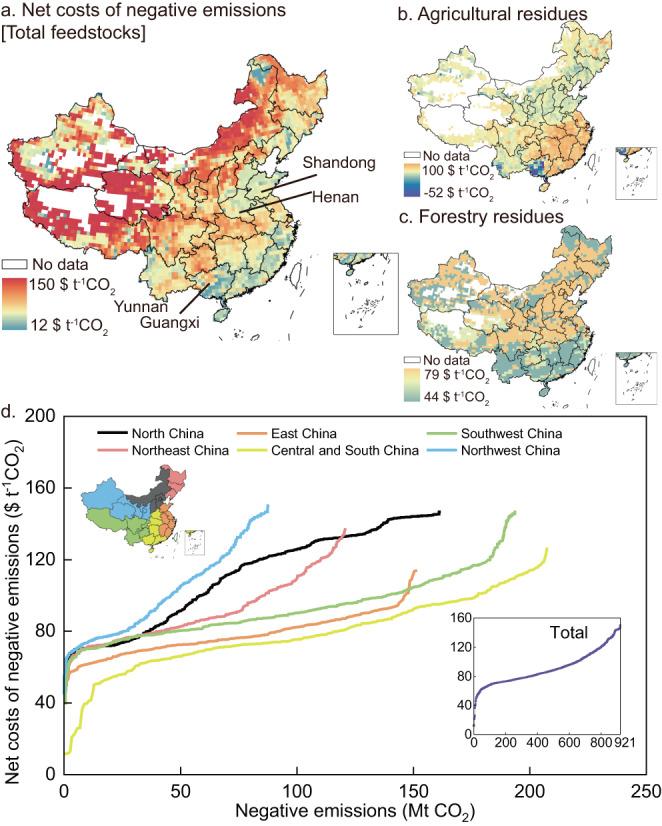
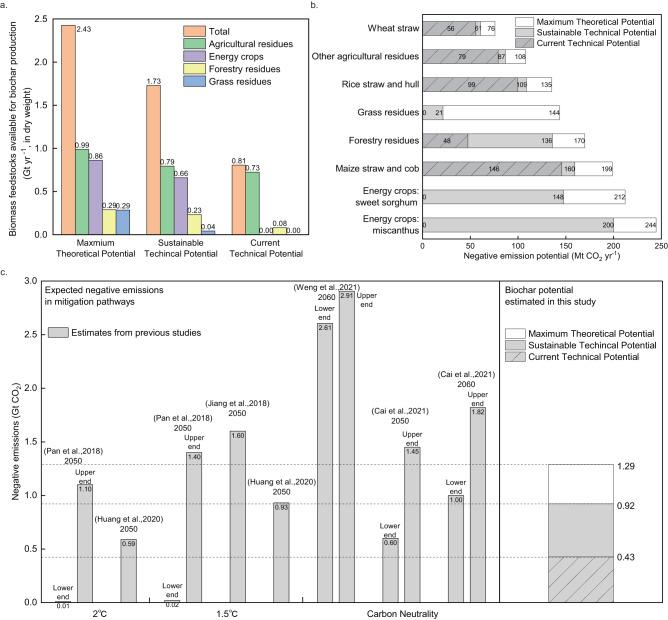
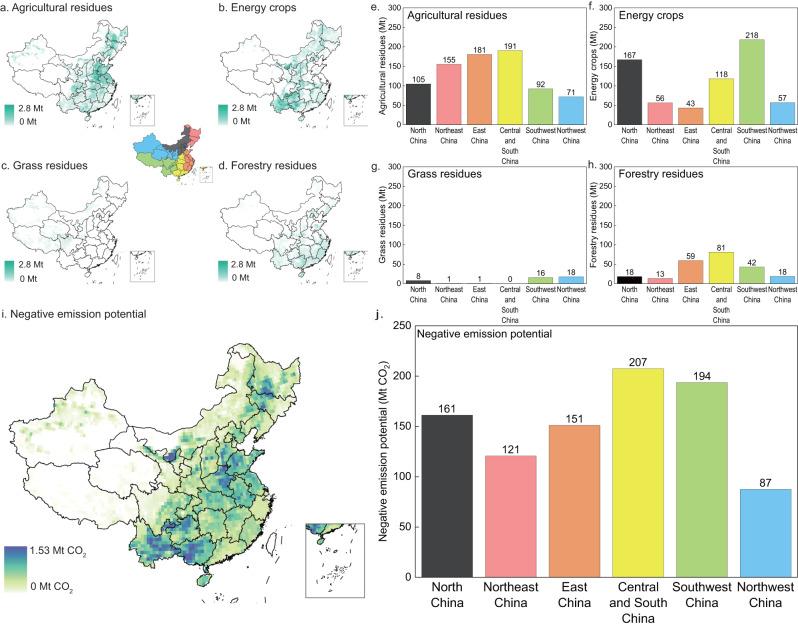
Limiting global warming to within 1.5 °C might require large-scale deployment of premature negative emission technologies with potentially adverse effects on the key sustainable development goals. Biochar has been proposed as an established technology for carbon sequestration with co-benefits in terms of soil quality and crop yield. However, the considerable uncertainties that exist in the potential, cost, and deployment strategies of biochar systems at national level prevent its deployment in China. Here, we conduct a spatially explicit analysis to investigate the negative emission potential, economics, and priority deployment sites of biochar derived from multiple feedstocks in China. Results show that biochar has negative emission potential of up to 0.92 billion tons of CO per year with an average net cost of US$90 per ton of CO in a sustainable manner, which could satisfy the negative emission demands in most mitigation scenarios compatible with China's target of carbon neutrality by 2060.
将全球变暖限制在1.5°C以内可能需要大规模部署尚不成熟的负排放技术,这可能会对关键的可持续发展目标产生不利影响。生物炭被认为是一种成熟的碳固存技术,对土壤质量和作物产量有协同效益。然而,生物炭系统在国家层面的潜力、成本和部署策略方面存在相当大的不确定性,这阻碍了其在中国的部署。在此,我们进行了一项空间明确的分析,以研究中国多种原料来源的生物炭的负排放潜力、经济性和优先部署地点。结果表明,生物炭每年具有高达9.2亿吨二氧化碳的负排放潜力,以可持续方式计算,平均每吨二氧化碳的净成本为90美元,这可以满足大多数与中国到2060年碳中和目标相符的减排情景中的负排放需求。

 Zotero 插件