
人类细胞存活和增殖对半胱天冬酶3前结构域的依赖性。
Dependence of human cell survival and proliferation on the CASP3 prodomain.
作者信息
Eskandari Ebrahim, Negri Gian Luca, Tan Susanna, MacAldaz Margarita E, Ding Shengsen, Long Justin, Nielsen Karina, Spencer Sandra E, Morin Gregg B, Eaves Connie J
机构信息
Terry Fox Laboratory, British Columbia Cancer Research Institute, Vancouver, BC, Canada.
Department of Medical Genetics, University of British Columbia, Vancouver, BC, Canada.
出版信息
Cell Death Discov. 2024 Feb 6;10(1):63. doi: 10.1038/s41420-024-01826-6.
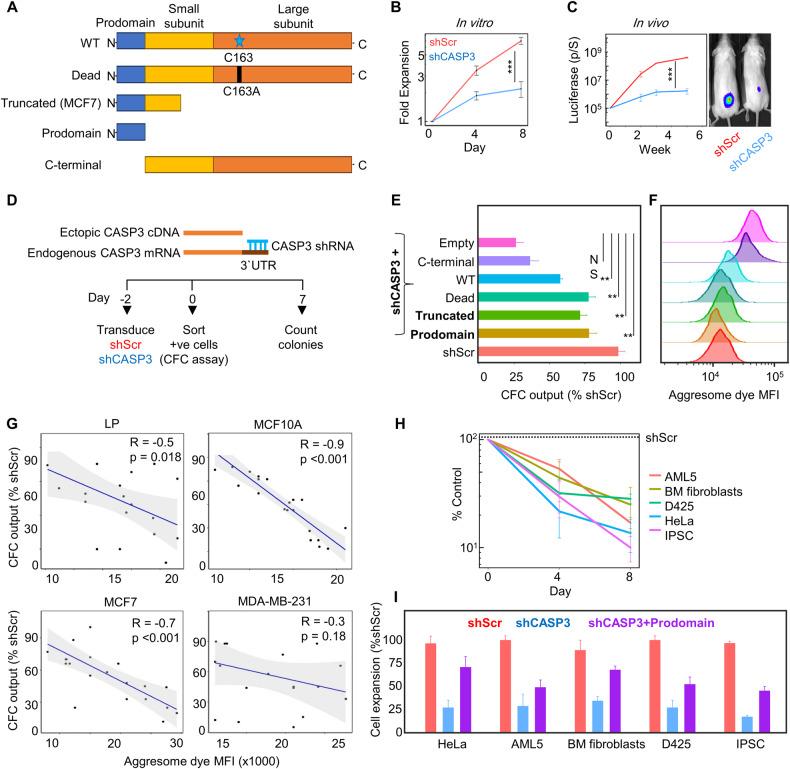
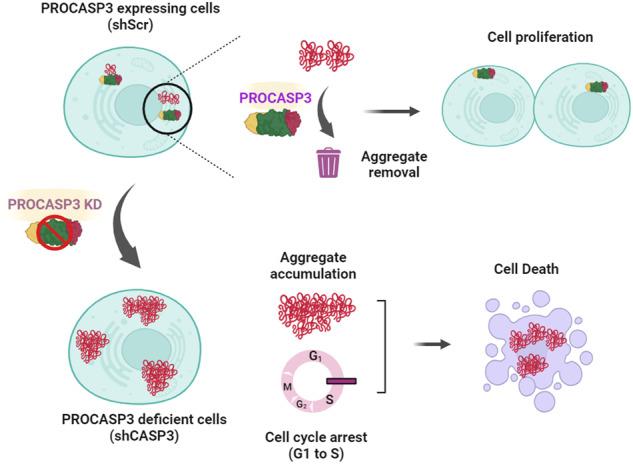
Mechanisms that regulate cell survival and proliferation are important for both the development and homeostasis of normal tissue, and as well as for the emergence and expansion of malignant cell populations. Caspase-3 (CASP3) has long been recognized for its proteolytic role in orchestrating cell death-initiated pathways and related processes; however, whether CASP3 has other functions in mammalian cells that do not depend on its known catalytic activity have remained unknown. To investigate this possibility, we examined the biological and molecular consequences of reducing CASP3 levels in normal and transformed human cells using lentiviral-mediated short hairpin-based knockdown experiments in combination with approaches designed to test the potential rescue capability of different components of the CASP3 protein. The results showed that a ≥50% reduction in CASP3 levels rapidly and consistently arrested cell cycle progression and survival in all cell types tested. Mass spectrometry-based proteomic analyses and more specific flow cytometric measurements strongly implicated CASP3 as playing an essential role in regulating intracellular protein aggregate clearance. Intriguingly, the rescue experiments utilizing different forms of the CASP3 protein showed its prosurvival function and effective removal of protein aggregates did not require its well-known catalytic capability, and pinpointed the N-terminal prodomain of CASP3 as the exclusive component needed in a diversity of human cell types. These findings identify a new mechanism that regulates human cell survival and proliferation and thus expands the complexity of how these processes can be controlled. The graphical abstract illustrates the critical role of CASP3 for sustained proliferation and survival of human cells through the clearance of protein aggregates.
调节细胞存活和增殖的机制对于正常组织的发育和稳态以及恶性细胞群体的出现和扩增都很重要。长期以来,半胱天冬酶-3(CASP3)因其在协调细胞死亡起始途径及相关过程中的蛋白水解作用而被人们所认识;然而,CASP3在哺乳动物细胞中是否具有不依赖其已知催化活性的其他功能仍不清楚。为了探究这种可能性,我们使用慢病毒介导的基于短发夹的敲低实验,并结合旨在测试CASP3蛋白不同组分潜在挽救能力的方法,研究了降低正常和转化人细胞中CASP3水平的生物学和分子学后果。结果表明,在所有测试的细胞类型中,CASP3水平降低≥50%会迅速且持续地阻止细胞周期进程和细胞存活。基于质谱的蛋白质组学分析以及更具特异性的流式细胞术测量结果有力地表明,CASP3在调节细胞内蛋白质聚集体清除中起关键作用。有趣的是,利用不同形式的CASP3蛋白进行的挽救实验表明,其促存活功能以及有效清除蛋白质聚集体并不需要其众所周知的催化能力,并确定了CASP3的N端前结构域是多种人类细胞类型中唯一需要的组分。这些发现确定了一种调节人类细胞存活和增殖的新机制,从而扩展了这些过程调控方式的复杂性。图形摘要说明了CASP3通过清除蛋白质聚集体对人类细胞持续增殖和存活的关键作用。


 Zotero 插件