
基于 Venetoclax 的治疗方案用于伴有 FLT3 突变的急性髓系白血病患者:临床和遗传特征预测其结局。
Clinical and genetic characteristics predict outcomes of acute myeloid leukemia patients with FLT3 mutations receiving venetoclax-based therapy.
机构信息
Department of Hematology and Shenzhen Bone Marrow Transplantation Public Service Platform, The First Affiliated Hospital of Shenzhen University, Shenzhen Second People's Hospital, Shenzhen, China.
Shenzhen Blood Center, Shenzhen, Guangdong, China.
出版信息
Cancer Med. 2024 Jan;13(2):e6885. doi: 10.1002/cam4.6885.
BACKGROUND
Acute myeloid leukemia (AML) is a heterogeneous disease, and its heterogeneity is associated with treatment response. Despite the demonstrated success of venetoclax (VEN)-based therapy for AML, the effect of FLT3 mutations on the efficacy of the therapy is poorly understood. We aimed to compare the efficacy of VEN-based therapy between FLT3-mutated (FLT3 ) and FLT3 wild-type (FLT3 ) patients and identify the predictors of efficacy in FLT3 patients.
METHODS
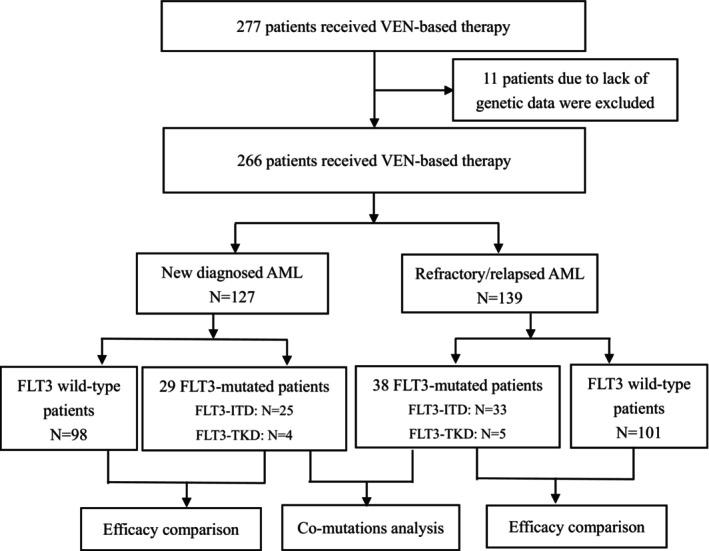
A total of 266 AML patients (127 newly diagnosed [ND] and 139 refractory/relapsed [R/R]) receiving VEN-based regimens were enrolled in this study. A retrospective analysis was performed, and the treatment responses and overall survival (OS) of FLT3 and FLT3 patients were compared. Logistic regression and Cox proportional hazards model were applied to examine the clinical and genetic predictors of outcomes.
RESULTS
With a median of two cycles of VEN-based therapy, for the ND AML cohort, the FLT3 group had a comparable composite complete remission (CRc) rate with the FLT3 group (79.3% vs. 61.2%, p = 0.072). For the R/R AML cohort, the FLT3 group exhibited a lower CRc rate than the FLT3 group. With a median follow-up of 8.6 months (95% confidence interval [CI], 8.0-10), the median OS observed in the FLT3 and FLT3 groups for both cohorts were close (14.0 vs. 19.9 months, p = 0.356; 10.0 vs. 11.9 months, p = 0.680). For the ND AML cohort, in FLT3 patients, MRD-positive and RNA-splicing mutation predicted inferior survival (hazard ratio [HR], 10.3; 95% CI: 2.0-53.8; p = 0.006; HR 11.3; 95% CI: 1.2-109.3; p = 0.036, respectively). For the R/R AML cohort, in FLT3 patients, adverse ELN risk was associated with an inferior response (odds ratio [OR], 0.2; 95% CI: 0.1-0.8; p = 0.025), whereas NPM1 co-mutation was associated with a superior response (57.1%; OR, 6.7; 95% CI: 1.5-30.1; p = 0.014). CR/CRi predicted a better survival (HR 0.2; 95% CI: 0.1-0.8; p = 0.029), while DNMT3A mutation predicted an inferior survival (HR, 4.6; 95% CI: 1.4-14.9; p = 0.011).
CONCLUSIONS
FLT3 mutations may influence response to VEN-based therapy in R/R AML patients but not in ND AML patients. Furthermore, clinical and genetic characteristics could predict outcomes of FLT3 patients receiving VEN-based therapy.
背景
急性髓系白血病(AML)是一种异质性疾病,其异质性与治疗反应相关。尽管基于 venetoclax(VEN)的治疗在 AML 中取得了显著成功,但 FLT3 突变对该治疗效果的影响仍知之甚少。我们旨在比较 FLT3 突变(FLT3 )和 FLT3 野生型(FLT3 )患者接受 VEN 为基础的治疗的疗效,并确定 FLT3 患者疗效的预测因素。
方法
共纳入 266 例接受 VEN 为基础方案治疗的 AML 患者(127 例初诊[ND]和 139 例难治/复发[R/R])。对这些患者进行回顾性分析,比较 FLT3 和 FLT3 患者的治疗反应和总生存(OS)。应用逻辑回归和 Cox 比例风险模型来检验结局的临床和遗传预测因素。
结果
在接受 VEN 为基础治疗的 ND AML 队列中,中位治疗两个周期后,FLT3 组的复合完全缓解(CRc)率与 FLT3 组相当(79.3% vs. 61.2%,p=0.072)。在 R/R AML 队列中,FLT3 组的 CRc 率低于 FLT3 组。中位随访 8.6 个月(95%置信区间[CI],8.0-10),FLT3 和 FLT3 两组患者的中位 OS 均相近(14.0 与 19.9 个月,p=0.356;10.0 与 11.9 个月,p=0.680)。在 ND AML 队列中,FLT3 患者中,MRD 阳性和 RNA 剪接突变预示着较差的生存(风险比[HR],10.3;95%CI:2.0-53.8;p=0.006;HR 11.3;95%CI:1.2-109.3;p=0.036)。在 R/R AML 队列中,FLT3 患者中,不良 ELN 风险与较差的反应相关(比值比[OR],0.2;95%CI:0.1-0.8;p=0.025),而 NPM1 共突变与较好的反应相关(57.1%;OR,6.7;95%CI:1.5-30.1;p=0.014)。CR/CRi 预示着更好的生存(HR 0.2;95%CI:0.1-0.8;p=0.029),而 DNMT3A 突变预示着较差的生存(HR,4.6;95%CI:1.4-14.9;p=0.011)。
结论
FLT3 突变可能影响 R/R AML 患者接受 VEN 为基础治疗的反应,但不影响 ND AML 患者。此外,临床和遗传特征可以预测接受 VEN 为基础治疗的 FLT3 患者的结局。



 Zotero 插件