
新鲜父母亲乳喂养早产儿:障碍与未来机遇。
Fresh Parent's Own Milk for Preterm Infants: Barriers and Future Opportunities.
机构信息
Elaine Marieb College of Nursing, University of Massachusetts Amherst, Amherst, MA 01003, USA.
Institute of Nursing Research and Evidence-Based Practice, Connecticut Children's, Hartford, CT 06106, USA.
出版信息
Nutrients. 2024 Jan 26;16(3):362. doi: 10.3390/nu16030362.
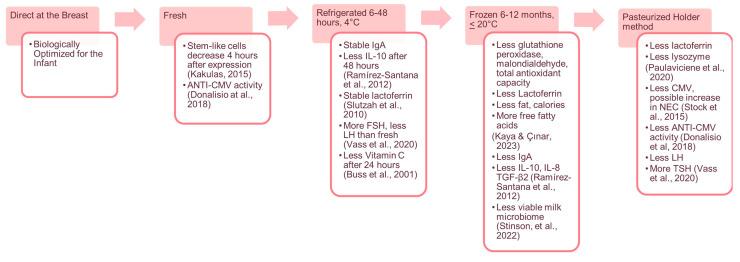
While direct at-the-breast feeding is biologically optimal, Neonatal Intensive Care Unit (NICU) admission due to infant immaturity or illness often necessitates the expression and storage of parent's milk. The provision of freshly expressed (never stored) parent's own milk to preterm infants is not widely prioritized, and this article provides an exploration of NICU practices and their implications for feeding premature or ill infants with parent's own milk. In this article, we discuss the potential biological benefits of fresh parent's own milk, highlighting its dynamic components and the changes incurred during storage. Research suggests that fresh milk may offer health advantages over stored milk. The authors advocate for further research, emphasizing the need for standardized definitions. Research is needed on the biological impact of fresh milk, both short- and long-term, as well as defining and understanding healthcare economics when using fresh milk.
虽然直接亲喂在生物学上是最佳的,但由于婴儿不成熟或患病而入住新生儿重症监护病房(NICU)通常需要挤出并储存父母的乳汁。向早产儿提供新鲜挤出(从未储存过)的父母自己的乳汁并没有得到广泛重视,本文探讨了 NICU 的实践及其对用父母自己的乳汁喂养早产儿或患病婴儿的影响。在本文中,我们讨论了新鲜父母自己的乳汁可能带来的潜在生物学益处,强调了其动态成分以及在储存过程中发生的变化。研究表明,新鲜的母乳可能比储存的母乳更具健康优势。作者主张进行更多的研究,强调需要标准化定义。需要研究新鲜母乳的短期和长期生物学影响,以及在使用新鲜母乳时定义和理解医疗保健经济学。
 Zotero 插件