
DNA 与含 1,10-菲咯啉的 Cd(II)配位化合物的相互作用。
DNA Interaction with Coordination Compounds of Cd(II)containing 1,10-Phenanthroline.
机构信息
Faculty of Physics, Saint Petersburg State University, 199034 Saint Petersburg, Russia.
I.V. Grebenshchikov Institute of Silicate Chemistry, Russian Academy of Sciences, 194021 Saint Petersburg, Russia.
出版信息
Int J Mol Sci. 2024 Feb 2;25(3):1820. doi: 10.3390/ijms25031820.
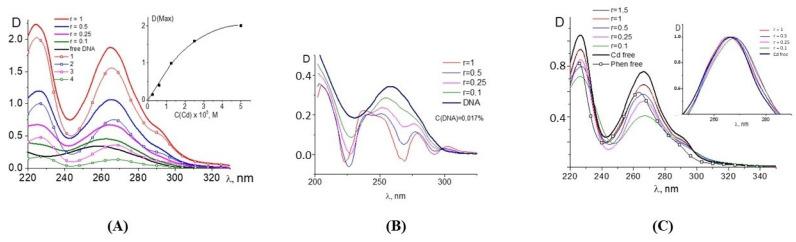
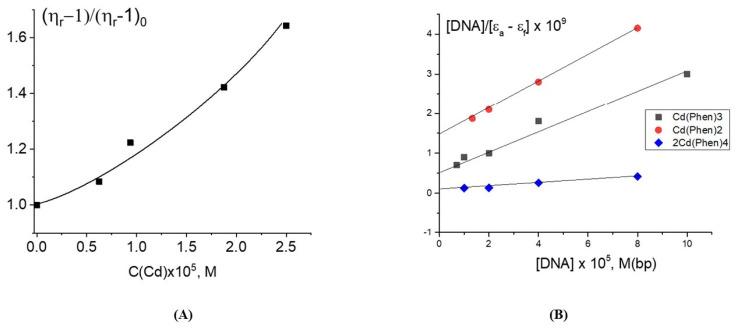
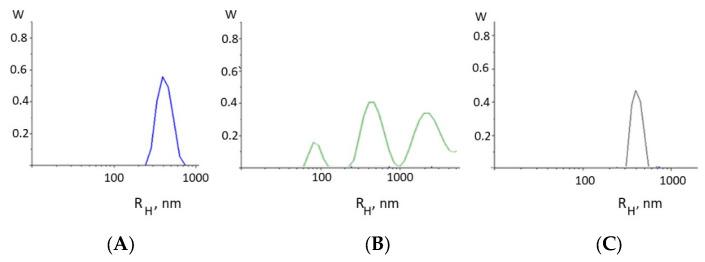
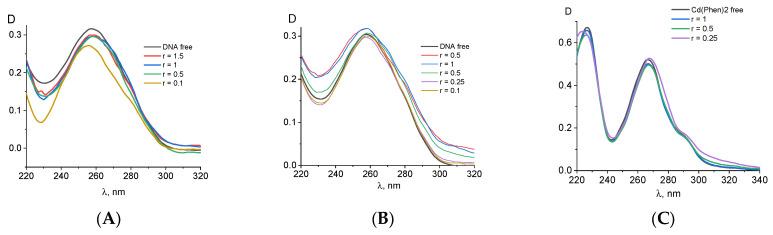
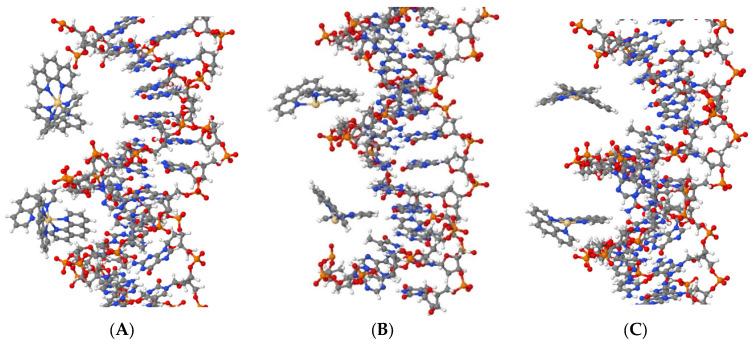
The experimental study of the DNA interaction with three cadmium coordination compounds Cd(phen), Cd(phen)(HO), and Cd(phen)(HO) was carried out using spectrophotometry, viscosity, and dynamic light scattering methods. The role of the solution ionic strength (concentration of NaCl) was analyzed. All compounds can penetrate (fully or partly) to the major or minor DNA grooves. It was shown that, in addition to the important role of electrostatic interactions in the formation of the complex, intercalation of the 1,10-phenanthroline ligand occurs for compounds Cd(phen)(HO) and Cd(phen)(HO). Compound Cd(phen) binds to DNA externally. The coordination bond between cadmium and DNA was formed in DNA complexes with Cd(phen)(HO). Preliminary computer modeling of the DNA interaction with the compounds used was performed.
采用分光光度法、粘度法和动态光散射法研究了三种镉配合物Cd(phen)、Cd(phen)(HO)和Cd(phen)(HO)与 DNA 的相互作用。分析了溶液离子强度(NaCl 浓度)的作用。所有化合物都可以(完全或部分)穿透 DNA 的大沟或小沟。结果表明,除了静电相互作用在配合物形成中起重要作用外,对于Cd(phen)(HO)和Cd(phen)(HO)化合物,1,10-邻菲啰啉配体发生了插入。化合物Cd(phen)与 DNA 外部结合。在与Cd(phen)(HO)形成的 DNA 配合物中形成了镉与 DNA 的配位键。对所使用的化合物与 DNA 的相互作用进行了初步的计算机建模。




 Zotero 插件