
美国按性别、年龄和种族划分的肝细胞癌发病率和死亡率:二十年全国性分析
Hepatocellular Carcinoma Incidence and Mortality in the USA by Sex, Age, and Race: A Nationwide Analysis of Two Decades.
作者信息
Abboud Yazan, Ismail Mohamed, Khan Hamza, Medina-Morales Esli, Alsakarneh Saqr, Jaber Fouad, Pyrsopoulos Nikolaos T
机构信息
Department of Internal Medicine, Rutgers New Jersey Medical School, Newark, NJ, USA.
Department of Internal Medicine, University of Missouri-Kansas City, Kansas City, MO, USA.
出版信息
J Clin Transl Hepatol. 2024 Feb 28;12(2):172-181. doi: 10.14218/JCTH.2023.00356. Epub 2024 Jan 2.
BACKGROUND AND AIMS
While the incidence rates of hepatocellular carcinoma (HCC) are increasing, there are limited comprehensive data on demographic-specific incidence and mortality trends in the USA. We aimed to evaluate recent trends in HCC incidence and mortality among different demographic groups in the USA.
METHODS
Age-adjusted HCC incidence rates were calculated from the Centers for Disease Control's United States Cancer Statistics database, which combines incidence data on newly diagnosed cancer cases and covers approximately 98% of the population in the USA. Additionally, age-adjusted HCC mortality rates were obtained from the Centers for Disease Control's National Center for Health Statistics database, which offers comprehensive coverage spanning nearly 100% of deaths attributed to HCC in the USA. Rates were stratified by sex, age (older [≥55 years] and younger [<55 years] adults), race and ethnicity (Non-Hispanic White, Non-Hispanic Black, Hispanic, Non-Hispanic Asian/Pacific Islander, and Non-Hispanic American Indian/Alaska Native), and tumor stage at diagnosis (early and late). Annual and average annual percentage change (AAPC) were calculated using joinpoint regression. A sex-specific pairwise comparison was conducted.
RESULTS
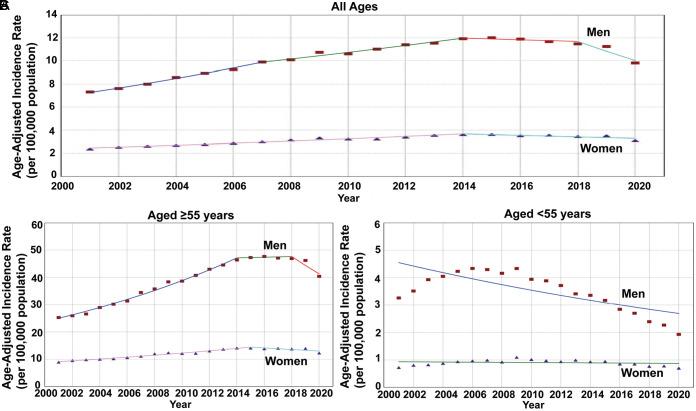
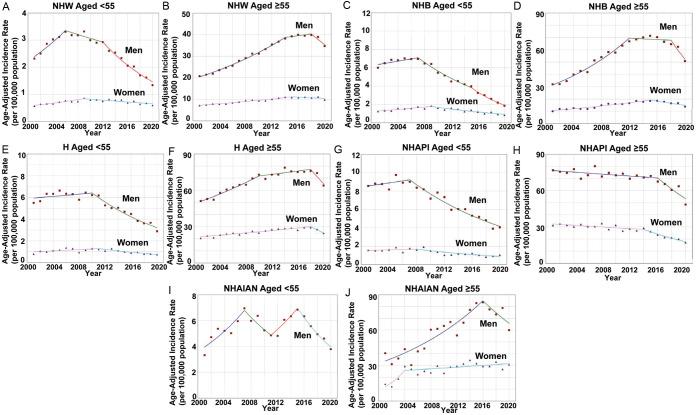
Between 2001 and 2020, there were 467,346 patients diagnosed with HCC (26.0% women), with increasing incidence in both sexes without significant difference (=0.65). In younger adults (78,169 patients), the incidence decreased in men but not in women (AAPC difference=-2.39, =0.002). This was seen in various racial and ethnic groups, mostly driven by early-stage tumors (AAPC difference=-2.65, =0.02). There were 329,973 deaths attributed to HCC between 2000 and 2020 (28.4% women). In younger adults (43,093 deaths), mortality decreased in men at a greater rate than in women (AAPC difference=1.61, =0.007). This was seen in various racial and ethnic groups, most notably in non-Hispanic American Indian/Alaska Natives (AAPC difference=-4.51, =0.01).
CONCLUSIONS
Nationwide USA data, covering nearly all HCC cases, show an increasing incidence and mortality over the last two decades. In younger adults, there was a decreasing incidence in men but not in women, due to early-stage tumors. Mortality improved in younger men at a greater rate than in women, especially in Non-Hispanic American Indian/Alaska Natives. Future studies are warranted to identify the risk factors associated with the occurrence and outcomes of HCC in demographic-specific populations, especially younger women.
背景与目的
虽然肝细胞癌(HCC)的发病率在上升,但美国关于特定人群发病率和死亡率趋势的综合数据有限。我们旨在评估美国不同人群中HCC发病率和死亡率的近期趋势。
方法
年龄调整后的HCC发病率根据疾病控制中心的美国癌症统计数据库计算得出,该数据库整合了新诊断癌症病例的发病率数据,覆盖了美国约98%的人口。此外,年龄调整后的HCC死亡率来自疾病控制中心的国家卫生统计中心数据库,该数据库全面涵盖了美国近100%归因于HCC的死亡病例。发病率按性别、年龄(年龄较大[≥55岁]和年龄较小[<55岁]的成年人)、种族和族裔(非西班牙裔白人、非西班牙裔黑人、西班牙裔、非西班牙裔亚裔/太平洋岛民以及非西班牙裔美国印第安人/阿拉斯加原住民)以及诊断时的肿瘤分期(早期和晚期)进行分层。使用Joinpoint回归计算年度和平均年度百分比变化(AAPC)。进行了性别特异性的成对比较。
结果
2001年至2020年期间,共有467,346例患者被诊断为HCC(女性占26.0%),男女发病率均呈上升趋势,无显著差异(P=0.65)。在年龄较小的成年人(78,169例患者)中,男性发病率下降,而女性未下降(AAPC差异=-2.39,P=0.002)。这在各种种族和族裔群体中均有体现,主要由早期肿瘤驱动(AAPC差异=-2.65,P=0.02)。2000年至2020年期间,共有329,973例死亡归因于HCC(女性占28.4%)。在年龄较小的成年人(43,093例死亡)中,男性死亡率下降速度高于女性(AAPC差异=1.61,P=0.007)。这在各种种族和族裔群体中均有体现,最明显的是在非西班牙裔美国印第安人/阿拉斯加原住民中(AAPC差异=-4.51,P=0.01)。
结论
覆盖几乎所有HCC病例的美国全国数据显示,在过去二十年中发病率和死亡率均呈上升趋势。在年龄较小的成年人中,由于早期肿瘤,男性发病率下降,而女性未下降。年龄较小的男性死亡率改善速度高于女性,尤其是在非西班牙裔美国印第安人/阿拉斯加原住民中。有必要开展进一步研究,以确定特定人群中与HCC发生和转归相关的危险因素,尤其是年龄较小的女性。


 Zotero 插件