
多学科、初级保健管理计划中糖尿病患者的痴呆风险。
Risk of Dementia Among Patients With Diabetes in a Multidisciplinary, Primary Care Management Program.
机构信息
Centre for Health Systems and Policy Research, Jockey Club School of Public Health and Primary Care, Faculty of Medicine, The Chinese University of Hong Kong, Hong Kong, China.
School of Public Health, Tianjin Medical University, Tianjin, China.
出版信息
JAMA Netw Open. 2024 Feb 5;7(2):e2355733. doi: 10.1001/jamanetworkopen.2023.55733.
IMPORTANCE
Although poorly controlled diabetes is associated with a higher incidence of dementia, few studies have examined the association of diabetes management interventions with dementia incidence.
OBJECTIVE
To examine the association of receiving a multidisciplinary diabetes management program (the Risk Assessment and Management Program-Diabetes Mellitus [RAMP-DM]) that enables better glycemic control with subsequent risk of dementia incidence and the association of dementia with glycemic control.
DESIGN, SETTING, AND PARTICIPANTS: This territory-wide, retrospective, matched cohort study with more than 8 years of follow-up was conducted using electronic health care records from all the patients who used public health care services in Hong Kong from 2011 to 2019. Eligible participants included all patients with type 2 diabetes (T2D) who were managed in primary care settings. Patients who received RAMP-DM were matched in a 1:1 ratio with patients who received usual care only. Data analysis occurred from April 2023 to July 2023.
EXPOSURES
Diagnosis of T2D, hemoglobin A1C (HbA1C) level, and attendance at a general outpatient clinic or family medicine clinic. Patients received either RAMP-DM or usual care.
MAIN OUTCOMES AND MEASURES
Incidence of all-cause dementia and subtypes of dementia were compared between the RAMP-DM and usual care participants using a Cox proportional hazard model with other baseline characteristics, biomarkers, and medication history adjusted. HbA1C levels were measured as a secondary outcome.
RESULTS
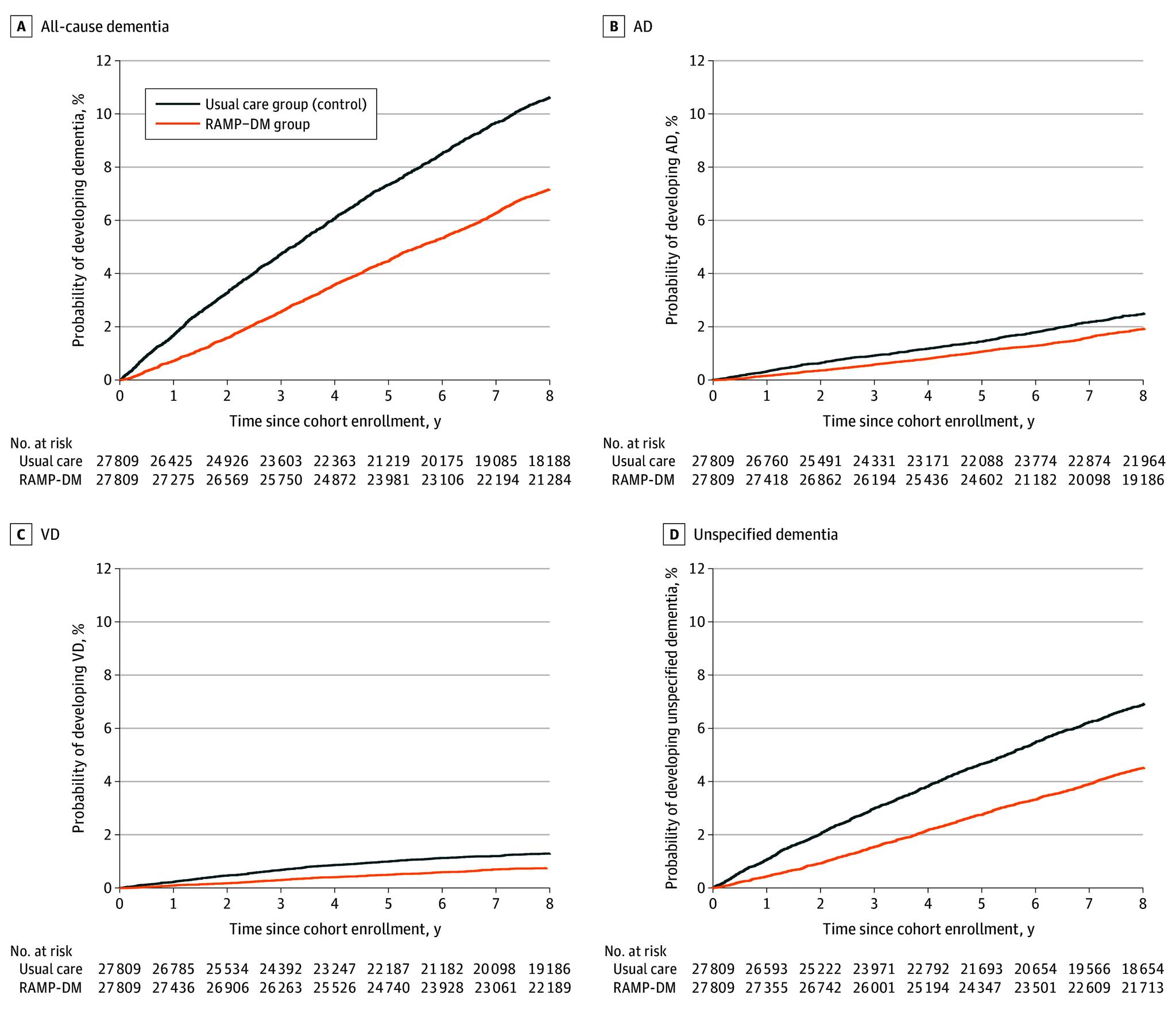
Among the 55 618 matched participants (mean [SD] age, 62.28 [11.90] years; 28 561 female [51.4%]; 27 057 male [48.6%]), including the 27 809 patients in the RAMP-DM group and 27 809 patients in the usual care group, patients had been diagnosed with T2D for a mean (SD) of 5.90 (4.20) years. During a median (IQR) follow-up period of 8.4 (6.8-8.8) years, 1938 patients in the RAMP-DM group (6.97%) and 2728 patients in the usual care group (9.81%) received a diagnosis of dementia. Compared with those receiving usual care, RAMP-DM participants had a lower risk of developing all-cause dementia (adjusted hazard ratio [aHR], 0.72; 95% CI, 0.68-0.77; P < .001), Alzheimer disease (aHR, 0.85; 95% CI, 0.76-0.96; P = .009), vascular dementia (aHR, 0.61; 95% CI, 0.51-0.73; P < .001), and other or unspecified dementia (aHR, 0.71; 95% CI, 0.66-0.77; P < .001). Compared with having a mean HbA1C level during the first 3 years after cohort entry between 6.5% and 7.5%, a higher risk of dementia incidence was detected for patients with a 3-year mean HbA1C level greater than 8.5% (aHR, 1.54; 95% CI, 1.31-1.80]), between 7.5% and 8.5% (aHR, 1.33; 95% CI, 1.19-1.48), between 6% and 6.5% (aHR, 1.17; 95% CI, 1.07-1.29), and 6% or less (aHR, 1.39; 95% CI, 1.24-1.57).
CONCLUSIONS AND RELEVANCE
In this cohort study of patients with T2D, the findings strengthened evidence of an association of glycemic control with dementia incidence, and revealed that a multidisciplinary primary care diabetes management program was associated with beneficial outcomes for T2D patients against dementia and its major subtypes. A moderate glycemic control target of HbA1C between 6.5% and 7.5% was associated with lower dementia incidence.
重要性:尽管控制不佳的糖尿病与痴呆症的发病率较高有关,但很少有研究探讨糖尿病管理干预与痴呆症发病率之间的关系。
目的:研究接受多学科糖尿病管理方案(风险评估和管理计划-糖尿病[RAMP-DM])与随后的痴呆症发病率风险之间的关系,以及痴呆症与血糖控制之间的关系,该方案可实现更好的血糖控制。
设计、地点和参与者:这是一项回顾性、匹配队列研究,随访时间超过 8 年,使用香港所有使用公共医疗保健服务的患者的电子医疗记录进行。合格的参与者包括在初级保健环境中接受管理的所有 2 型糖尿病(T2D)患者。接受 RAMP-DM 的患者与仅接受常规护理的患者进行 1:1 匹配。数据分析于 2023 年 4 月至 2023 年 7 月进行。
暴露:T2D 的诊断、血红蛋白 A1C(HbA1C)水平以及在普通门诊或家庭医学诊所就诊。患者接受 RAMP-DM 或常规护理。
主要结果和措施:使用 Cox 比例风险模型比较 RAMP-DM 和常规护理参与者的全因痴呆症和痴呆症亚型的发病率,该模型调整了其他基线特征、生物标志物和药物治疗史。测量 HbA1C 水平作为次要结果。
结果:在 55618 名匹配参与者(平均[SD]年龄,62.28[11.90]岁;女性 28561 名[51.4%];男性 27057 名[48.6%])中,包括 27809 名 RAMP-DM 组患者和 27809 名常规护理组患者,患者被诊断为 T2D 的平均(SD)时间为 5.90(4.20)年。在中位数(IQR)随访期间为 8.4(6.8-8.8)年期间,RAMP-DM 组 1938 名患者(6.97%)和常规护理组 2728 名患者(9.81%)被诊断为痴呆症。与接受常规护理的患者相比,RAMP-DM 组参与者发生全因痴呆症的风险较低(调整后的危险比[aHR],0.72;95%CI,0.68-0.77;P<.001)、阿尔茨海默病(aHR,0.85;95%CI,0.76-0.96;P=0.009)、血管性痴呆(aHR,0.61;95%CI,0.51-0.73;P<.001)和其他或未指定的痴呆(aHR,0.71;95%CI,0.66-0.77;P<.001)。与入组后前 3 年的平均 HbA1C 水平在 6.5%至 7.5%之间相比,发现 3 年平均 HbA1C 水平大于 8.5%(aHR,1.54;95%CI,1.31-1.80])、7.5%至 8.5%(aHR,1.33;95%CI,1.19-1.48])、6%至 6.5%(aHR,1.17;95%CI,1.07-1.29])和 6%或更低(aHR,1.39;95%CI,1.24-1.57)的患者痴呆症发病风险更高。
结论和相关性:在这项针对 T2D 患者的队列研究中,研究结果强化了血糖控制与痴呆症发病率之间存在关联的证据,并表明多学科初级保健糖尿病管理方案与降低 T2D 患者的痴呆症及其主要亚型的发生风险相关。HbA1C 介于 6.5%至 7.5%之间的中等血糖控制目标与痴呆症发病率降低相关。
 Zotero 插件