
强化多因素干预在 2 型糖尿病患者中的应用。
Intensified Multifactorial Intervention in Patients with Type 2 Diabetes Mellitus.
机构信息
Department of Diabetes and Metabolic Diseases, Graduate School of Medicine, The University of Tokyo, Tokyo, Japan.
Diabetes Research Center, Research Institute, National Center for Global Health and Medicine, Tokyo, Japan.
出版信息
Diabetes Metab J. 2023 Mar;47(2):185-197. doi: 10.4093/dmj.2022.0325. Epub 2023 Jan 12.
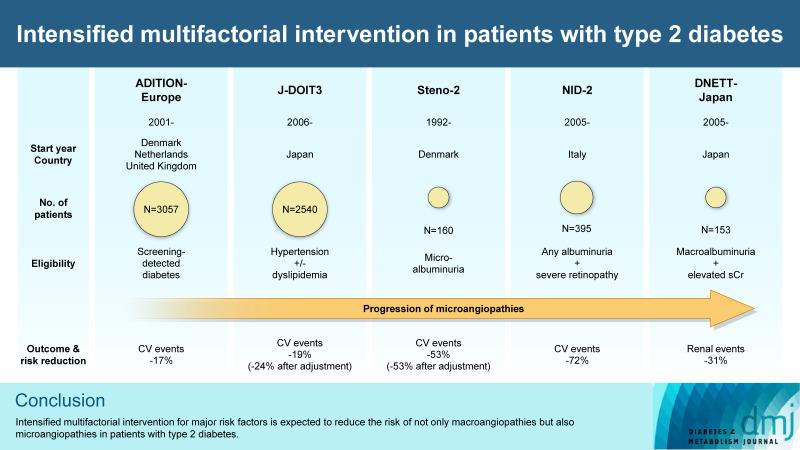
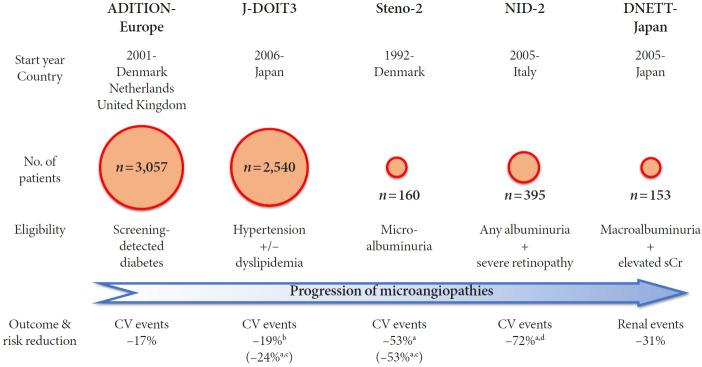
In the management of diabetes mellitus, one of the most important goals is to prevent its micro- and macrovascular complications, and to that end, multifactorial intervention is widely recommended. Intensified multifactorial intervention with pharmacotherapy for associated risk factors, alongside lifestyle modification, was first shown to be efficacious in patients with microalbuminuria (Steno-2 study), then in those with less advanced microvascular complications (the Anglo-Danish-Dutch Study of Intensive Treatment In People with Screen Detected Diabetes in Primary Care [ADDITION]-Europe and the Japan Diabetes Optimal Treatment study for 3 major risk factors of cardiovascular diseases [J-DOIT3]), and in those with advanced microvascular complications (the Nephropathy In Diabetes-Type 2 [NID-2] study and Diabetic Nephropathy Remission and Regression Team Trial in Japan [DNETT-Japan]). Thus far, multifactorial intervention led to a reduction in cardiovascular and renal events, albeit not necessarily significant. It should be noted that not only baseline characteristics but also the control status of the risk factors and event rates during intervention among the patients widely varied from one trial to the next. Further evidence is needed for the efficacy of multifactorial intervention in a longer duration and in younger or elderly patients. Moreover, now that new classes of antidiabetic drugs are available, it should be addressed whether strict and safe glycemic control, alongside control of other risk factors, could lead to further risk reductions in micro- and macrovascular complications, thereby decreasing all-cause mortality in patients with type 2 diabetes mellitus.
在糖尿病管理中,最重要的目标之一是预防其微血管和大血管并发症,为此,广泛推荐多因素干预。强化多因素干预,包括针对相关危险因素的药物治疗和生活方式改变,最初在微量白蛋白尿患者(Steno-2 研究)中显示出有效,随后在微血管并发症进展程度较低的患者(丹麦-荷兰-英国初级保健人群中筛查出的糖尿病强化治疗研究[ADDITION]-欧洲和日本心血管疾病 3 大危险因素的最佳治疗研究[J-DOIT3])和微血管并发症进展程度较高的患者(糖尿病 2 型肾病研究[NID-2]和日本糖尿病肾病缓解和回归团队试验[DNETT-Japan])中显示出有效。迄今为止,多因素干预导致心血管和肾脏事件减少,但不一定显著。值得注意的是,不仅是基线特征,而且患者之间的危险因素控制状况和干预期间的事件发生率也因试验而异。需要进一步的证据来证明多因素干预在更长时间内、在年轻或老年患者中的疗效。此外,现在有了新的抗糖尿病药物类别,应该探讨严格和安全的血糖控制以及其他危险因素的控制是否可以进一步降低微血管和大血管并发症的风险,从而降低 2 型糖尿病患者的全因死亡率。

 Zotero 插件