
日本成年人通过各种网络和线下媒体资源寻求饮食和营养信息的流行情况及相关因素:基于网络的横断面研究。
Prevalence and Correlates of Dietary and Nutrition Information Seeking Through Various Web-Based and Offline Media Sources Among Japanese Adults: Web-Based Cross-Sectional Study.
机构信息
Department of Social and Preventive Epidemiology, School of Public Health, The University of Tokyo, Tokyo, Japan.
Department of Nutritional Epidemiology and Behavioural Nutrition, Graduate School of Medicine, The University of Tokyo, Tokyo, Japan.
出版信息
JMIR Public Health Surveill. 2024 Feb 14;10:e54805. doi: 10.2196/54805.
BACKGROUND
The advent of the internet has changed the landscape of available nutrition information. However, little is known about people's information-seeking behavior toward healthy eating and its potential consequences.
OBJECTIVE
We aimed to examine the prevalence and correlates of nutrition information seeking from various web-based and offline media sources.
METHODS
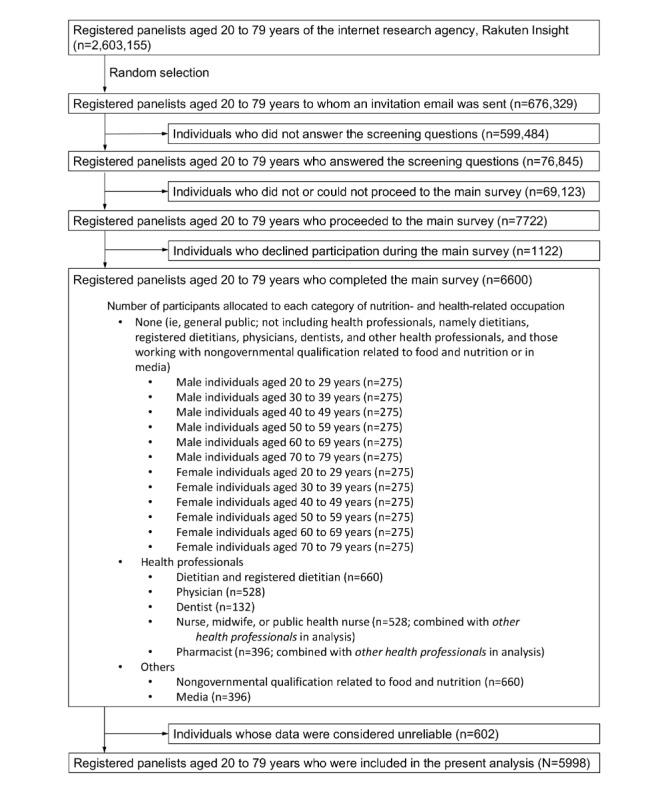
This cross-sectional study included 5998 Japanese adults aged 20 to 79 years participating in a web-based questionnaire survey (February and March 2023). The dependent variable was the regular use of web-based and offline media as a reliable source of nutrition information. The main independent variables included health literacy, food literacy, and diet quality, which were assessed using validated tools, as well as sociodemographic factors (sex, age, education level, and nutrition- and health-related occupations).
RESULTS
The top source of nutrition information was television (1973/5998, 32.89%), followed by web searches (1333/5998, 22.22%), websites of government and medical manufacturers (997/5998, 16.62%), newspapers (901/5998, 15.02%), books and magazines (697/5998, 11.62%), and video sites (eg, YouTube; 634/5998, 10.57%). Multivariable logistic regression showed that higher health literacy was associated with higher odds of using all the individual sources examined; odds ratios (ORs) for 1-point score increase ranged from 1.27 (95% CI 1.09-1.49) to 1.81 (95% CI 1.57-2.09). By contrast, food literacy was inversely associated with the use of television (OR 0.65, 95% CI 0.55-0.77), whereas it was positively associated with the use of websites of government and medical manufacturers (OR 1.98, 95% CI 1.62-2.44), books and magazines (OR 2.09, 95% CI 1.64-2.66), and video sites (OR 1.53, 95% CI 1.19-1.96). Furthermore, diet quality was positively associated with the use of newspapers (OR 1.02, 95% CI 1.01-1.03) and books and magazines (OR 1.03, 95% CI 1.02-1.04). Being female was associated with using television and books and magazines, whereas being male was associated with using websites of government and medical manufacturers, newspapers, and video sites. Age was positively associated with using newspapers and inversely associated with using websites of government and medical manufacturers and video sites. People with higher education were more likely to refer to websites of government and medical manufacturers and newspapers but less likely to use television and video sites. Dietitians were more likely to use websites of government and medical manufacturers and books and magazines than the general public but less likely to use television and video sites.
CONCLUSIONS
We identified various web-based and offline media sources regularly used by Japanese adults when seeking nutrition information, and their correlates varied widely. A lack of positive associations between the use of the top 2 major sources (television and web searches) and food literacy or diet quality is highlighted. These findings provide useful insights into the potential for developing and disseminating evidence-based health promotion materials.
背景
互联网的出现改变了可用营养信息的格局。然而,人们对健康饮食信息搜索行为及其潜在后果知之甚少。
目的
本研究旨在调查人们从各种网络和线下媒体来源获取营养信息的频率及其相关因素。
方法
本横断面研究纳入了 5998 名年龄在 20 至 79 岁的日本成年人,他们参加了一项基于网络的问卷调查(2023 年 2 月至 3 月)。因变量是定期使用网络和线下媒体作为可靠的营养信息来源。主要的独立变量包括健康素养、食品素养和饮食质量,这些都是通过经过验证的工具进行评估的,以及社会人口因素(性别、年龄、教育水平和营养与健康相关职业)。
结果
营养信息的首选来源是电视(1973/5998,32.89%),其次是网络搜索(1333/5998,22.22%)、政府和医疗制造商的网站(997/5998,16.62%)、报纸(901/5998,15.02%)、书籍和杂志(697/5998,11.62%)以及视频网站(如 YouTube;634/5998,10.57%)。多变量逻辑回归显示,较高的健康素养与使用所有被检查的单个来源的几率更高相关;每增加 1 分的比值比(OR)范围为 1.27(95%CI 1.09-1.49)至 1.81(95%CI 1.57-2.09)。相比之下,食品素养与电视的使用呈负相关(OR 0.65,95%CI 0.55-0.77),而与政府和医疗制造商网站的使用呈正相关(OR 1.98,95%CI 1.62-2.44)、书籍和杂志(OR 2.09,95%CI 1.64-2.66)以及视频网站(OR 1.53,95%CI 1.19-1.96)。此外,饮食质量与报纸(OR 1.02,95%CI 1.01-1.03)和书籍和杂志(OR 1.03,95%CI 1.02-1.04)的使用呈正相关。女性与使用电视和书籍和杂志有关,而男性与使用政府和医疗制造商网站、报纸和视频网站有关。年龄与报纸的使用呈正相关,与政府和医疗制造商网站以及视频网站的使用呈负相关。受教育程度较高的人更倾向于参考政府和医疗制造商网站以及报纸,但不太可能使用电视和视频网站。营养师比普通公众更有可能使用政府和医疗制造商网站以及书籍和杂志,但不太可能使用电视和视频网站。
结论
本研究确定了日本成年人在获取营养信息时经常使用的各种网络和线下媒体来源,其相关因素差异很大。电视和网络搜索这两个主要来源的使用与食品素养或饮食质量之间缺乏积极关联的情况尤为突出。这些发现为开发和传播基于证据的健康促进材料提供了有用的见解。
 Zotero 插件