
ChatGPT用于根据餐食照片估算营养成分的评估
An Evaluation of ChatGPT for Nutrient Content Estimation from Meal Photographs.
作者信息
O'Hara Cathal, Kent Gráinne, Flynn Angela C, Gibney Eileen R, Timon Claire M
机构信息
School of Population Health, Royal College of Surgeons in Ireland (RCSI), D02 YN77 Dublin, Ireland.
UCD Institute of Food and Health, University College Dublin, D04 V1W8 Dublin, Ireland.
出版信息
Nutrients. 2025 Feb 7;17(4):607. doi: 10.3390/nu17040607.
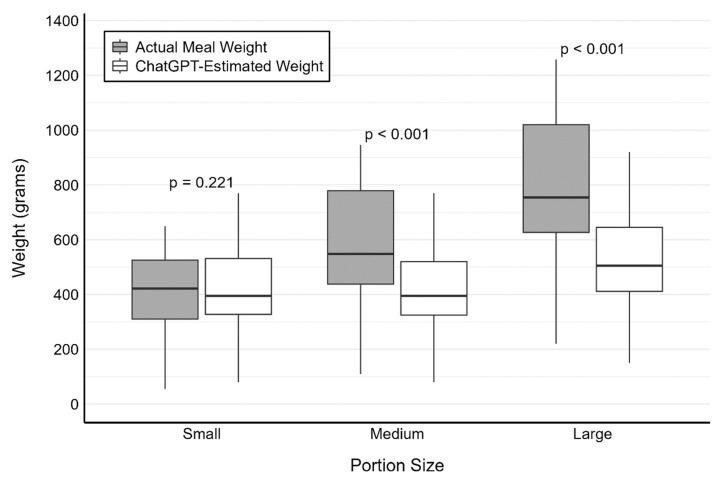
: Advances in artificial intelligence now allow combined use of large language and vision models; however, there has been limited evaluation of their potential in dietary assessment. This study aimed to evaluate the accuracy of ChatGPT-4 in estimating nutritional content of commonly consumed meals using meal photographs derived from national dietary survey data. : Meal photographs ( = 114) were uploaded to ChatGPT and it was asked to identify the foods in each meal, estimate their weight, and estimate the nutrient content of the meals for 16 nutrients for comparison with the known values using precision, paired -tests, Wilcoxon signed rank test, percentage difference, and Spearman correlation (r). Seven dietitians also estimated energy, protein, and carbohydrate content of thirty-eight meal photographs for comparison with ChatGPT using intraclass correlation (ICC). : Comparing ChatGPT and actual meals, ChatGPT showed good precision (93.0%) for correctly identifying the foods in the photographs. There was good agreement for meal weight ( = 0.221) for small meals, but poor agreement for medium ( < 0.001) and large ( < 0.001) meals. There was poor agreement for 10 of the 16 nutrients ( < 0.05). Percentage difference from actual values was >10% for 13 nutrients, with ChatGPT underestimating 11 nutrients. Correlations were adequate or good for all nutrients with r ranging from 0.29 to 0.83. When comparing ChatGPT and dietitians, the ICC ranged from 0.31 to 0.67 across nutrients. : ChatGPT performed well for identifying foods, estimating weights of small portion sizes, and ranking meals according to nutrient content, but performed poorly for estimating weights of medium and large portion sizes and providing accurate estimates of nutrient content.
人工智能的进步现在允许结合使用大语言模型和视觉模型;然而,对它们在饮食评估中的潜力评估有限。本研究旨在使用来自全国饮食调查数据的餐食照片评估ChatGPT-4在估计常见餐食营养成分方面的准确性。:将餐食照片(=114)上传到ChatGPT,并要求其识别每餐中的食物,估计其重量,并估计这16种营养素的餐食营养成分,以便使用精度、配对t检验、威尔科克森符号秩检验、百分比差异和斯皮尔曼相关性(r)与已知值进行比较。七名营养师还估计了38张餐食照片的能量、蛋白质和碳水化合物含量,以便使用组内相关性(ICC)与ChatGPT进行比较。:将ChatGPT与实际餐食进行比较,ChatGPT在正确识别照片中的食物方面显示出良好的精度(93.0%)。小餐食的餐食重量一致性良好(=0.221),但中(<0.001)大餐食的一致性较差。16种营养素中的10种一致性较差(<0.05)。13种营养素与实际值的百分比差异>10%,ChatGPT低估了11种营养素。所有营养素的相关性都足够或良好,r范围为0.29至0.83。当将ChatGPT与营养师进行比较时,跨营养素的ICC范围为0.31至0.67。:ChatGPT在识别食物、估计小份食物的重量以及根据营养成分对餐食进行排名方面表现良好,但在估计中份和大份食物的重量以及提供准确的营养成分估计方面表现较差。
 Zotero 插件