
欧洲脑出血负担:预测2019年至2050年的发病率和死亡率
Burden of intracerebral haemorrhage in Europe: forecasting incidence and mortality between 2019 and 2050.
作者信息
Wafa Hatem A, Marshall Iain, Wolfe Charles D A, Xie Wanqing, Johnson Catherine O, Veltkamp Roland, Wang Yanzhong
机构信息
School of Life Course and Population Health Sciences, King's College London, London, UK.
National Institute for Health Research (NIHR) Collaboration for Leadership in Applied Health Research and Care (CLAHRC) South London, London, UK.
出版信息
Lancet Reg Health Eur. 2024 Feb 9;38:100842. doi: 10.1016/j.lanepe.2024.100842. eCollection 2024 Mar.
BACKGROUND
Anticipating the burden of intracerebral haemorrhage is crucial for proactive management and building resilience against future health challenges. Prior forecasts are based on population demography and to a lesser extent epidemiological trends. This study aims to utilise selected modifiable risk factors and socio-demographic indicators to forecast the incidence and mortality of intracerebral haemorrhage in Europe between 2019 and 2050.
METHODS
Three intracerebral haemorrhage risk factors identified in the Global Burden of Diseases, Injuries, and Risk Factors study (GBD 2019)-high systolic blood pressure, high fasting plasma glucose, and high body mass index-were utilised to predict the risk-attributable fractions between 2019 and 2050. Disease burden not attributable to these risk factors was then forecasted using time series models (autoregressive integrated moving average [ARIMA]), incorporating the Socio-demographic Index (SDI) as an external predictor. The optimal parameters of ARIMA models were selected for each age-sex-country group based on the Akaike Information Criterion (AIC). Different health scenarios were constructed by extending the past 85th and 15th percentiles of annualised rates of change in risk factors and SDI across all location-years, stratified by age and sex groups. A decomposition analysis was performed to assess the relative contributions of population size, age composition, and intracerebral haemorrhage risk on the projected changes.
FINDINGS
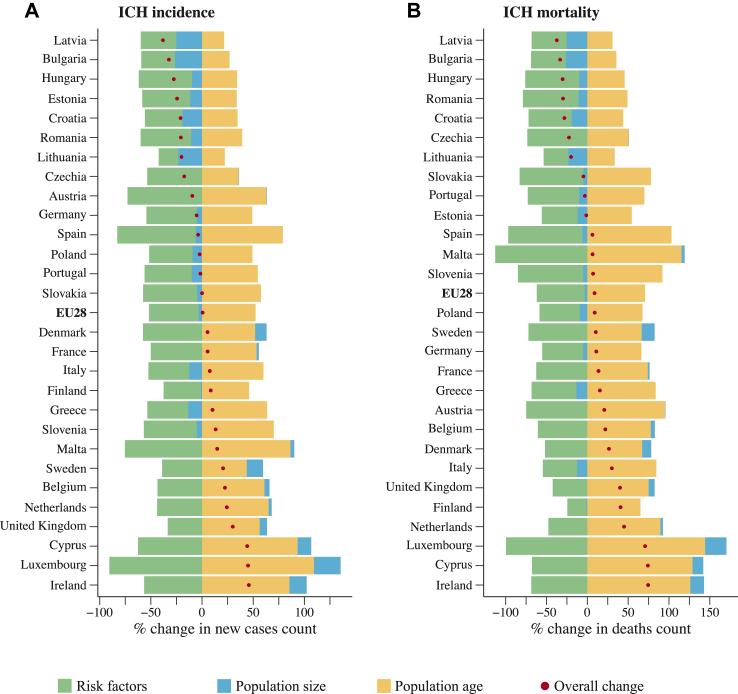
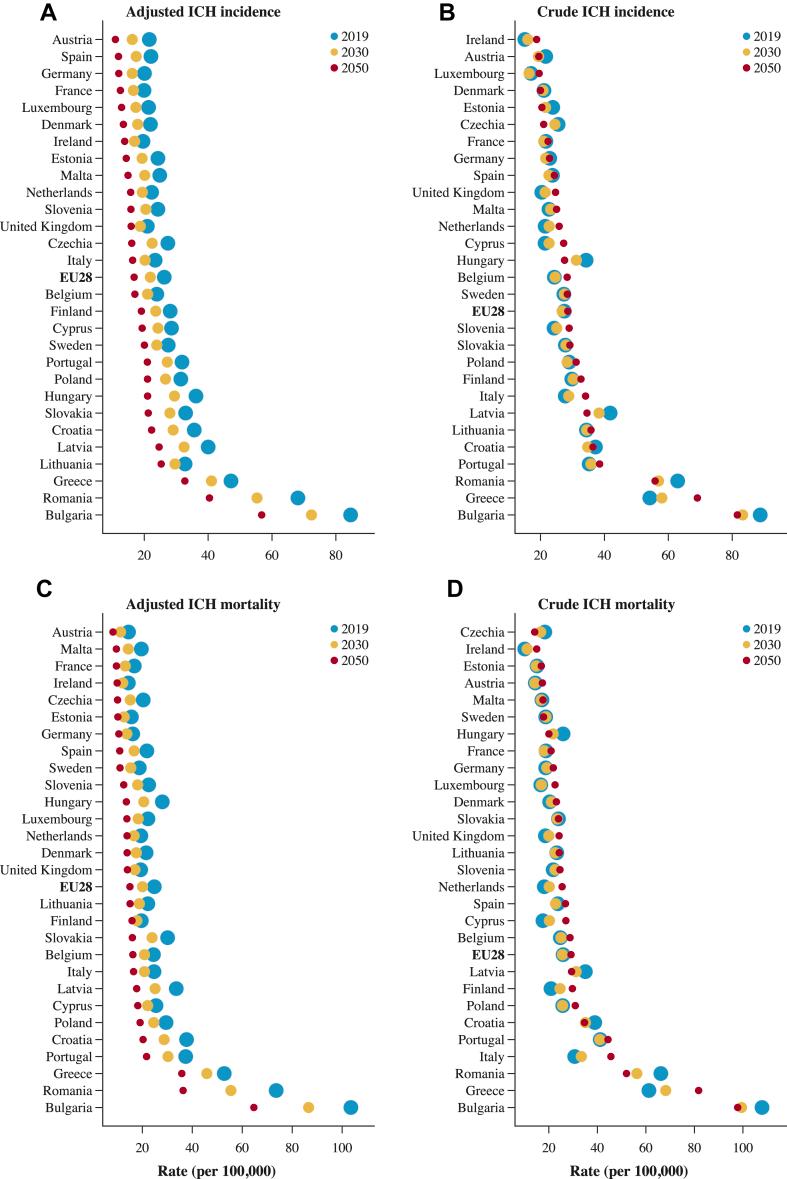
Compared with observed figures in 2019, our analysis predicts an increase in the burden of intracerebral haemorrhage in Europe in 2050, with a marginal rise of 0.6% (95% uncertainty interval [UI], -7.4% to 9.6%) in incident cases and an 8.9% (-2.8% to 23.6%) increase in mortality, reaching 141.2 (120.6-166.5) thousand and 144.2 (122.9-172.2) thousand respectively. These projections may fluctuate depending on trajectories of the risk factors and SDI; worsened trends could result in increases of 16.7% (8.7%-25.3%) in incidence and 31.2% (17.7%-48%) in mortality, while better trajectories may lead to a 10% (16.4%-2.3%) decrease in intracerebral haemorrhage cases with stabilised mortality. Individuals aged ≥80 years are expected to contribute significantly to the burden, comprising 62.7% of the cases in 2050, up from 40% in 2019, and 72.5% of deaths, up from 50.5%. Country-wide variations were noted in the projected changes, with decreases in the standardised rates across all nations but varying crude rates. The largest relative reductions in counts for both incidence and mortality are expected in Latvia, Bulgaria, and Hungary-ranging from -38.2% to -32.4% and -37.3% to -30.2% respectively. In contrast, the greatest increases for both measures were forecasted in Ireland (45.7% and 74.4%), Luxembourg (45% and 70.7%), and Cyprus (44.5% and 74.2%). The modelled increase in the burden of intracerebral haemorrhage could largely be attributed to population ageing.
INTERPRETATION
This study provides a comprehensive forecast of intracerebral haemorrhage in Europe until 2050, presenting different trajectories. The potential increase in the number of people experiencing and dying from intracerebral haemorrhage could have profound implications for both caregiving responsibilities and associated costs. However, forecasts were divergent between different scenarios and among EU countries, signalling the pivotal role of public health initiatives in steering the trajectories.
FUNDING
The European Union's Horizon 2020 Research and Innovation Programme under grant agreement No. 754517. The National Institute for Health and Care Research (NIHR) under its Programme Grants for Applied Research (NIHR202339).
背景
预测脑出血负担对于积极管理以及增强应对未来健康挑战的能力至关重要。以往的预测基于人口统计学,在较小程度上还基于流行病学趋势。本研究旨在利用选定的可改变风险因素和社会人口学指标,预测2019年至2050年欧洲脑出血的发病率和死亡率。
方法
利用全球疾病、伤害及风险因素负担研究(GBD 2019)中确定的三个脑出血风险因素——高收缩压、高空腹血糖和高体重指数,预测2019年至2050年的风险归因分数。然后使用时间序列模型(自回归积分滑动平均模型[ARIMA])预测不归因于这些风险因素的疾病负担,并将社会人口学指数(SDI)作为外部预测因子纳入其中。根据赤池信息准则(AIC)为每个年龄 - 性别 - 国家组选择ARIMA模型的最佳参数。通过扩展所有地点 - 年份的风险因素和SDI年化变化率的过去第85和第15百分位数,构建不同的健康情景,并按年龄和性别组进行分层。进行分解分析以评估人口规模、年龄构成和脑出血风险对预测变化的相对贡献。
研究结果
与2019年的观察数据相比,我们的分析预测2050年欧洲脑出血负担将增加,发病病例略有上升0.6%(95%不确定性区间[UI],-7.4%至9.6%),死亡率上升8.9%(-2.8%至23.6%),分别达到14.12万(12.06 - 16.65万)和14.42万(12.29 - 17.22万)。这些预测可能会根据风险因素和SDI的轨迹而波动;趋势恶化可能导致发病率增加16.7%(8.7% - 25.3%),死亡率增加31.2%(17.7% - 48%),而较好的轨迹可能导致脑出血病例减少10%(16.4% - 2.3%)且死亡率稳定。预计80岁及以上的个体将对负担有显著贡献,在2050年占病例的62.7%,高于2019年的40%,占死亡的72.5%,高于2019年的50.5%。在预测变化中注意到各国之间的差异,所有国家的标准化率均下降,但粗率各不相同。预计拉脱维亚、保加利亚和匈牙利的发病率和死亡率计数相对降幅最大,分别为 - 38.2%至 - 32.4%和 - 37.3%至 - 30.2%。相比之下,预计爱尔兰(45.7%和74.4%)、卢森堡(45%和70.7%)和塞浦路斯(44.5%和74.2%)这两项指标增幅最大。脑出血负担的模拟增加在很大程度上可归因于人口老龄化。
解读
本研究提供了直至2050年欧洲脑出血的全面预测,并呈现了不同的轨迹。经历脑出血和死于脑出血的人数的潜在增加可能对护理责任和相关成本产生深远影响。然而,不同情景之间以及欧盟国家之间的预测存在差异,这表明公共卫生举措在引导轨迹方面具有关键作用。
资金来源
欧盟“地平线2020”研究与创新计划,资助协议编号754517。国家卫生与保健研究所(NIHR)的应用研究项目资助(NIHR202339)。



 Zotero 插件