
同源重组修复缺陷状态与早期 HER2 低乳腺癌患者长期预后的关系:一项回顾性队列研究。
Association between Homologous Recombination Repair Defect Status and Long-Term Prognosis of Early HER2-Low Breast Cancer: A Retrospective Cohort Study.
机构信息
Guangdong Provincial Key Laboratory of Malignant Tumor Epigenetics and Gene Regulation, Sun Yat-Sen Memorial Hospital, Sun Yat-Sen University, Guangzhou, People's Republic of China.
Department of Breast Surgery, Breast Tumor Center, Sun Yat-Sen Memorial Hospital, Sun Yat-Sen University, Guangzhou, People's Republic of China.
出版信息
Oncologist. 2024 Jul 5;29(7):e864-e876. doi: 10.1093/oncolo/oyae021.
BACKGROUND
As a newly identified subtype of HER2-negative tumors associated with a less favorable prognosis, it remains crucial to evaluate potential prognostic and predictive factors, particularly non-invasive biomarkers, for individuals with human epidermal growth factor 2 (HER2) low early-stage breast cancer (EBC). Multiple investigations have highlighted that HER2-negative patients with EBC exhibiting high homologous recombination deficiency (HRD) scores display lower rates of pathological complete response (PCR) to neoadjuvant chemotherapy (NAC). Nevertheless, no study to date has explored the correlation between HRD and the long-term prognosis in HER2-low patients with EBC.
PATIENTS AND METHODS
This retrospective observational study focuses on primary EBC sourced from The Cancer Genome Atlas dataset (TCGA). It reveals the gene mutation landscape in EBC with low HER2 expression and elucidates the tumor immune landscape across different HRD states. Utilizing bioinformatics analysis and Cox proportional models, along with the Kaplan-Meier method, the study assesses the correlation between HRD status and disease-specific survival (DSS), disease-free interval (DFI), and progression-free interval (PFI). Subgroup analyses were conducted to identify potential variations in the association between HRD and prognosis.
RESULTS
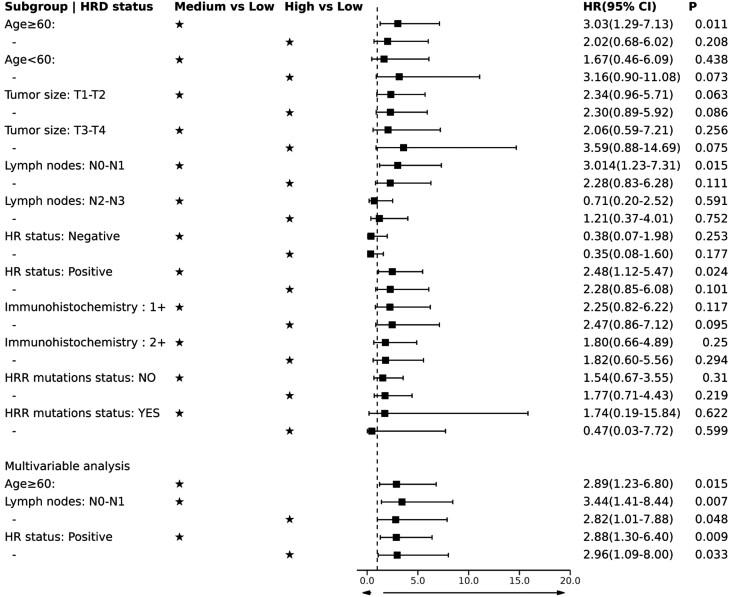
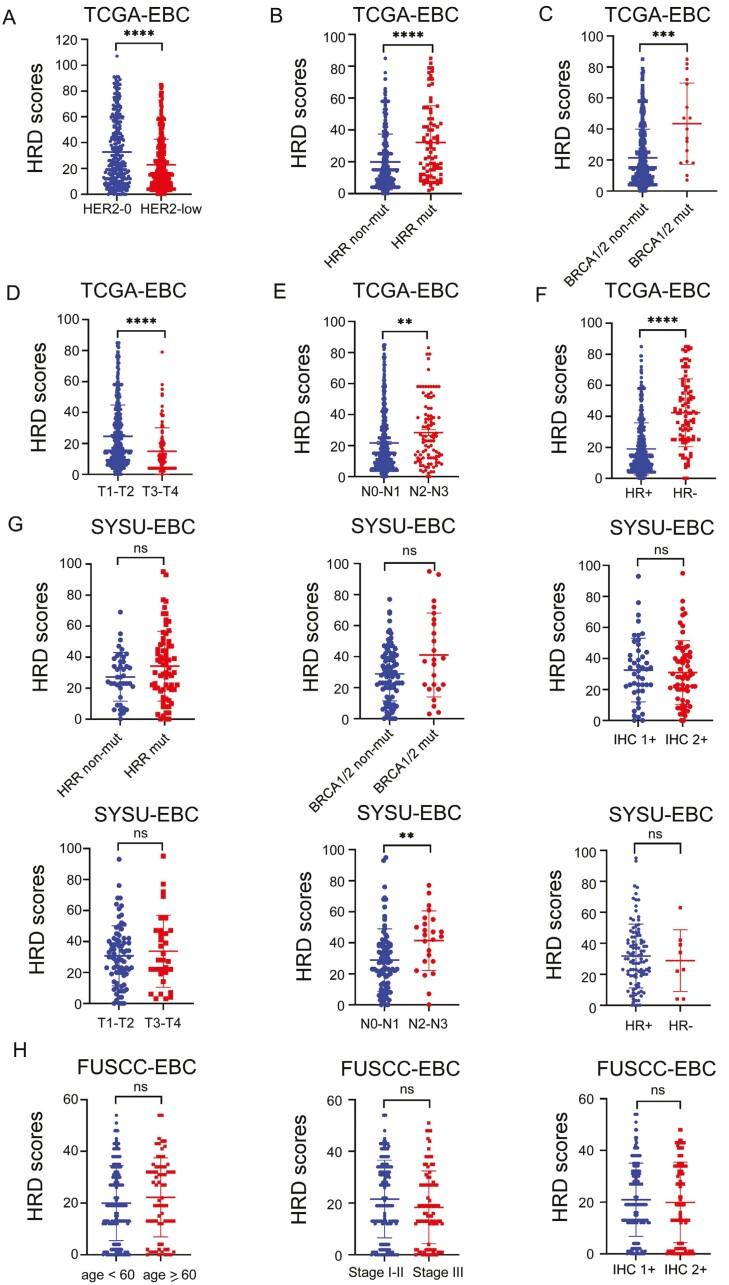
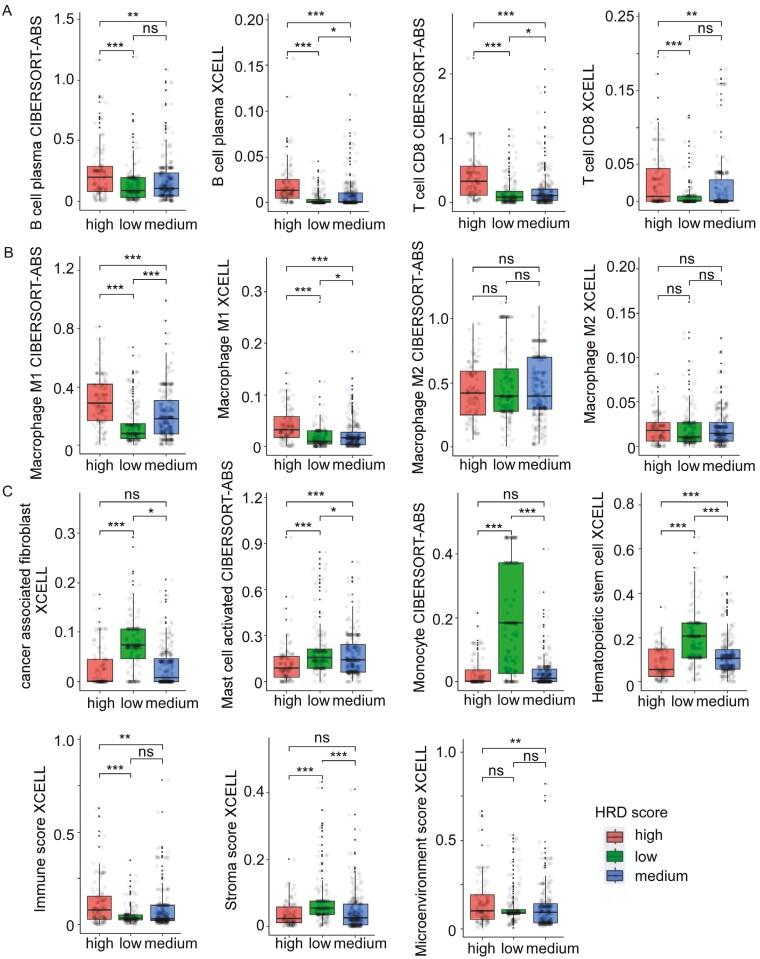
In the patients with HER2-low breast cancer, patients with homologous recombination related genes (HRRGs) defects had an HRD score about twice that of those without related genes mutations, and were at higher risk of acquiring ARID1A, ATM, and BRCA2 mutations. We also found that most immune cell abundances were significantly higher in EBC tumors with high HRD than in EBC tumors with low HRD or HRD-medium, particularly plasma B-cell abundance, CD8 T-cell abundance, and M1 macrophages. In addition, these tumors with HRD-high also appear to have significantly higher tumor immune scores and lower interstitial scores. Then, we analyzed the relationship between different HRD status and prognosis. There was statistical significance (P = .036 and P = .046, respectively) in DSS and PFI between the HRD-low and HRD-high groups, and patients with HRD-high EBC showed relatively poor survival outcomes. A medium HRD score (hazard ratio, HR = 2.15, 95% CI: 1.04-4.41, P = .038) was a significant risk factor for PFI. Hormone receptor positivity is an important factor in obtaining medium-high HRD score and poor prognosis.
CONCLUSION
Higher HRD scores were associated with poorer PFI outcomes, particularly in people with HR+/HER2-low. Varied HRD states exhibited distinctions in HRRGs and the tumor immune landscape. These insights have the potential to assist clinicians in promptly identifying high-risk groups and tailoring personalized treatments for patients with HER2-low EBC, aiming to enhance long-term outcomes.
背景
作为一种与预后较差相关的新鉴定的 HER2 阴性肿瘤亚型,评估人类表皮生长因子 2(HER2)低早期乳腺癌(EBC)患者的潜在预后和预测因素(特别是非侵入性生物标志物)仍然至关重要。多项研究强调,HER2 阴性 EBC 患者中同源重组缺陷(HRD)评分较高的患者对新辅助化疗(NAC)的病理完全缓解(PCR)率较低。然而,迄今为止,尚无研究探讨 HRD 与 HER2 低表达 EBC 患者的长期预后之间的相关性。
患者和方法
本回顾性观察性研究集中在来自癌症基因组图谱数据集(TCGA)的原发性 EBC。它揭示了 HER2 表达较低的 EBC 中的基因突变图谱,并阐明了不同 HRD 状态下的肿瘤免疫图谱。利用生物信息学分析和 Cox 比例模型以及 Kaplan-Meier 方法,研究评估了 HRD 状态与疾病特异性生存(DSS)、无病间隔(DFI)和无进展间隔(PFI)之间的相关性。进行了亚组分析以确定 HRD 与预后之间关联的潜在变化。
结果
在 HER2 低乳腺癌患者中,同源重组相关基因(HRRGs)缺陷的患者 HRD 评分约为无相关基因突变患者的两倍,并且更容易获得 ARID1A、ATM 和 BRCA2 突变。我们还发现,高 HRD 的 EBC 肿瘤中大多数免疫细胞丰度明显高于低 HRD 或 HRD-中等的 EBC 肿瘤,特别是浆细胞 B 细胞丰度、CD8 T 细胞丰度和 M1 巨噬细胞丰度。此外,这些 HRD-高的肿瘤似乎还具有明显更高的肿瘤免疫评分和更低的间质评分。然后,我们分析了不同 HRD 状态与预后之间的关系。在 DSS 和 PFI 方面,HRD-低和 HRD-高组之间存在统计学意义(P=0.036 和 P=0.046),并且 HRD-高 EBC 患者的生存结果相对较差。中等 HRD 评分(危险比,HR=2.15,95%CI:1.04-4.41,P=0.038)是 PFI 的显著危险因素。激素受体阳性是获得中高 HRD 评分和不良预后的重要因素。
结论
较高的 HRD 评分与较差的 PFI 结果相关,尤其是在 HR+/HER2 低的人群中。不同的 HRD 状态在 HRRGs 和肿瘤免疫图谱方面存在差异。这些发现有可能帮助临床医生及时识别高危人群,并为 HER2 低表达 EBC 患者量身定制个性化治疗,以提高长期预后。

 Zotero 插件