
雌激素受体α相关易位导致乳腺癌中癌基因扩增。
ERα-associated translocations underlie oncogene amplifications in breast cancer.
机构信息
Department of Biomedical Informatics, Harvard Medical School, Boston, MA, USA.
Ludwig Center at Harvard, Harvard Medical School, Boston, MA, USA.
出版信息
Nature. 2023 Jun;618(7967):1024-1032. doi: 10.1038/s41586-023-06057-w. Epub 2023 May 17.
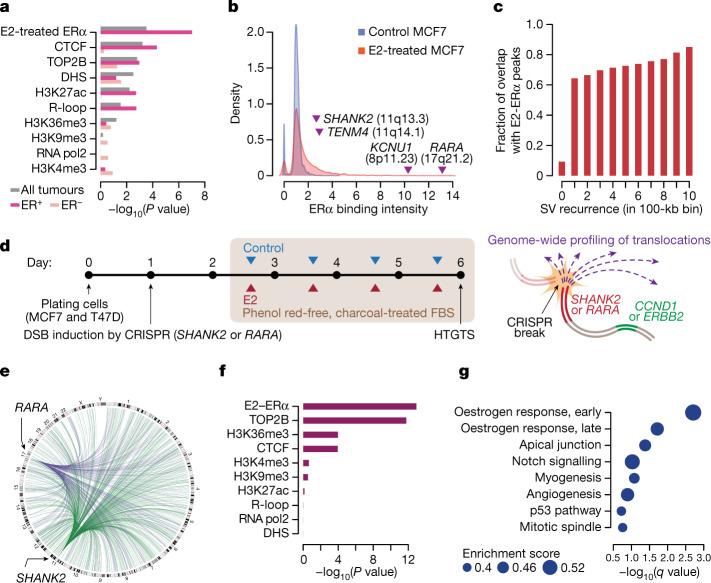
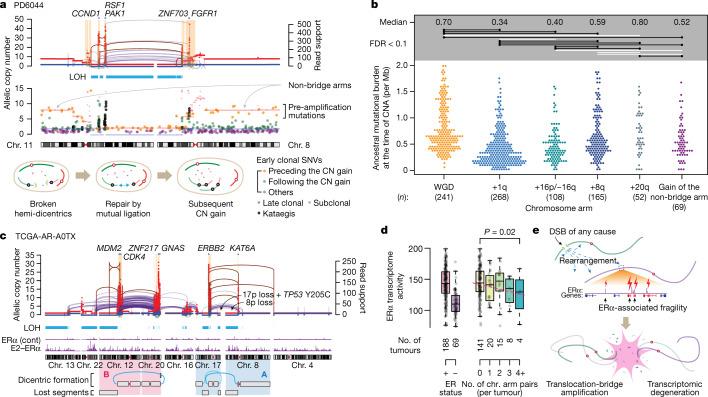
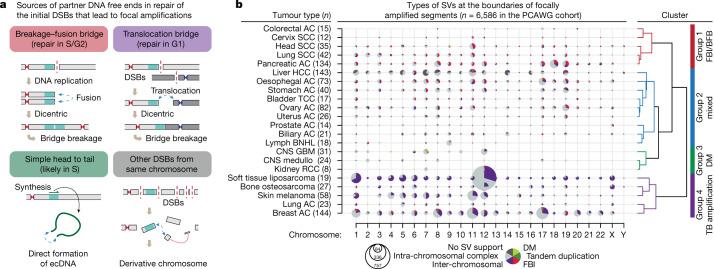
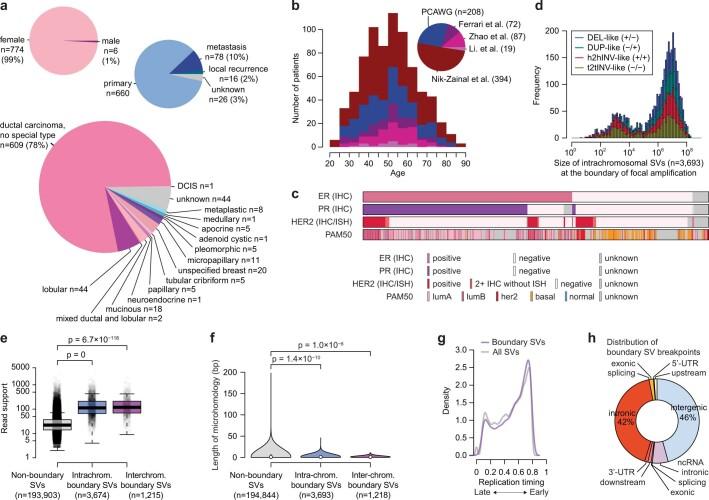
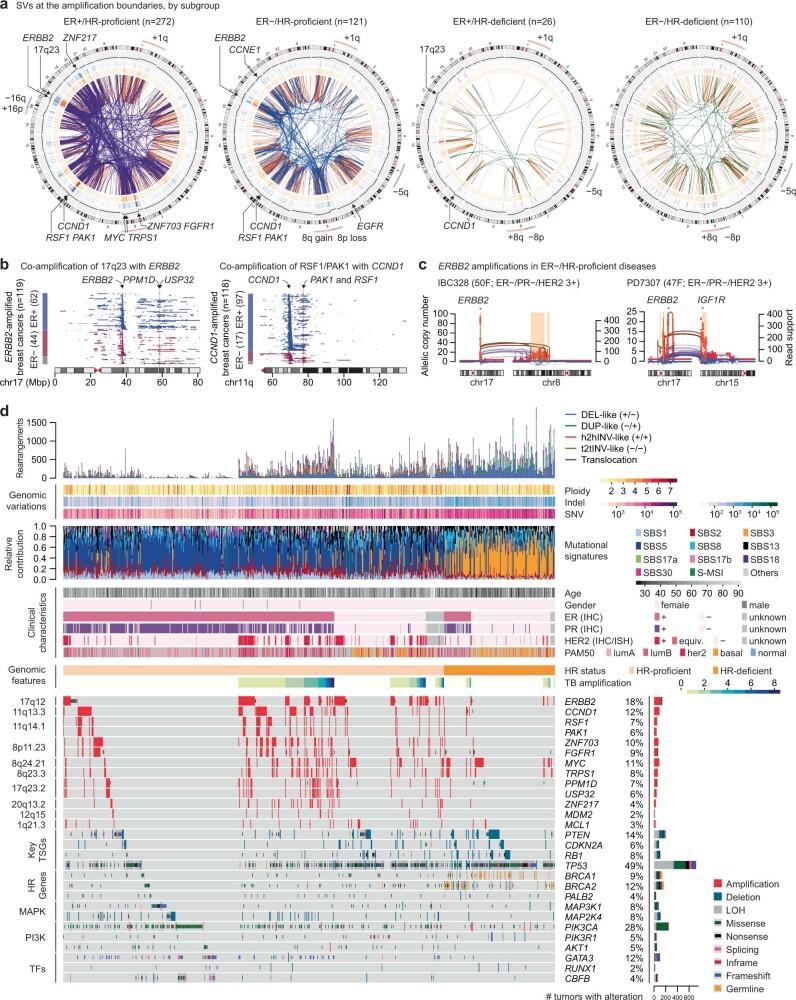
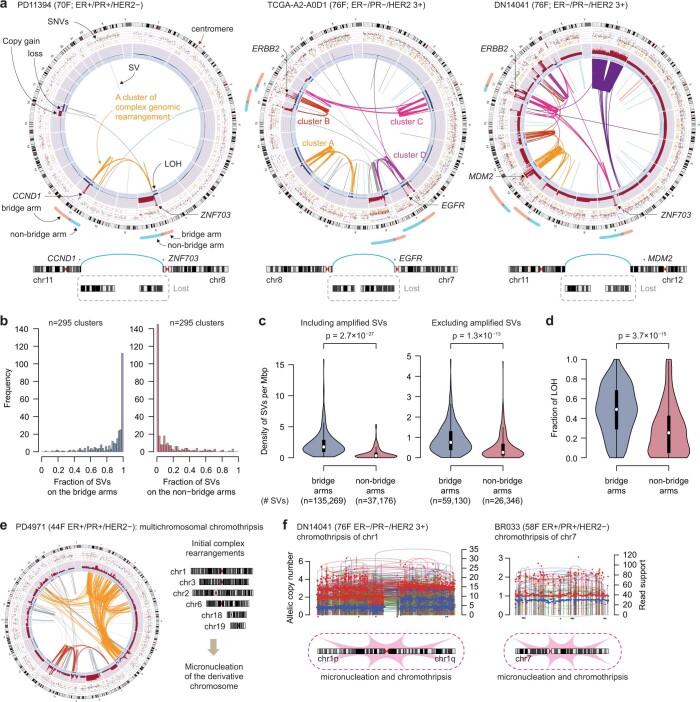
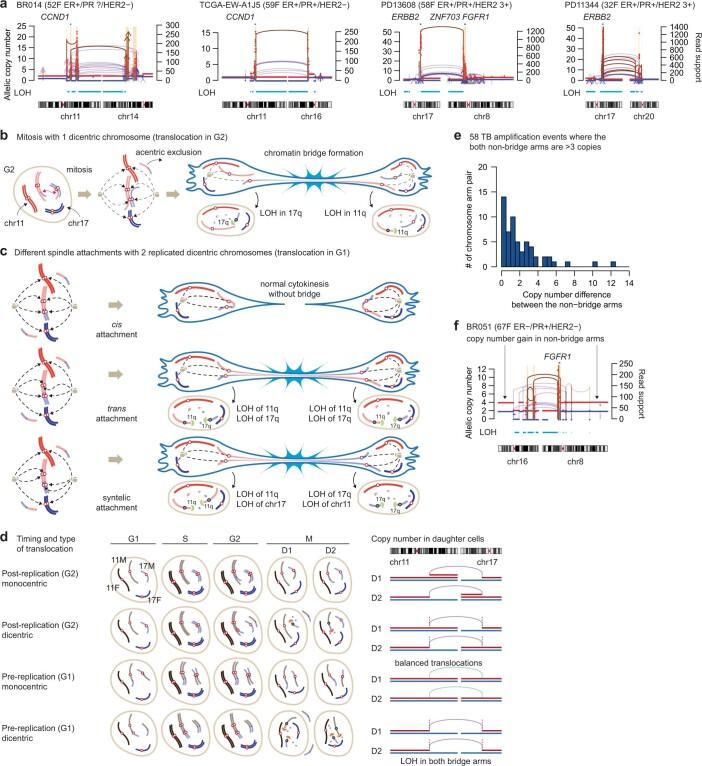
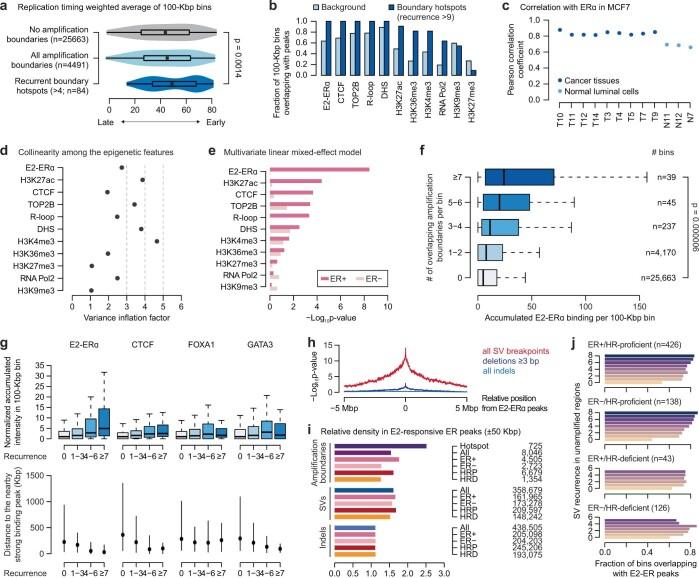
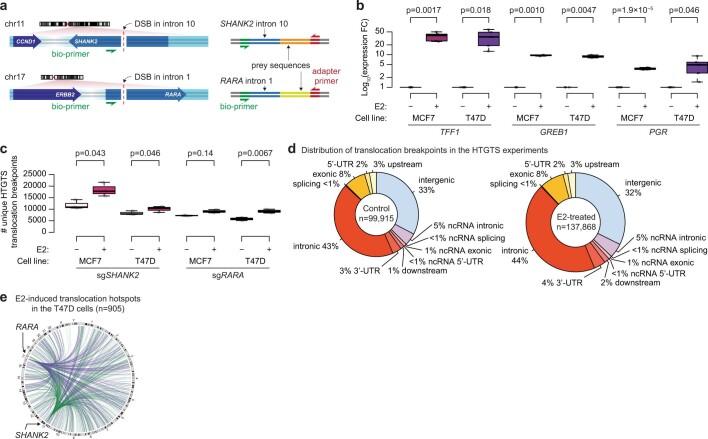
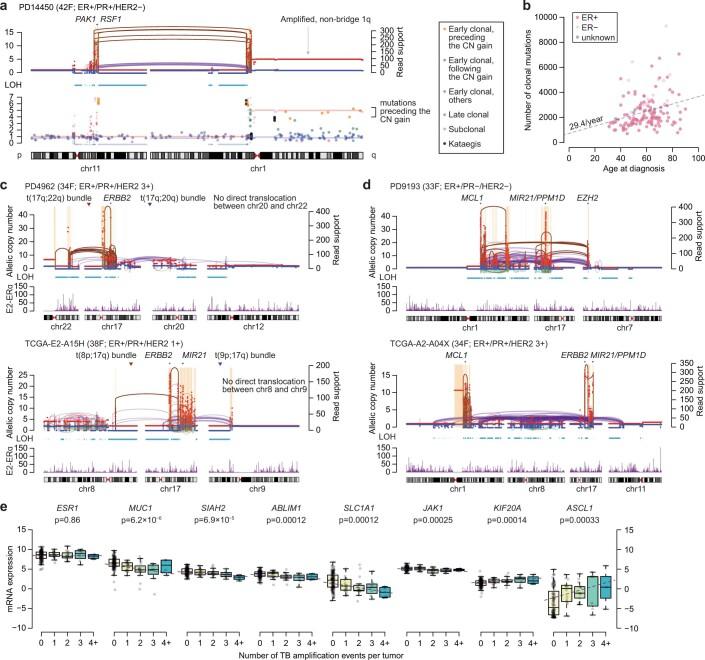
Focal copy-number amplification is an oncogenic event. Although recent studies have revealed the complex structure and the evolutionary trajectories of oncogene amplicons, their origin remains poorly understood. Here we show that focal amplifications in breast cancer frequently derive from a mechanism-which we term translocation-bridge amplification-involving inter-chromosomal translocations that lead to dicentric chromosome bridge formation and breakage. In 780 breast cancer genomes, we observe that focal amplifications are frequently connected to each other by inter-chromosomal translocations at their boundaries. Subsequent analysis indicates the following model: the oncogene neighbourhood is translocated in G1 creating a dicentric chromosome, the dicentric chromosome is replicated, and as dicentric sister chromosomes segregate during mitosis, a chromosome bridge is formed and then broken, with fragments often being circularized in extrachromosomal DNAs. This model explains the amplifications of key oncogenes, including ERBB2 and CCND1. Recurrent amplification boundaries and rearrangement hotspots correlate with oestrogen receptor binding in breast cancer cells. Experimentally, oestrogen treatment induces DNA double-strand breaks in the oestrogen receptor target regions that are repaired by translocations, suggesting a role of oestrogen in generating the initial translocations. A pan-cancer analysis reveals tissue-specific biases in mechanisms initiating focal amplifications, with the breakage-fusion-bridge cycle prevalent in some and the translocation-bridge amplification in others, probably owing to the different timing of DNA break repair. Our results identify a common mode of oncogene amplification and propose oestrogen as its mechanistic origin in breast cancer.
焦点拷贝数扩增是致癌事件。尽管最近的研究揭示了致癌基因扩增子的复杂结构和进化轨迹,但它们的起源仍知之甚少。在这里,我们表明乳腺癌中的焦点扩增经常源自一种机制——我们称之为易位桥接扩增——涉及染色体间易位,导致双着丝粒染色体桥的形成和断裂。在 780 个乳腺癌基因组中,我们观察到焦点扩增经常通过其边界处的染色体间易位相互连接。随后的分析表明了以下模型:致癌基因附近在 G1 中易位,形成双着丝粒染色体,双着丝粒染色体复制,并且在有丝分裂期间双着丝粒姐妹染色体分离时,形成染色体桥,然后断裂,片段通常在染色体外 DNA 中被环化。该模型解释了关键致癌基因的扩增,包括 ERBB2 和 CCND1。反复出现的扩增边界和重排热点与乳腺癌细胞中的雌激素受体结合相关。实验上,雌激素处理在雌激素受体靶区域诱导 DNA 双链断裂,这些断裂通过易位修复,表明雌激素在产生初始易位中的作用。泛癌症分析揭示了启动焦点扩增的机制的组织特异性偏向,其中断裂-融合-桥循环在某些组织中普遍存在,而在其他组织中则存在易位桥接扩增,这可能归因于 DNA 断裂修复的不同时间。我们的结果确定了一种常见的致癌基因扩增模式,并提出雌激素是乳腺癌中其机制起源。




 Zotero 插件