
睡眠塑造了多元事件记忆中模式完成的联想结构。
Sleep shapes the associative structure underlying pattern completion in multielement event memory.
机构信息
Institute of Medical Psychology and Behavioral Neurobiology, University of Tübingen, Tübingen 72076, Germany.
Institute of Medical Psychology, LMU Munich, Munich 80336, Germany.
出版信息
Proc Natl Acad Sci U S A. 2024 Feb 27;121(9):e2314423121. doi: 10.1073/pnas.2314423121. Epub 2024 Feb 20.
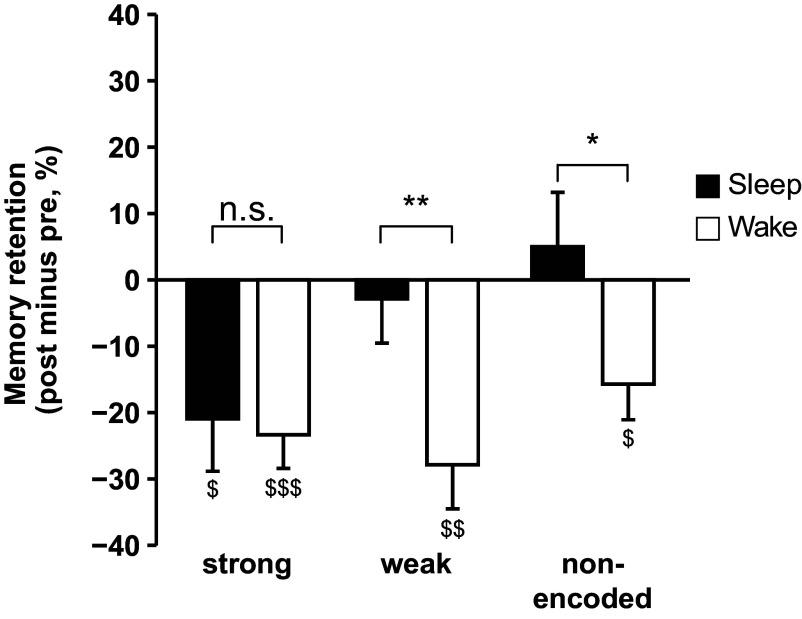
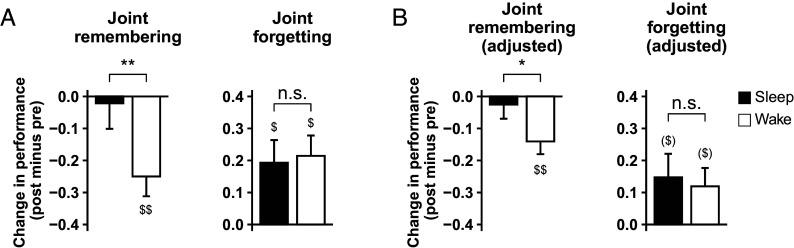
Sleep supports the consolidation of episodic memory. It is, however, a matter of ongoing debate how this effect is established, because, so far, it has been demonstrated almost exclusively for simple associations, which lack the complex associative structure of real-life events, typically comprising multiple elements with different association strengths. Because of this associative structure interlinking the individual elements, a partial cue (e.g., a single element) can recover an entire multielement event. This process, referred to as pattern completion, is a fundamental property of episodic memory. Yet, it is currently unknown how sleep affects the associative structure within multielement events and subsequent processes of pattern completion. Here, we investigated the effects of post-encoding sleep, compared with a period of nocturnal wakefulness (followed by a recovery night), on multielement associative structures in healthy humans using a verbal associative learning task including strongly, weakly, and not directly encoded associations. We demonstrate that sleep selectively benefits memory for weakly associated elements as well as for associations that were not directly encoded but not for strongly associated elements within a multielement event structure. Crucially, these effects were accompanied by a beneficial effect of sleep on the ability to recall multiple elements of an event based on a single common cue. In addition, retrieval performance was predicted by sleep spindle activity during post-encoding sleep. Together, these results indicate that sleep plays a fundamental role in shaping associative structures, thereby supporting pattern completion in complex multielement events.
睡眠有助于巩固情景记忆。然而,这种效应是如何建立的,目前仍存在争议,因为到目前为止,这种效应几乎仅在简单关联中得到了证明,而简单关联缺乏现实生活事件的复杂关联结构,通常由多个具有不同关联强度的元素组成。由于这种关联结构将各个元素相互联系起来,因此部分线索(例如单个元素)可以恢复整个多元素事件。这个过程被称为模式完成,是情景记忆的基本属性。然而,目前尚不清楚睡眠如何影响多元素事件中的关联结构以及随后的模式完成过程。在这里,我们使用包括强关联、弱关联和未直接编码关联的口头联想学习任务,研究了后编码睡眠与夜间清醒(随后是恢复夜)对健康人类多元素关联结构的影响。我们证明,睡眠选择性地有益于记忆弱关联的元素以及未直接编码的关联,但对多元素事件结构中的强关联元素没有益处。至关重要的是,这些影响伴随着睡眠对基于单个共同线索回忆事件多个元素的能力的有益影响。此外,检索性能可以根据后编码睡眠期间的睡眠纺锤波活动进行预测。总之,这些结果表明,睡眠在塑造关联结构方面起着至关重要的作用,从而支持复杂多元素事件中的模式完成。


 Zotero 插件