
麻叶绣球属叶绿体基因组的特征分析及比较基因组学研究。
Characterization of the chloroplast genome of Gleditsia species and comparative analysis.
机构信息
Institute for Forest Resources and Environment of Guizhou, Key Laboratory of Forest Cultivation in Plateau Mountain of Guizhou Province, College of Forestry, Guizhou University, Guiyang, 550025, Guizhou, China.
College of Continuing Education, Yanbian University, Yanji, 133002, Jilin, China.
出版信息
Sci Rep. 2024 Feb 21;14(1):4262. doi: 10.1038/s41598-024-54608-6.
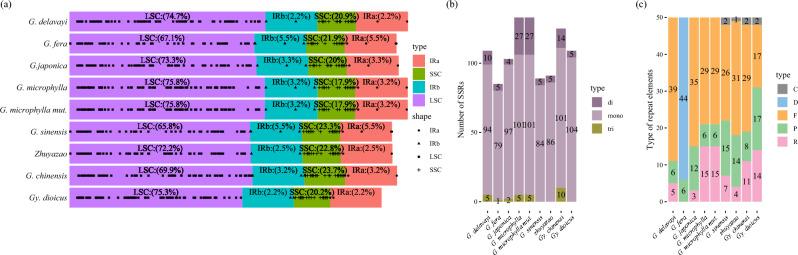
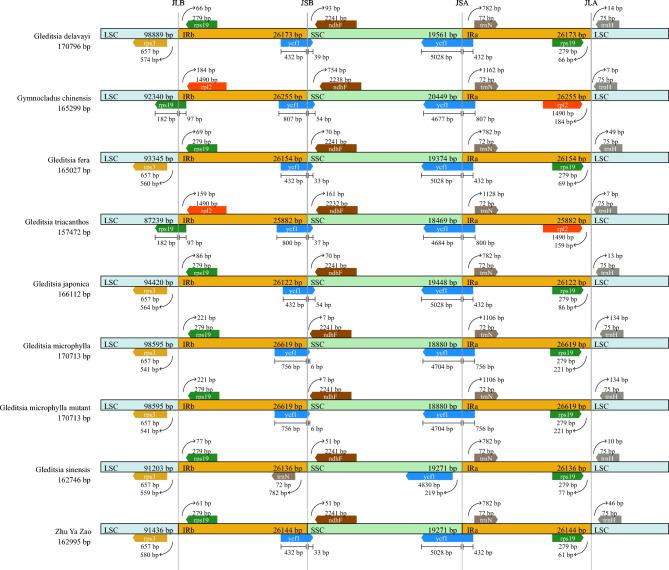
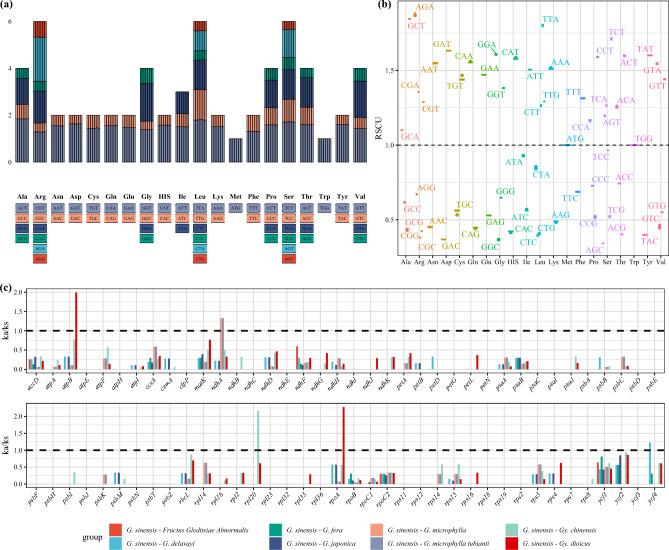
The genus Gleditsia has significant medicinal and economic value, but information about the chloroplast genomic characteristics of Gleditsia species has been limited. Using the Illumina sequencing, we assembled and annotated the whole chloroplast genomes of seven Gleditsia species (Gleditsia sinensis, Gleditsia japonica var. delavayi (G. delavayi), G. fera, G. japonica, G. microphylla, Fructus Gleditsiae Abnormalis (Zhū Yá Zào), G. microphylla mutant). The assembled genomes revealed that Gleditsia species have a typical circular tetrad structure, with genome sizes ranging from 162,746 to 170,907 bp. Comparative genomic analysis showed that most (65.8-75.8%) of the abundant simple sequence repeats in Gleditsia and Gymnocladus species were located in the large single copy region. The Gleditsia chloroplast genome prefer T/A-ending codons and avoid C/G-ending codons, positive selection was acting on the rpoA, rpl20, atpB, ndhA and ycf4 genes, most of the chloroplast genes of Gleditsia species underwent purifying selection. Expansion and contraction of the inverted repeat (IR)/single copy (SC) region showed similar patterns within the Gleditsia genus. Polymorphism analysis revealed that coding regions were more conserved than non-coding regions, and the IR region was more conserved than the SC region. Mutational hotspots were mostly found in intergenic regions such as "rps16-trnQ", "trnT-trnL", "ndhG-ndhI", and "rpl32-trnL" in Gleditsia. Phylogenetic analysis showed that G. fera is most closely related to G. sinensis,G. japonica and G. delavayi are relatively closely related. Zhū Yá Zào can be considered a bud mutation of the G. sinensis. The albino phenotype of G. microphylla mutant is not caused by variations in the chloroplast genome, and that the occurrence of the albino phenotype may be due to mutations in chloroplast-related genes involved in splicing or localization functions. This study will help us enhance our exploration of the genetic evolution and geographical origins of the Gleditsia genus.
皂荚属具有重要的药用和经济价值,但关于皂荚属植物叶绿体基因组特征的信息有限。本研究利用 Illumina 测序技术,组装并注释了 7 种皂荚属植物(皂荚、滇皂荚、猪牙皂、日本皂荚、小叶皂荚、异形猪牙皂和小叶皂荚突变体)的完整叶绿体基因组。组装的基因组表明,皂荚属植物具有典型的圆形四联体结构,基因组大小范围为 162746-170907bp。比较基因组分析表明,在皂荚属和云实属植物中,大多数(65.8%-75.8%)丰富的简单重复序列位于大片段重复区。皂荚属叶绿体基因组偏好 T/A 结尾的密码子,避免 C/G 结尾的密码子,rpoA、rpl20、atpB、ndhA 和 ycf4 基因受到正选择,大多数皂荚属植物的叶绿体基因经历了纯化选择。反转重复(IR)/单拷贝(SC)区的扩张和收缩在皂荚属内表现出相似的模式。多态性分析表明,编码区比非编码区更保守,IR 区比 SC 区更保守。突变热点大多位于基因间区,如“rps16-trnQ”、“trnT-trnL”、“ndhG-ndhI”和“rpl32-trnL”。系统发育分析表明,棘果皂荚与皂荚、中国皂荚和滇皂荚的亲缘关系最为密切,异形猪牙皂可视为皂荚的芽变,小叶皂荚突变体的白化表型不是由叶绿体基因组变异引起的,白化表型的发生可能是由于参与剪接或定位功能的叶绿体相关基因发生突变。本研究将有助于我们深入了解皂荚属的遗传进化和地理起源。


 Zotero 插件