
四跨膜蛋白在消化系统肿瘤发生发展中的作用:最新进展与新证据
The role of Tetraspanins in digestive system tumor development: update and emerging evidence.
作者信息
Shao Shijie, Bu Zhen, Xiang Jinghua, Liu Jiachen, Tan Rui, Sun Han, Hu Yuanwen, Wang Yimin
机构信息
Articular Orthopaedics, The Third Affiliated Hospital of Soochow University, Changzhou, China.
Department of General Surgery, Xinyi People's Hospital, Xinyi, China.
出版信息
Front Cell Dev Biol. 2024 Feb 8;12:1343894. doi: 10.3389/fcell.2024.1343894. eCollection 2024.
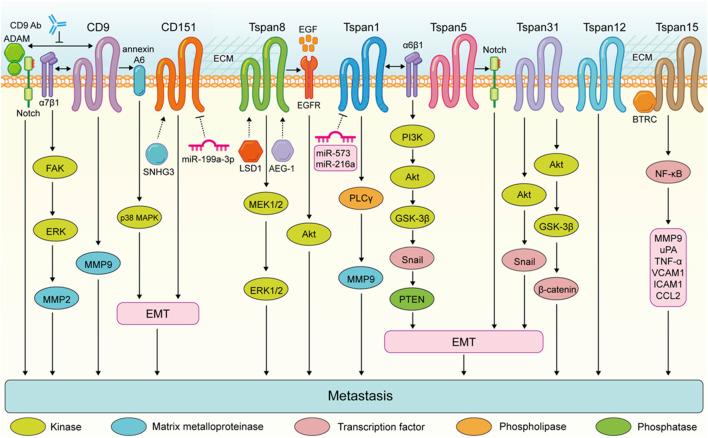
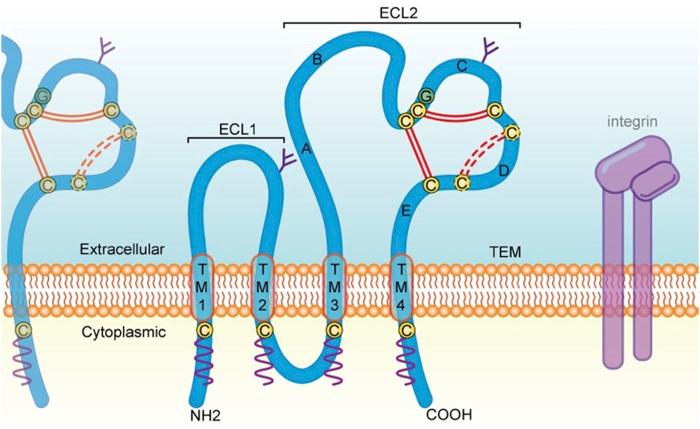
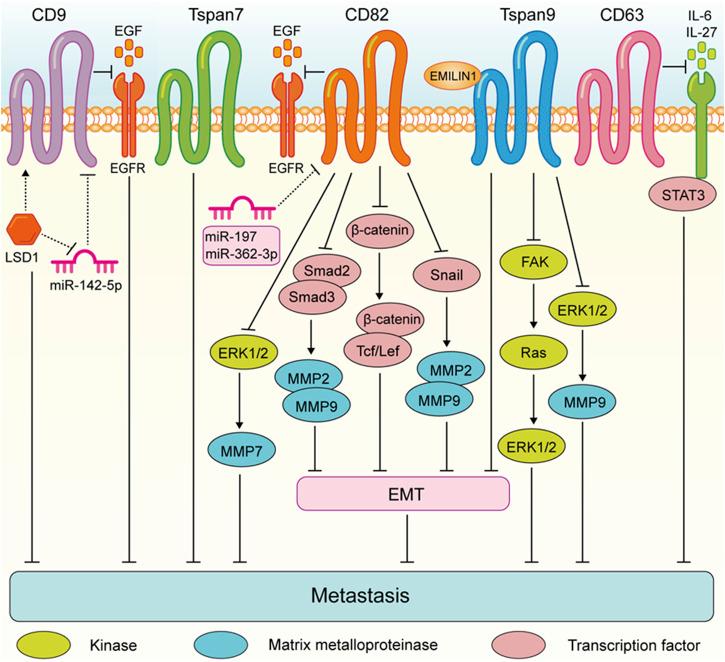
Digestive system malignancies, including cancers of the esophagus, pancreas, stomach, liver, and colorectum, are the leading causes of cancer-related deaths worldwide due to their high morbidity and poor prognosis. The lack of effective early diagnosis methods is a significant factor contributing to the poor prognosis for these malignancies. Tetraspanins (Tspans) are a superfamily of 4-transmembrane proteins (TM4SF), classified as low-molecular-weight glycoproteins, with 33 Tspan family members identified in humans to date. They interact with other membrane proteins or TM4SF members to form a functional platform on the cytoplasmic membrane called Tspan-enriched microdomain and serve multiple functions including cell adhesion, migration, propagation and signal transduction. In this review, we summarize the various roles of Tspans in the progression of digestive system tumors and the underlying molecular mechanisms in recent years. Generally, the expression of CD9, CD151, Tspan1, Tspan5, Tspan8, Tspan12, Tspan15, and Tspan31 are upregulated, facilitating the migration and invasion of digestive system cancer cells. Conversely, Tspan7, CD82, CD63, Tspan7, and Tspan9 are downregulated, suppressing digestive system tumor cell metastasis. Furthermore, the connection between Tspans and the metastasis of malignant bone tumors is reviewed. We also summarize the potential role of Tspans as novel immunotherapy targets and as an approach to overcome drug resistance. Finally, we discuss the potential clinical value and therapeutic targets of Tspans in the treatments of digestive system malignancies and provide some guidance for future research.
消化系统恶性肿瘤,包括食管癌、胰腺癌、胃癌、肝癌和结直肠癌,因其高发病率和不良预后,是全球癌症相关死亡的主要原因。缺乏有效的早期诊断方法是导致这些恶性肿瘤预后不良的一个重要因素。四跨膜蛋白(Tspans)是一个由4次跨膜蛋白(TM4SF)组成的超家族,归类为低分子量糖蛋白,迄今为止在人类中已鉴定出33个Tspan家族成员。它们与其他膜蛋白或TM4SF成员相互作用,在细胞质膜上形成一个称为富含Tspan的微结构域的功能平台,并发挥多种功能,包括细胞黏附、迁移、增殖和信号转导。在本综述中,我们总结了近年来Tspans在消化系统肿瘤进展中的各种作用及其潜在的分子机制。一般来说,CD9、CD151、Tspan1、Tspan5、Tspan8、Tspan12、Tspan15和Tspan31的表达上调,促进消化系统癌细胞的迁移和侵袭。相反,Tspan7、CD82、CD63、Tspan7和Tspan9表达下调,抑制消化系统肿瘤细胞转移。此外,还综述了Tspans与恶性骨肿瘤转移之间的联系。我们还总结了Tspans作为新型免疫治疗靶点以及克服耐药性方法的潜在作用。最后,我们讨论了Tspans在消化系统恶性肿瘤治疗中的潜在临床价值和治疗靶点,并为未来研究提供一些指导。
 Zotero 插件