
嗅觉关键期:气味暴露如何塑造小鼠和果蝇发育中的大脑。
Olfactory Critical Periods: How Odor Exposure Shapes the Developing Brain in Mice and Flies.
作者信息
Mallick Ahana, Dacks Andrew M, Gaudry Quentin
机构信息
Department of Biology, University of Maryland, College Park, MD 20742, USA.
Department of Biology, West Virginia University, Morgantown, WV 26505, USA.
出版信息
Biology (Basel). 2024 Feb 2;13(2):94. doi: 10.3390/biology13020094.
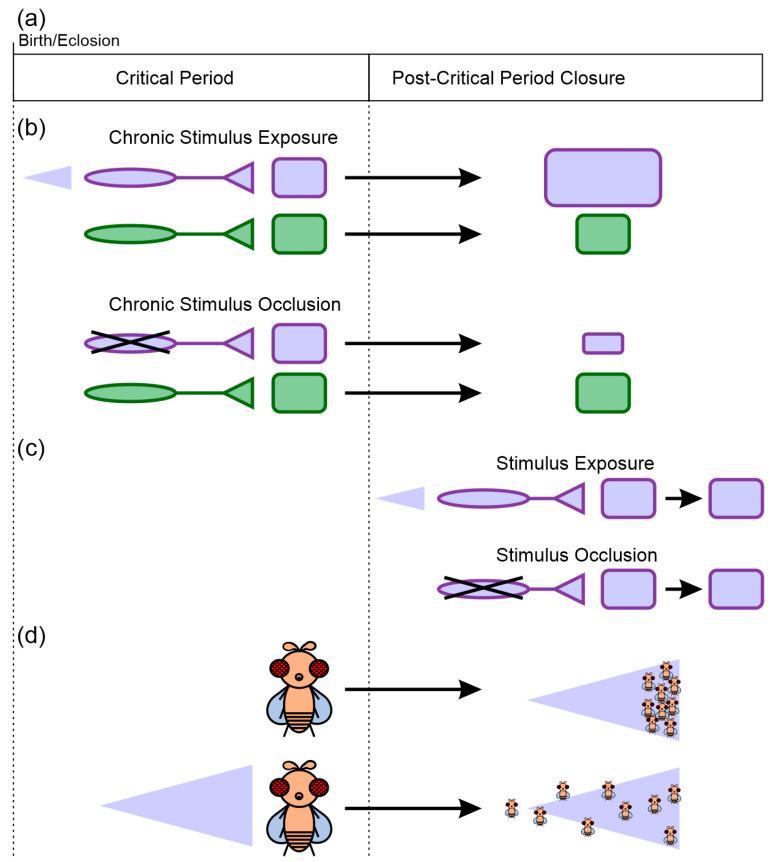
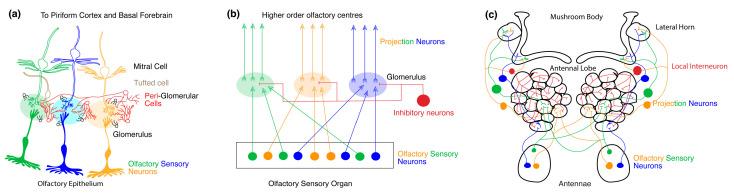
Neural networks have an extensive ability to change in response to environmental stimuli. This flexibility peaks during restricted windows of time early in life called critical periods. The ubiquitous occurrence of this form of plasticity across sensory modalities and phyla speaks to the importance of critical periods for proper neural development and function. Extensive investigation into visual critical periods has advanced our knowledge of the molecular events and key processes that underlie the impact of early-life experience on neuronal plasticity. However, despite the importance of olfaction for the overall survival of an organism, the cellular and molecular basis of olfactory critical periods have not garnered extensive study compared to visual critical periods. Recent work providing a comprehensive mapping of the highly organized olfactory neuropil and its development has in turn attracted a growing interest in how these circuits undergo plasticity during critical periods. Here, we perform a comparative review of olfactory critical periods in fruit flies and mice to provide novel insight into the importance of early odor exposure in shaping neural circuits and highlighting mechanisms found across sensory modalities.
神经网络具有广泛的能力,能够根据环境刺激而发生变化。这种灵活性在生命早期被称为关键期的特定时间段内达到顶峰。这种可塑性形式在各种感觉模态和动物门类中普遍存在,这表明关键期对于正常神经发育和功能的重要性。对视觉关键期的广泛研究增进了我们对分子事件以及早期生活经历对神经元可塑性影响背后的关键过程的了解。然而,尽管嗅觉对于生物体的整体生存至关重要,但与视觉关键期相比,嗅觉关键期的细胞和分子基础尚未得到广泛研究。最近的工作对高度有组织的嗅觉神经纤维网及其发育进行了全面的图谱绘制,这反过来又引发了人们对这些神经回路在关键期如何发生可塑性变化的日益浓厚的兴趣。在这里,我们对果蝇和小鼠的嗅觉关键期进行了比较综述,以提供关于早期气味暴露在塑造神经回路中的重要性的新见解,并突出跨感觉模态发现的机制。

 Zotero 插件