
化学-酶法合成四糖连接肽以研究糖胺聚糖生物合成中的分歧步骤。
Chemo-enzymatic synthesis of tetrasaccharide linker peptides to study the divergent step in glycosaminoglycan biosynthesis.
机构信息
Institut de Biologie Structurale, UMR 5075, University Grenoble Alpes, CNRS, CEA, 71, Avenue des Martyrs, 38044 Grenoble, France.
出版信息
Glycobiology. 2024 Apr 19;34(5). doi: 10.1093/glycob/cwae016.
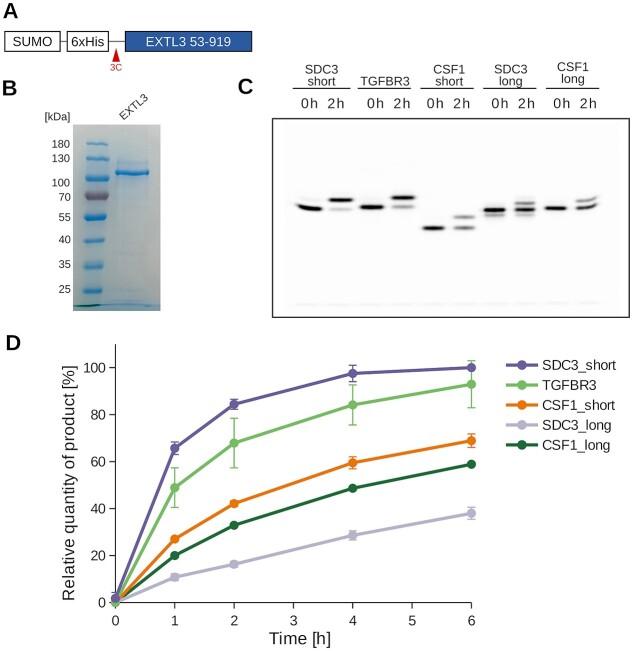
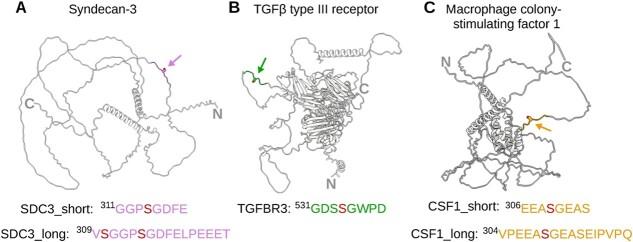
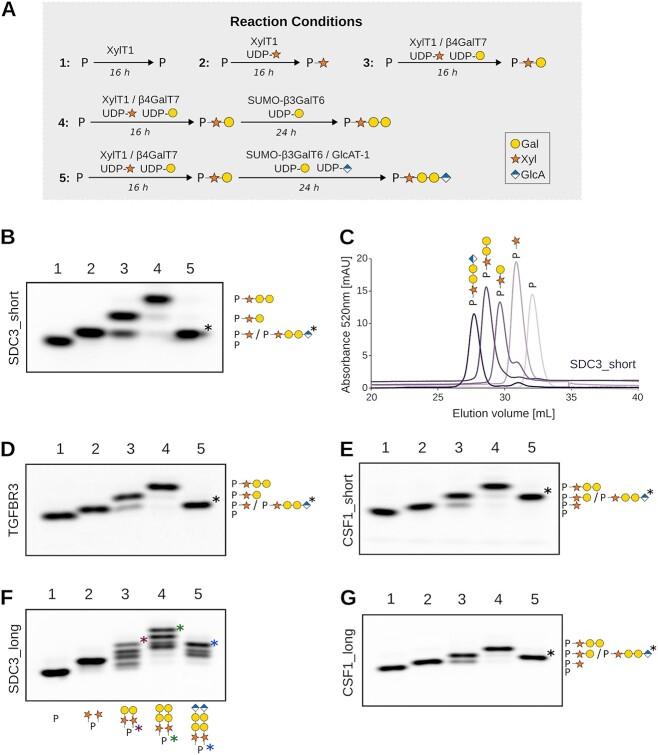
Glycosaminoglycans are extended linear polysaccharides present on cell surfaces and within the extracellular matrix that play crucial roles in various biological processes. Two prominent glycosaminoglycans, heparan sulfate and chondroitin sulfate, are covalently linked to proteoglycan core proteins through a common tetrasaccharide linker comprising glucuronic acid, galactose, galactose, and xylose moities. This tetrasaccharide linker is meticulously assembled step by step by four Golgi-localized glycosyltransferases. The addition of the fifth sugar moiety, either N-acetylglucosamine or N-acetylgalactosamine, initiates further chain elongation, resulting in the formation of heparan sulfate or chondroitin sulfate, respectively. Despite the fundamental significance of this step in glycosaminoglycan biosynthesis, its regulatory mechanisms have remained elusive. In this study, we detail the expression and purification of the four linker-synthesizing glycosyltransferases and their utilization in the production of fluorescent peptides carrying the native tetrasaccharide linker. We generated five tetrasaccharide peptides, mimicking the core proteins of either heparan sulfate or chondroitin sulfate proteoglycans. These peptides were readily accepted as substrates by the EXTL3 enzyme, which adds an N-acetylglucosamine moiety, thereby initiating heparan sulfate biosynthesis. Importantly, EXTL3 showed a preference towards peptides mimicking the core proteins of heparan sulfate proteoglycans over the ones from chondroitin sulfate proteoglycans. This suggests that EXTL3 could play a role in the decision-making step during glycosaminoglycan biosynthesis. The innovative strategy for chemo-enzymatic synthesis of fluorescent-labeled linker-peptides promises to be instrumental in advancing future investigations into the initial steps and the divergent step of glycosaminoglycan biosynthesis.
糖胺聚糖是存在于细胞表面和细胞外基质中的线性多糖,在各种生物过程中发挥着关键作用。两种突出的糖胺聚糖,肝素硫酸盐和软骨素硫酸盐,通过共同的四糖连接子与蛋白聚糖核心蛋白共价连接,该四糖连接子由葡萄糖醛酸、半乳糖、半乳糖和木糖部分组成。这个四糖连接子是由四个定位于高尔基体的糖基转移酶一步一步精心组装而成的。第五个糖基部分,无论是 N-乙酰葡萄糖胺还是 N-乙酰半乳糖胺的添加,都会引发进一步的链延伸,分别导致肝素硫酸盐或软骨素硫酸盐的形成。尽管这一步在糖胺聚糖生物合成中具有重要意义,但它的调节机制仍然难以捉摸。在这项研究中,我们详细描述了四个连接子合成糖基转移酶的表达和纯化及其在带有天然四糖连接子的荧光肽生产中的应用。我们生成了五个四糖肽,模拟肝素硫酸盐或软骨素硫酸盐蛋白聚糖的核心蛋白。这些肽很容易被添加 N-乙酰葡萄糖胺部分的 EXTL3 酶接受,从而启动肝素硫酸盐生物合成。重要的是,EXTL3 对模拟肝素硫酸盐蛋白聚糖核心蛋白的肽表现出偏好,而不是对模拟软骨素硫酸盐蛋白聚糖的肽。这表明 EXTL3 可能在糖胺聚糖生物合成的决策步骤中发挥作用。化学酶法合成荧光标记的连接肽的创新策略有望成为推进糖胺聚糖生物合成初始步骤和发散步骤的未来研究的重要工具。



 Zotero 插件