
使用细胞内结晶重组蛋白(InCellCryst)进行结构解析的简化方法。
A streamlined approach to structure elucidation using in cellulo crystallized recombinant proteins, InCellCryst.
机构信息
Institute of Biochemistry, University of Lübeck, Lübeck, Germany.
Center for Free-Electron Laser Science (CFEL), Hamburg, Germany.
出版信息
Nat Commun. 2024 Feb 24;15(1):1709. doi: 10.1038/s41467-024-45985-7.
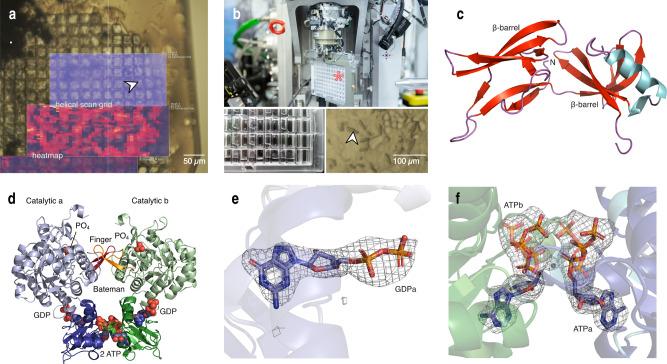
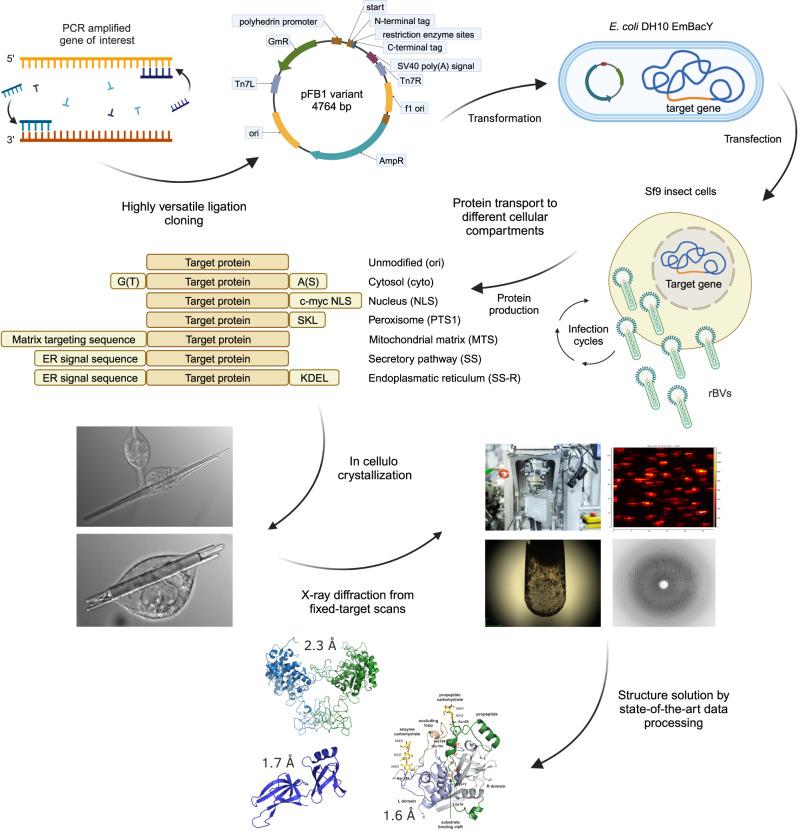
With the advent of serial X-ray crystallography on microfocus beamlines at free-electron laser and synchrotron facilities, the demand for protein microcrystals has significantly risen in recent years. However, by in vitro crystallization extensive efforts are usually required to purify proteins and produce sufficiently homogeneous microcrystals. Here, we present InCellCryst, an advanced pipeline for producing homogeneous microcrystals directly within living insect cells. Our baculovirus-based cloning system enables the production of crystals from completely native proteins as well as the screening of different cellular compartments to maximize chances for protein crystallization. By optimizing cloning procedures, recombinant virus production, crystallization and crystal detection, X-ray diffraction data can be collected 24 days after the start of target gene cloning. Furthermore, improved strategies for serial synchrotron diffraction data collection directly from crystals within living cells abolish the need to purify the recombinant protein or the associated microcrystals.
随着自由电子激光和同步辐射设施微焦点光束线上的 X 射线晶体学的出现,近年来对蛋白质微晶体的需求显著增加。然而,通过体外结晶,通常需要大量的努力来纯化蛋白质并产生足够均匀的微晶体。在这里,我们介绍了 InCellCryst,这是一种在活昆虫细胞内直接生产均匀微晶体的先进方法。我们的基于杆状病毒的克隆系统能够从完全天然的蛋白质中生产晶体,并且可以筛选不同的细胞区室,以最大化蛋白质结晶的机会。通过优化克隆程序、重组病毒的生产、结晶和晶体检测,可以在目标基因克隆开始后的 24 天收集 X 射线衍射数据。此外,改进的策略可以直接从活细胞内的晶体中进行连续同步辐射衍射数据收集,从而无需纯化重组蛋白或相关的微晶体。
 Zotero 插件