
CT 上预先存在的肺部磨玻璃密度影的定量分析用于预测晚期非小细胞肺癌患者接受检查点抑制剂治疗后的肺炎。
Quantification of preexisting lung ground glass opacities on CT for predicting checkpoint inhibitor pneumonitis in advanced non-small cell lung cancer patients.
机构信息
Tianjin Medical University Cancer Institute & Hospital, National Clinical Research Center for Cancer, Tianjin, China.
Key Laboratory of Cancer Prevention and Therapy, Tianjin, China.
出版信息
BMC Cancer. 2024 Feb 26;24(1):269. doi: 10.1186/s12885-024-12008-z.
BACKGROUND
Immune checkpoint inhibitors (ICIs) can lead to life-threatening pneumonitis, and pre-existing interstitial lung abnormalities (ILAs) are a risk factor for checkpoint inhibitor pneumonitis (CIP). However, the subjective assessment of ILA and the lack of standardized methods restrict its clinical utility as a predictive factor. This study aims to identify non-small cell lung cancer (NSCLC) patients at high risk of CIP using quantitative imaging.
METHODS
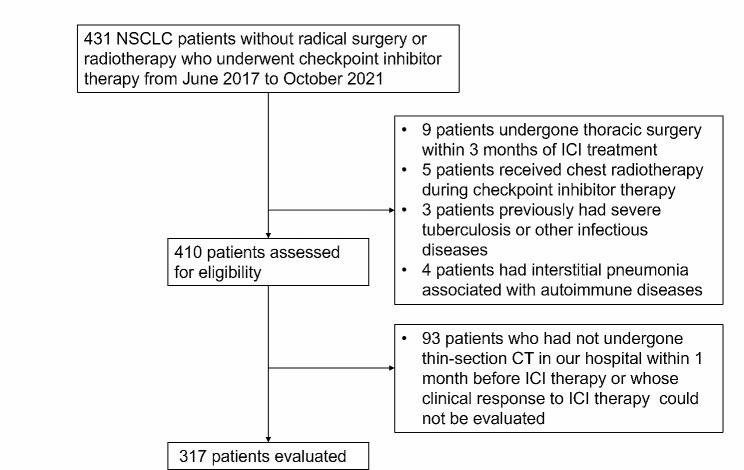
This cohort study involved 206 cases in the training set and 111 cases in the validation set. It included locally advanced or metastatic NSCLC patients who underwent ICI therapy. A deep learning algorithm labeled the interstitial lesions and computed their volume. Two predictive models were developed to predict the probability of grade ≥ 2 CIP or severe CIP (grade ≥ 3). Cox proportional hazard models were employed to analyze predictors of progression-free survival (PFS).
RESULTS
In a training cohort of 206 patients, 21.4% experienced CIP. Two models were developed to predict the probability of CIP based on different predictors. Model 1 utilized age, histology, and preexisting ground glass opacity (GGO) percentage of the whole lung to predict grade ≥ 2 CIP, while Model 2 used histology and GGO percentage in the right lower lung to predict grade ≥ 3 CIP. These models were validated, and their accuracy was assessed. In another exploratory analysis, the presence of GGOs involving more than one lobe on pretreatment CT scans was identified as a risk factor for progression-free survival.
CONCLUSIONS
The assessment of GGO volume and distribution on pre-treatment CT scans could assist in monitoring and manage the risk of CIP in NSCLC patients receiving ICI therapy.
CLINICAL RELEVANCE STATEMENT
This study's quantitative imaging and computational analysis can help identify NSCLC patients at high risk of CIP, allowing for better risk management and potentially improved outcomes in those receivingICI treatment.
背景
免疫检查点抑制剂(ICIs)可导致危及生命的肺炎,而预先存在的间质性肺异常(ILAs)是检查点抑制剂肺炎(CIP)的危险因素。然而,ILA 的主观评估和缺乏标准化方法限制了其作为预测因素的临床应用。本研究旨在使用定量成像技术确定患有 CIP 的非小细胞肺癌(NSCLC)患者的高危人群。
方法
这项队列研究纳入了 206 例训练集和 111 例验证集的患者,包括接受 ICI 治疗的局部晚期或转移性 NSCLC 患者。一个深度学习算法对间质病变进行了标记,并计算了它们的体积。建立了两个预测模型来预测 CIP 发生率≥2 级或严重 CIP(等级≥3)的概率。采用 Cox 比例风险模型分析无进展生存期(PFS)的预测因素。
结果
在 206 例患者的训练队列中,21.4%的患者发生了 CIP。基于不同的预测因素,建立了两种预测 CIP 概率的模型。模型 1 利用年龄、组织学和全肺预先存在的磨玻璃影(GGO)百分比来预测 CIP 发生率≥2 级,而模型 2 则利用组织学和右肺下叶的 GGO 百分比来预测 CIP 发生率≥3 级。对这两个模型进行了验证,并评估了它们的准确性。在另一项探索性分析中,发现治疗前 CT 扫描上存在累及一个以上肺叶的 GGO 是无进展生存期的危险因素。
结论
治疗前 CT 扫描上 GGO 体积和分布的评估可以帮助监测和管理接受 ICI 治疗的 NSCLC 患者的 CIP 风险。
临床相关性声明
本研究的定量成像和计算分析有助于识别患有 CIP 的 NSCLC 患者的高危人群,从而更好地进行风险管理,并可能改善接受 ICI 治疗患者的预后。



 Zotero 插件