
PARP 抑制剂在卵巢癌治疗中的应用:一项随机对照试验的系统评价和荟萃分析。
PARP inhibitor era in ovarian cancer treatment: a systematic review and meta-analysis of randomized controlled trials.
机构信息
Department of Obstetrics and Gynecology, Semmelweis University, Üllői út 78/A, Budapest, H-1082, Hungary.
Centre for Translational Medicine, Semmelweis University, Budapest, Hungary.
出版信息
J Ovarian Res. 2024 Feb 26;17(1):53. doi: 10.1186/s13048-024-01362-y.
BACKGROUND
Ovarian cancer is the eighth leading cause of cancer-related death among women, characterized by late diagnosis and a high relapse rate. In randomized controlled trials, we aimed to evaluate the efficacy and safety of PARP inhibitors (PARPi) in treating advanced ovarian cancer.
METHODS
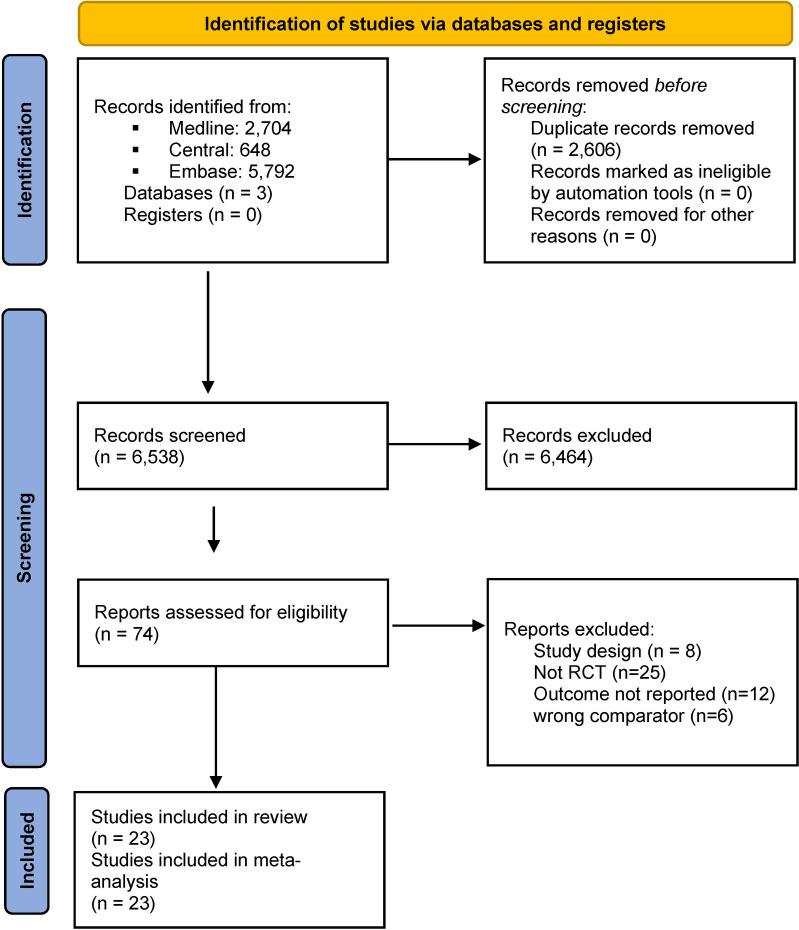
This review was registered on PROSPERO (CRD42021283150), included all phase II and phase III randomized controlled trials (RCTs) assessing the effect of PARPi on ovarian cancer until the 13th of April, 2022. The main outcomes were progression- free survival (PFS), overall survival (OS), and adverse events (AEs). Pooled hazard ratios (HRs), and risk ratios (RRs) were calculated with 95% confidence intervals (95% CI). The random-effects model was applied in all analyses.
RESULTS
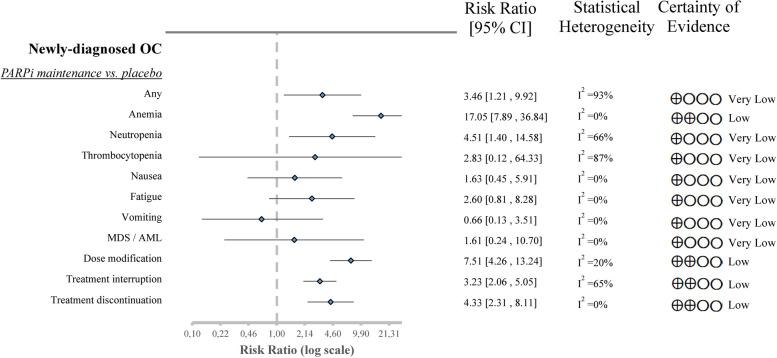
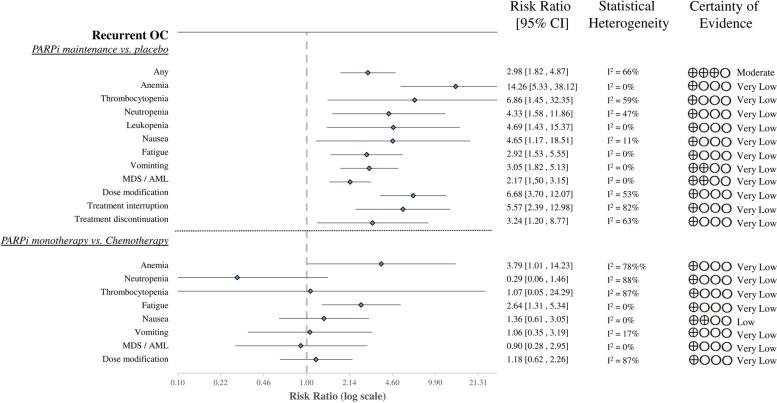
In the meta-analysis, 16 eligible RCTs were included, with a total of 5,815 patients. In recurrent ovarian cancer, PARPi maintenance therapy showed a significant PFS benefit over placebo in the total population (HR 0.34, CI 0.29-0.40), BRCA mutant (HR 0.24, CI 0.18-0.31), germline BRCA mutant (HR 0.23, CI 0.18-0.30), and BRCA wild-type cases (HR 0.50, CI 0.39-0.65). PARPi monotherapy also improved PFS (HR 0.62, CI 0.51-0.76) compared with chemotherapy in BRCAm patients with recurrent ovarian cancer. The use of PARPi maintenance therapy resulted in an improvement in PFS over placebo in newly-diagnosed cancers in the overall population (HR 0.46, CI 0.30-0.71) and the BRCAm population (HR 0.36, CI 0.29-0.44). Although the risk of severe AEs was increased by PARPi therapy compared to placebo in most settings investigated, these side effects were controllable with dose modification, and treatment discontinuation was required in the minority of cases.
CONCLUSIONS
PARPis are an effective therapeutic option for newly-diagnosed and recurrent ovarian cancer. Despite a minor increase in the frequency of serious adverse effects, they are generally well tolerated.
背景
卵巢癌是女性癌症相关死亡的第八大原因,其特点是诊断较晚和复发率高。在随机对照试验中,我们旨在评估聚腺苷二磷酸核糖聚合酶(PARP)抑制剂(PARPi)治疗晚期卵巢癌的疗效和安全性。
方法
本综述在 PROSPERO(CRD42021283150)上注册,纳入了截至 2022 年 4 月 13 日评估 PARPi 对卵巢癌影响的所有 II 期和 III 期随机对照试验(RCT)。主要结局是无进展生存期(PFS)、总生存期(OS)和不良事件(AE)。使用 95%置信区间(95%CI)计算了合并的风险比(HR)和风险比(RR)。所有分析均采用随机效应模型。
结果
在荟萃分析中,纳入了 16 项合格的 RCT,共 5815 名患者。在复发性卵巢癌中,PARPi 维持治疗在总体人群(HR 0.34,CI 0.29-0.40)、BRCA 突变(HR 0.24,CI 0.18-0.31)、种系 BRCA 突变(HR 0.23,CI 0.18-0.30)和 BRCA 野生型病例(HR 0.50,CI 0.39-0.65)中均显示出显著的 PFS 获益。PARPi 单药治疗也改善了复发性卵巢癌中 BRCA 突变患者的 PFS(HR 0.62,CI 0.51-0.76)与化疗相比。PARPi 维持治疗在总体人群(HR 0.46,CI 0.30-0.71)和 BRCA 突变人群(HR 0.36,CI 0.29-0.44)中均改善了新诊断癌症的 PFS 优于安慰剂。与安慰剂相比,PARPi 治疗在大多数研究的情况下增加了严重 AE 的风险,但这些副作用可以通过剂量调整控制,并且在少数情况下需要停止治疗。
结论
PARPi 是新诊断和复发性卵巢癌的有效治疗选择。尽管严重不良事件的频率略有增加,但总体上耐受性良好。

 Zotero 插件