
巴塔哥尼亚北部一个极酸性湖泊水-沉积物界面的营养结构动态与微生物群落
Nutrient structure dynamics and microbial communities at the water-sediment interface in an extremely acidic lake in northern Patagonia.
作者信息
Cuevas Mayra, Francisco Issotta, Díaz-González Fernando, Diaz Mónica, Quatrini Raquel, Beamud Guadalupe, Pedrozo Fernando, Temporetti Pedro
机构信息
Instituto de Investigaciones en Biodiversidad y Medioambiente (INIBIOMA), Centro Regional Universitario Bariloche-UNComahue, CCT-Patagonia Norte, CONICET, San Carlos de Bariloche, Argentina.
Centro Científico y Tecnológico de Excelencia Ciencia & Vida, Fundación Ciencia & Vida, Santiago, Chile.
出版信息
Front Microbiol. 2024 Feb 12;15:1335978. doi: 10.3389/fmicb.2024.1335978. eCollection 2024.
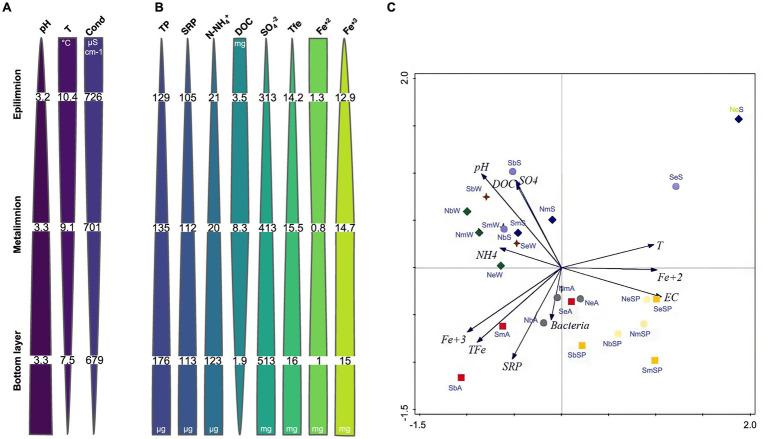
Lake Caviahue (37° 50 'S and 71° 06' W; Patagonia, Argentina) is an extreme case of a glacial, naturally acidic, aquatic environment (pH ~ 3). Knowledge of the bacterial communities in the water column of this lake, is incipient, with a basal quantification of the bacterioplankton abundance distribution in the North and South Basins of Lake Caviahue, and the described the presence of sulfur and iron oxidizing bacteria in the lake sediments. The role that bacterioplankton plays in nutrient utilization and recycling in this environment, especially in the phosphorus cycle, has not been studied. In this work, we explore this aspect in further depth by assessing the diversity of pelagic, littoral and sediment bacteria, using state of the art molecular methods and identifying the differences and commonalties in the composition of the cognate communities. Also, we investigate the interactions between the sediments of Lake Caviahue and the microbial communities present in both sediments, pore water and the water column, to comprehend the ecological relationships driving nutrient structure and fluxes, with a special focus on carbon, nitrogen, and phosphorus. Two major environmental patterns were observed: (a) one distinguishing the surface water samples due to temperature, Fe, and electrical conductivity, and (b) another distinguishing winter and summer samples due to the high pH and increasing concentrations of N-NH, DOC and SO, from autumn and spring samples with high soluble reactive phosphorus (SRP) and iron concentrations. The largest bacterial abundance was found in autumn, alongside higher levels of dissolved phosphorus, iron forms, and increased conductivity. The highest values of bacterial biomass were found in the bottom strata of the lake, which is also where the greatest diversity in microbial communities was found. The experiments using continuous flow column microcosms showed that microbial growth over time, in both the test and control columns, was accompanied by a decrease in the concentration of dissolved nutrients (SRP and N-NH), providing proof that sediment microorganisms are active and contribute significantly to nutrient utilization/mobilization.
卡维阿韦湖(南纬37°50′,西经71°06′;阿根廷巴塔哥尼亚)是一个极端的冰川、天然酸性水生环境(pH值约为3)的例子。对该湖水柱中细菌群落的了解尚处于起步阶段,仅对卡维阿韦湖北部和南部流域的浮游细菌丰度分布进行了初步量化,并描述了湖泊沉积物中硫和铁氧化细菌的存在情况。浮游细菌在该环境中营养物质利用和循环,特别是在磷循环中所起的作用尚未得到研究。在这项工作中,我们通过使用先进的分子方法评估浮游、沿岸和沉积物细菌的多样性,并确定相关群落组成中的差异和共性,进一步深入探讨这一方面。此外,我们研究了卡维阿韦湖沉积物与沉积物、孔隙水和水柱中存在的微生物群落之间的相互作用,以理解驱动营养结构和通量的生态关系,特别关注碳、氮和磷。观察到两种主要的环境模式:(a)一种是由于温度、铁和电导率而区分地表水样本,(b)另一种是由于高pH值以及从秋季和春季样本中高可溶性活性磷(SRP)和铁浓度的样本中N-NH、溶解有机碳(DOC)和SO浓度的增加而区分冬季和夏季样本。秋季发现的细菌丰度最高,同时溶解磷、铁形态水平较高,电导率增加。细菌生物量的最高值出现在湖底地层,这里也是发现微生物群落多样性最大的地方。使用连续流柱微宇宙进行的实验表明,随着时间的推移,测试柱和对照柱中的微生物生长都伴随着溶解营养物质(SRP和N-NH)浓度的降低,这证明沉积物微生物是活跃的,对营养物质的利用/动员有显著贡献。




 Zotero 插件