
面向可穿戴机器人设备评估的可用性属性验证词汇表。
Towards a validated glossary of usability attributes for the evaluation of wearable robotic devices.
机构信息
International Doctoral School, Rey Juan Carlos University, Madrid, Spain.
Biomechanics and Technical Aids Unit, National Hospital for Paraplegics, Toledo, Spain.
出版信息
J Neuroeng Rehabil. 2024 Feb 28;21(1):30. doi: 10.1186/s12984-024-01312-1.
BACKGROUND
Despite technical advances in the field of wearable robotic devices (WRD), there is still limited user acceptance of these technologies. While usability often comes as a key factor influencing acceptance, there is a scattered landscape of definitions and scopes for the term. To advance usability evaluation, and to integrate usability features as design requirements during technology development, there is a need for benchmarks and shared terminology. These should be easily accessible and implementable by developers.
METHODS
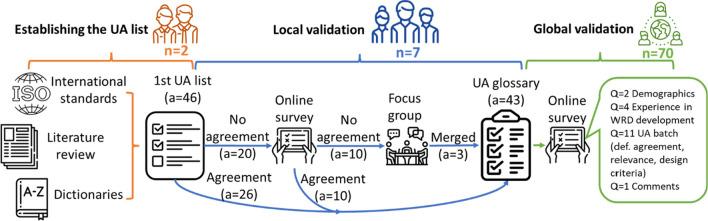
An initial set of usability attributes (UA) was extracted from a literature survey on usability evaluation in WRD. The initial set of attributes was enriched and locally validated with seven developers of WRD through an online survey and a focus group. The locally validated glossary was then externally validated through a globally distributed online survey.
RESULTS
The result is the Robotics Usability Glossary (RUG), a comprehensive glossary of 41 UA validated by 70 WRD developers from 17 countries, ensuring its generalizability. 31 of the UA had high agreement scores among respondents and 27 were considered highly relevant in the field, but only 11 of them had been included as design criteria by the respondents.
CONCLUSIONS
Multiple UA ought to be considered for a comprehensive usability assessment. Usability remains inadequately incorporated into device development, indicating a need for increased awareness and end-user perspective. The RUG can be readily accessed through an online platform, the Interactive Usability Toolbox (IUT), developed to provide context-specific outcome measures and usability evaluation methods. Overall, this effort is an important step towards improving and promoting usability evaluation practices within WRD. It has the potential to pave the way for establishing usability evaluation benchmarks that further endorse the acceptance of WRD.
背景
尽管可穿戴机器人设备(WRD)领域取得了技术进步,但这些技术的用户接受度仍然有限。虽然可用性通常是影响接受度的关键因素,但该术语的定义和范围却分散不一。为了推进可用性评估,并在技术开发过程中将可用性特性集成到设计要求中,我们需要基准和共享术语。这些基准和术语应该易于开发人员获取和实施。
方法
从 WRD 可用性评估的文献调查中提取了一组初始可用性属性(UA)。通过在线调查和焦点小组,将初始属性集与 7 名 WRD 开发人员进行了丰富和局部验证。然后,通过全球分布式在线调查对局部验证后的术语表进行了外部验证。
结果
结果是机器人可用性术语表(RUG),这是一个包含 41 个 UA 的综合术语表,由来自 17 个国家的 70 名 WRD 开发人员验证,确保其具有普遍性。31 个 UA 在受访者中具有较高的一致性得分,27 个被认为在该领域非常相关,但只有 11 个被受访者视为设计标准。
结论
应该考虑多个 UA 进行全面的可用性评估。可用性在设备开发中仍然没有得到充分的体现,这表明需要提高认识和终端用户的视角。RUG 可以通过在线平台 Interactive Usability Toolbox(IUT)轻松访问,该平台旨在提供特定于上下文的结果衡量标准和可用性评估方法。总体而言,这是朝着改进和促进 WRD 中的可用性评估实践迈出的重要一步。它有可能为建立可用性评估基准铺平道路,从而进一步促进 WRD 的接受度。


 Zotero 插件