
病例报告:在一名患有ANK3-RET融合阳性非小细胞肺癌的年轻白种人中,首次证明了调整剂量的塞尔帕替尼具有显著疗效。
Case report: First evidence of impressive efficacy of modulated dose selpercatinib in a young Caucasian with ANK3-RET fusion-positive NSCLC.
作者信息
De Carlo Elisa, Bertoli Elisa, Schiappacassi Monica, Stanzione Brigida, Del Conte Alessandro, Doliana Roberto, Spina Michele, Bearz Alessandra
机构信息
Department of Medical Oncology, Centro di Riferimento Oncologico di Aviano (CRO), Istituto di Ricovero e Cura a Carattere Scientifico (IRCCS), Aviano, Italy.
Department of Medicine (DAME), University of Udine, Udine, Italy.
出版信息
Front Oncol. 2024 Feb 7;14:1307458. doi: 10.3389/fonc.2024.1307458. eCollection 2024.
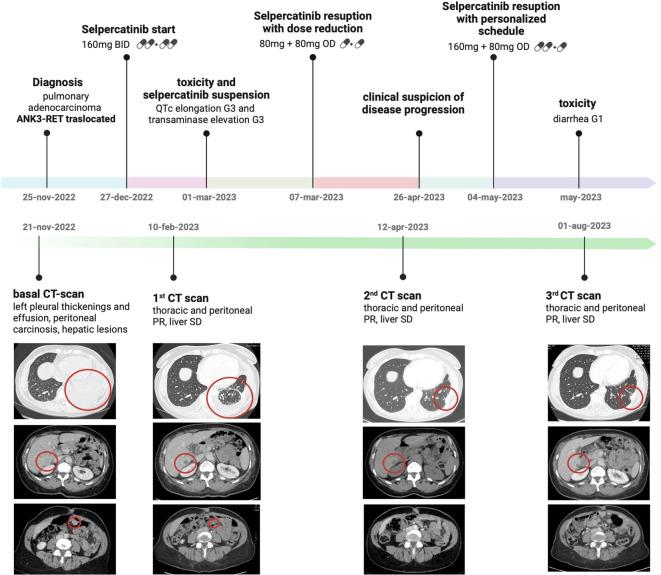
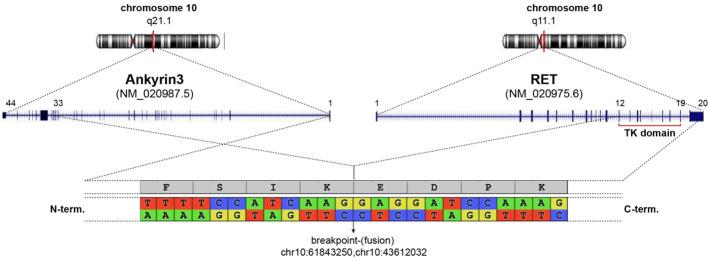
Over the past decade, molecular characterization has led to change the management of advanced non-small cell lung cancer (NSCLC) harboring driver mutations. Rearranged during transfection () gene fusions, occurring in 1% to 2% of NSCLC, have emerged as an oncogenic druggable target. Systemic targeted therapies with highly selective inhibitors (RETi), selpercatinib and pralsetinib, represent a recent clinical breakthrough. While the development of RETi has improved survival, with their increasing use, it is crucial to be aware of the risks of rare but serious adverse events (AEs). A particular challenge for clinicians in applying targeted therapies is not only diagnosing but also interpreting rare mutations. Herein, we report a case of a 43-year-old Caucasian advanced NSCLC patient diagnosed with a rare gene fusion, , identified with Next Generation Sequencing (NGS). Selpercatinib has been initiated at the recommended initial dose after one incomplete chemotherapy cycle due to a severe infusion reaction, but it subsequently required a dose adjustment following grade 3 (G3) AEs. During treatment, we used a particular selpercatinib dosage (160 mg in the morning and 80 mg in the evening) with good tolerance and without compromising effectiveness. Our finding broadens the range of fusion types in not-Asian NSCLC. To the best of our knowledge, our case demonstrates, for the first time, a clinical and radiological response to frontline highly selective RETi selpercatinib, expanding the spectrum of potential oncogenic fusion partners in newly diagnosed NSCLC patients. Furthermore, to our knowledge, this is the first case describing a fusion-positive (+) NSCLC patient treated with a modified selpercatinib dosage outside the drug data sheet and demonstrating a safe and effective use.
在过去十年中,分子特征分析已改变了对携带驱动基因突变的晚期非小细胞肺癌(NSCLC)的治疗管理。转染期间重排(RET)基因融合在1%至2%的NSCLC中出现,已成为一种可靶向治疗的致癌靶点。使用高选择性RET抑制剂(RETi)塞尔帕替尼和普拉替尼进行的全身靶向治疗代表了近期的一项临床突破。虽然RETi的发展提高了生存率,但随着其使用的增加,了解罕见但严重不良事件(AE)的风险至关重要。临床医生在应用靶向治疗时面临的一个特殊挑战不仅是诊断罕见突变,还包括解读这些突变。在此,我们报告一例43岁的白种人晚期NSCLC患者,经下一代测序(NGS)确诊为罕见的RET基因融合。由于严重的输注反应,在一个化疗周期未完成后,已按照推荐的初始剂量开始使用塞尔帕替尼,但随后因3级(G3)AE需要调整剂量。在治疗期间,我们使用了一种特殊的塞尔帕替尼剂量(早上160mg,晚上80mg),耐受性良好且不影响疗效。我们的发现拓宽了非亚洲NSCLC中RET融合类型的范围。据我们所知,我们的病例首次证明了对一线高选择性RETi塞尔帕替尼的临床和影像学反应,扩大了新诊断NSCLC患者中潜在致癌RET融合伙伴的范围。此外,据我们所知,这是第一例描述在药品说明书之外使用改良剂量塞尔帕替尼治疗RET融合阳性(+)NSCLC患者并证明其安全有效的病例。
 Zotero 插件